

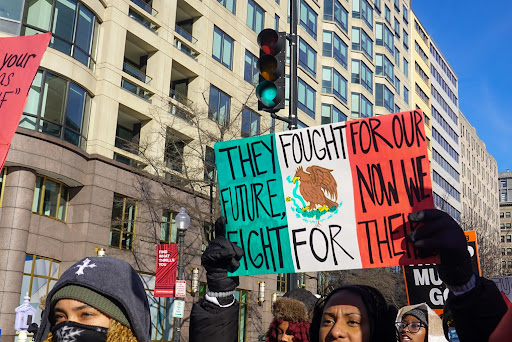
Howard Students protesting in support of those affected by ICE occupations on Jan. 30, 2026. (Photo courtesy of Brisa Higgins) 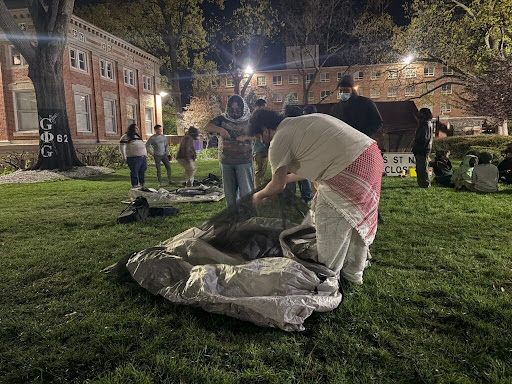
Demonstrators set up tents on The Yard, April 2025 (Cymphani Hargrave/The Hilltop) 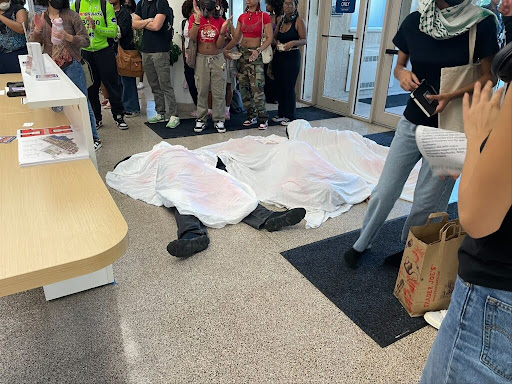
Student protestors lay on the ground covered by white clothes stained with red to symbolize the deaths of Palestinians in October of 2024 (Natalie Betts/The Hilltop Archives)
On March 19, 1968, a group of students at Howard University made history by becoming the first students in the nation to ever protest by taking over a campus building. More than 50 years later, sit-ins, encampments and building takeovers are common ways students across the U.S. speak out. Since 1968, Howard students have used these tactics several times to push for change at the institution.
Clyde Waite was a senior Hilltop reporter who covered the protests, sitting inside the occupation of the administration building to document everything that happened around him. For Waite, the 1968 protest was a clash of class motivations within Black America.
“I could see the same social divisions between the fraternity level social upper-class, and the social underclass [at Howard],” said Waite, who said that before the occupation, students felt that Howard’s curriculum trained students to align with the small but growing middle-class Black community rather than the broader Black community by encouraging an individualist mindset.
“We were out to make it for ourselves as opposed to making it in a way that was beneficial to the entire Black community,” said Waite, who worked full-time as a secretary at the Library of Congress while attending Howard. Waite came from a low-income family and saw the class division from his hometown of McKeesport, Pennsylvania, duplicated on campus, only without the racial divide.
Students advocated for five primary demands over the course of months. Such included a curriculum more centered on collective Black liberation, for Howard to be more relevant to the Black community and for the resignation of then-President James Nabrit Jr.
Anthony “Tony” Gittens,one of many student organizers in the 1968 occupation, learned about Black struggle in activism while working at the public library in Brooklyn. Gittens naturally gravitated to the activism scene on campus, which included leaders like Stokley Carmichael, also known as Kwame Ture, whom he saw as a friend. According to Gittens, the occupation was a culmination of years of activism.
“It takes a lot of time, and if you are willing to put in the time, you got a chance,” said Gittens on advocating for change.
The occupation lasted four days, until the University conceded to demands to make the University more Black-centered and to amend the disciplinary process to include student representation.
Another occupation of the administration building would occur in 1989 to protest the appointment of Lee Atwater to the board of trustees. Atwater, an infamous political strategist for the Republican Party, crafted the narrative of Willie Horton to invoke race-based fears of crime to get Republicans like George H.W. Bush into office. After three days, a resignation from Atwater and negotiations that included Marion Berry, who de-escalated police response, university President James Cheek and the student coalition leaders, the occupation seemingly ended in success for students.
In 2018, HU Resist, an activism group that first came about with what many students saw as a university alignment with the first Trump administration, led another occupation in the administration building.
Alexis McKenney was a senior during the occupation and was one of the founders of HU Resist. Through consistent action and surveying from the year prior, HU Resist created what was originally a list of nine commands. The demands included reform around sexual assault response on campus, administrative decision, financial transparency, improved housing and the Howard University Police Department.
“The president of the university at the time was making nice with the new administration and specifically meeting with Betsy DeVos, who was the secretary of education at the time,” said McKenney.
While efforts occurred prior to the occupation, McKenney and other students realized an opportunity for action when Howard was caught in a financial aid embezzlement scandal in March of 2018. Multiple financial aid workers were found to have misappropriated $1 million to themselves and other fraudulent recipients.
“The stealing of funds provided the spark that allowed for the larger student body to become more activated in what we were doing,” explained McKinney.
For over nine days, the occupation remained a joyful but determined environment with students dancing and chanting, according to Hilltop reports, which ended with the University reaching seven of the nine demands. However, McKinney feels that the university didn’t truly implement the changes demanded.
“We had experienced a lot of internal issues that made it hard for us to really push through the execution and the University wasn’t committed either,” said McKinney.
While the Blackburn takeover in 2021, aimed at improving living conditions inside dorms, was the last demonstration to receive mass attention on a national stage, two encampments occurred in the spring of 2024 and 2025, one in solidarity with national Palestinian liberation protests and the other being the ‘People’s University’ encampment.
A student who wishes to remain anonymous out of fear of university retaliation was present at last year’s ‘People’s University,’ a short-lived encampment on The Yard between Carnegie Hall and Douglass Hall aimed at raising awareness for student activism on campus.
According to the student, the encampment was precipitated by a rally on The Yard, in which students and off-campus Pan-African organizations shared their fears, concerns and advocacies related to the Trump administration.
“The goal wasn’t so much demands as it was to make a statement,” they said. “Like ‘We’re here, We’re not going to be policed. This is our school and we deserve to take up space,’” the student said.
While the student wasn’t aware of the university’s activist history prior to attending Howard, they say the legacy of those before them pushes them into further action.

“I have an opportunity and responsibility to fight for my campus and be better,” said the student.
They believe that the university is still too concerned with individual success as opposed to educating for the benefit of all Black Americans.
“We deserve a high-quality education, and we deserve an education that not only empowers us, but the communities whose backs we stand on,” they said.
Copy edited by D’Nyah Jefferson – Philmore