

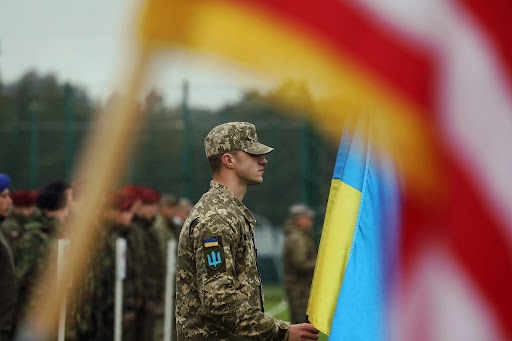
President Donald Trump’s administration is taking a different approach to the United State’s role in the Russia-Ukraine war, pivoting from sustained military aid to a strategy centering rapid negotiation.
Under the Biden administration, roughly $182 billion in aid enabled Ukraine to sustain its defense against Russian invasion for four years, framing American support as lasting “as long as it takes.” By contrast, the Trump administration’s emphasis on negotiation, paired with a lack of renewed congressional funding, signals a willingness to trade continued military backing for a potential ceasefire.
As political priorities shift and news cycles accelerate, the stakes for those on the ground remain immediate. A Ukrainian civilian, who requested anonymity due to security concerns, described the rhythm of daily life: “mostly the attacks happen during the night … you hear a siren, and with ballistics, you have only two minutes to run down to the shelter.”
For many civilians, a key aspect of surviving the Ukrainian war is adaptation. As Matt Gallagher, an Iraq War combat veteran, author and war correspondent who has reported from Ukraine, explained, “[Ukrainians] moved elementary school classes [to the metro], because they got so sick of school getting interrupted by missile warnings and air sirens. They did that to maintain a sense of normalcy for the kids’ sake.”
The tension between survival and routine has come to define the war.
“It’s like Afghanistan during the night time, and it’s like any peaceful European country during the daylight,” an anonymous source living in Ukraine explained.
At the same time, U.S. policy priorities are shifting. By declining to pursue new congressional funding, President Donald Trump’s administration has shifted course – emphasizing negotiation over military support.
Gallagher said he observed a sense of national pride about the way the matter was handled during the Biden administration.
“The most patriotic as an adult I’ve ever felt about my country was in Ukraine, hearing Ukrainians talk about what American ideals mean to them,” he said.
However, the shift in administration has caused inconsistency in actions related to foreign aid, and the repercussions of this are reflected in Ukrainians’ response to Americans on the ground.
“At first, [Americans] were seen as the beacon of freedom, the ideal example for what [Ukrainians] aspire to attain for themselves, and that was beginning to erode. Our strange, wishy washy commitment to aid has a big impact,” said Gallagher.
In declining to pursue congressional funding in favor of negotiation, the Trump administration signals a departure from previous American commitments.
Analysts at NPR suggest that this administrative approach is driven by a desire to position Trump as a dealmaker, prioritizing a rapid end to combat even if it is at the cost of Ukraine’s territorial sovereignty. According to The Independent, Trump recently told NBC News that Ukraine was “the last” country the U.S. needed help from, dismissing its role in drone warfare. He has also publicly criticized Volodymyr Zelenskyy, suggesting the continuation of the war reflects Ukraine’s failure to negotiate with Putin – a stance that has further strained the alliance.
Proposed peace negotiations have generated significant controversy. Critics at Just Security argue that reported terms, including potential territorial concessions by Ukraine, limits on military capacity and a pledge for Ukraine not to join NATO, would disproportionately favor Russia. While some proposals include the possibility of long-term U.S. security guarantees, Ukraine has remained resistant to agreements that compromise its territorial sovereignty.
As one anonymous Ukrainian political observer noted, the country’s long-term direction remains clear: “People are still building this resilience. For instance, we talk about European integration. Since 2018, EU and NATO accession has been written into Ukraine’s constitution, people continue to look for ways to move forward with integration.”
A central form of contention is based on reported proposals from late 2025, in which Trump’s peace plan requires Ukraine to cede roughly 20 percent of its territory – including the Crimea and Donbas regions according to the Center for Strategic and International Studies. Yet, as one anonymous Ukrainian source noted, “If we talk about any territorial concessions, it’s really unacceptable to Ukrainian society. Any peace deal results will be decided on the battlefield.”
Yet, on the battlefield, Ukraine’s rapid adaptation to large-scale drone attacks on Russia since 2022 has made it a global leader in modern drone warfare, according to AP News. Where Iran was once the leading nation in this regard, technology such as the Shahed drone and Ukrainian First Person View (FPV) interceptors have now come to characterize Ukrainian military intelligence. This has positioned the country as a contributor to broader international defense efforts, including cooperation with U.S. and allied interests in the Middle East. The conflict is increasingly shaping global military strategy and diplomatic alliances.
Beyond strategy and geopolitics, this war continues to impact millions of innocent people. As Gallagher put it, “It’s ultimately about your average Ukrainian person wanting the fundamental human rights that we take for granted. And how, as Americans, could we not respect and value that, given our own history?”
Copy edited by Kennedi Bryant