

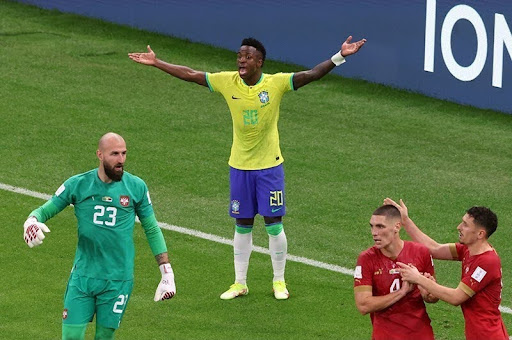
When Vinícius Júnior scored the decisive goal for Real Madrid against Benfica on Feb. 18, 2026, in the Champions League round of 32, it should have been remembered as another milestone in his growing legacy. Instead, the match was halted after Vinícius accused Benfica’s Gianluca Prestianni of directing a racist slur toward him following his celebration, prompting officials to activate UEFA’s anti racism protocol. UEFA has since opened an investigation.
The moment was another reminder that for Black soccer players in Europe, even scoring the winning goal does not guarantee the story will be about the game. Too often, racism still dictates the narrative.
As has often been the case throughout his career in Spain, the focus quickly shifted away from his performance and toward his reaction. The debate centered on his celebration, his temperament and whether he provoked the confrontation. The alleged verbal abuse became secondary to questions about tone. No matter how brilliant the display, racism once again hijacked the narrative.
After the match, Vinícius condemned the verbal abuse on social media, calling racists “cowards” and criticizing the handling of the situation. His frustration echoed comments he has made in previous seasons after repeated incidents in La Liga. In 2023, amid widespread abuse in Spain, Vinícius said, “I am not a victim of racism. I am a tormentor of racists,” according to coverage from ESPN.
What followed the Benfica match felt familiar. As UEFA reviews the case, conversation across European media has again drifted toward whether Vinícius’ behavior contributes to the hostility he faces. That framing mirrors a broader pattern in sports, where Black athletes are scrutinized for emotion while the abuse directed at them is minimized.
Vinícius is not alone.
In Italy, Romelu Lukaku spoke out after being subjected to monkey chants during a Serie A match in 2019. “Instead of going forward, we’re going backwards,” Lukaku wrote on Instagram after the incident. Despite his global profile, Lukaku continued to experience racist abuse in subsequent seasons, highlighting how even elite status does not provide insulation.
Former Napoli defender Kalidou Koulibaly endured similar treatment during a 2018 Serie A match against Inter Milan, where monkey chants followed him throughout the game. Afterward, Koulibaly wrote that he was “proud of the colour of my skin,” reaffirming his identity in response to the abuse.
More recently, reporting from AP News has documented a rise in racist incidents across European competitions this season, including abuse directed at players in England, Germany, Italy and Spain. Anti-discrimination organizations cited in the report said complaints of racist behavior have increased compared with previous seasons, reinforcing that the issue remains systemic rather than isolated.
These repeated incidents reveal a deeper contradiction within European soccer. The sport generates billions of dollars in global revenue and heavily markets the talent and style of Black athletes, yet governing bodies often respond to racist abuse with fines or temporary sanctions that critics argue lack deterrent power.
UEFA’s anti racism protocol allows matches to be paused and potentially abandoned. But pauses alone do not dismantle culture. Investigations without consistent, severe consequences risk becoming procedural rather than transformative.
The emotional toll of this environment is rarely quantified. Many Black players move abroad as teenagers, adapting to new languages, new cultures and intense scrutiny. When racism enters that experience, it compounds isolation. Speaking out invites backlash. Staying silent demands endurance.
Vinícius’ situation underscores how power functions in global sports. He is one of the most marketable athletes in the world, central to Real Madrid’s branding and the Champions League’s global appeal. Yet he remains vulnerable to abuse that shifts blame onto him.
If a player of his stature is forced to defend his humanity after scoring a winning goal, the implications for lesser-known players are even more troubling.
European soccer cannot continue to frame these moments as misunderstandings or emotional flare-ups. Progress will not come from slogans on warm-up shirts or brief stoppages in play. It will require penalties strong enough to deter behavior and narratives bold enough to center those harmed rather than those offended by accountability.
Until that shift occurs, Black players will continue to perform at the highest level while navigating hostility that has nothing to do with talent. On Feb. 18, Vinícius Júnior scored the goal that won the match. Once again, he also had to defend his dignity.
That reality says more about the state of European soccer than the final score ever could.
Copy edited by D’Nyah Jefferson – Philmore