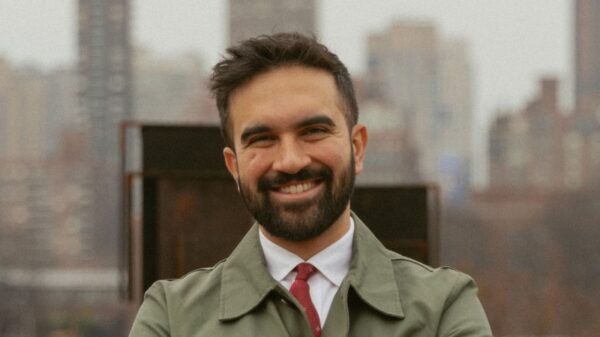

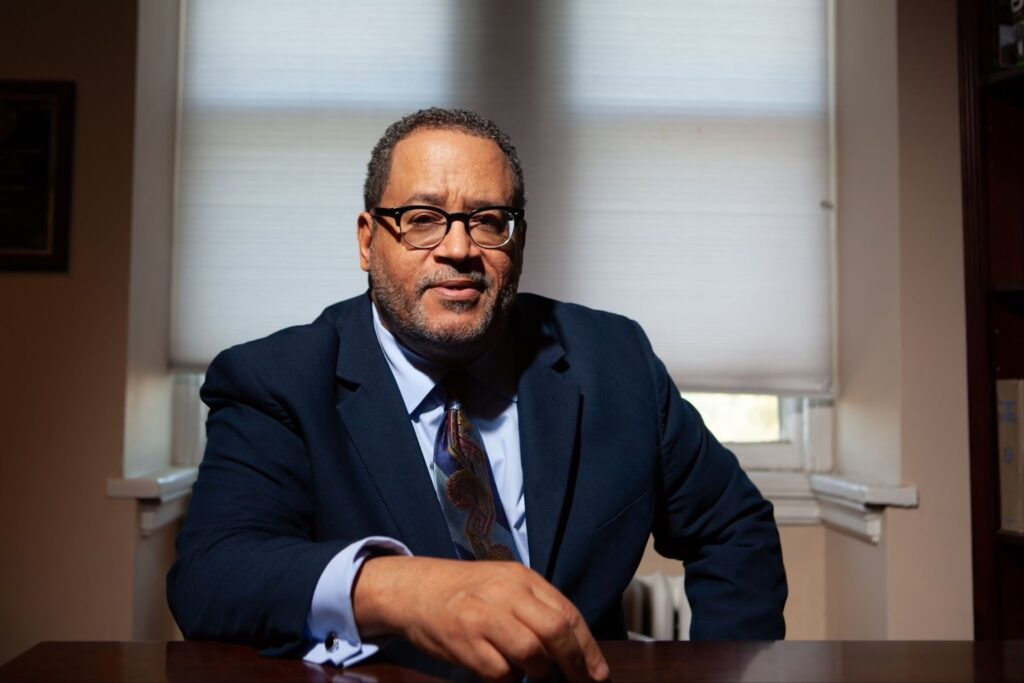
Howard University welcomed Michael Eric Dyson to its Call to Chapel service in Cramton Auditorium, where he delivered a sermon titled “How to Heal the Land,” kicking off homecoming week on Sunday, Oct. 19.
Dyson, a native of Detroit, Michigan, is a renowned professor, writer, preacher, lecturer and media personality.
As a professor who earned a doctorate in religion from Princeton University, Dyson has
taught at multiple universities such as Brown University, the University of North Carolina at Chapel Hill, the University of Pennsylvania and Georgetown University.
The morning opened with Dyson’s prayer of gratitude and reflection.
“We are grateful, oh God, for this majestic and mighty moment where we have been taught that
our expectations sometimes are a mismatch for your blessing. We’re grateful for Blackness this
morning,” Dyson said.
Dyson is an author of over 25 books, including seven New York Times bestsellers. Through
his writing, Dyson wants to challenge readers to think deeply about important issues and to consider new perspectives. Dyson has won the 2020 Langston Hughes Medal, an American Book Award and two NAACP Image Awards.
He greeted the audience warmly, honoring the dean of the Chapel, Reverend Bernard L. Richardson, Assistant Dean Hazel Cherry and the chapel community, praising Howard’s legacy of spiritual and social leadership.
“What an honor it is to be here again at Howard, where the intensity of your devotion to your
people is itself a sermon,” he said, having preached at the chapel last year.
Referencing a brief sound issue during the dancers’ performance, Dyson turned it into a
metaphor for perseverance and faith, saying, “When the technology fails, the technique prevails. They had practiced when they could hear the voice clearly, so when distortion came, they had internalized that voice and kept pace.”
From there, Dyson transitioned to his sermon text, reading from 2 Chronicles 7:14.
He referenced the passage stating that if people humble themselves, pray, seek God’s presence and turn away from wrongdoing, then God will listen, forgive their sins and restore their nation.
Dyson used the scripture to call attention to what he said is the moral and social decay of the nation and the need for humility, prayer and compassion.
“We are a land in need of healing. We are sick with bigotry, with arrogance, with the worship of
nationalism over God,” he said.
In a reflection on culture and language, Dyson recounted how receiving a dictionary as a child
opened his eyes to the beauty of words and the legitimacy of Black English. He explained how the inclusion of words like “ain’t” and “irregardless” in the 1961 Webster’s Dictionary represented a revolution in linguistic democracy.
“What we did with language was remarkable. We learned to read when we couldn’t read. We
learned to write when we couldn’t write. To capture the majestic rhythm and tonalities of
Blackness is a beautiful thing,” Dyson said.
One student, Ryan Mack, a freshman mechanical engineering major from Philadelphia, PA, commented that, “God will answer your prayers, even if it’s not how you imagined it.”
He attributes this to being a good person and correlates Dr. Dyson’s message to that.
“For me, this translates to being grateful and not taking anything for granted. It’s useful to take a step back and count your blessings now and then,” Mack said.
He first started going to service at Howard during freshman week, after growing up in a Baptist household, but admits to not having that strong of a relationship with religion as he got older.
“On top of that, I always went to Quaker schools, so my relationship with religion was always kind of in ambiguity,” Mack said. “When I moved in, I figured now was the time to ‘get my life together.”
Mack believes that going to service is a great way to start the week, and it’s important to understand the people who are here, passing down the legacy of attending Howard.
“Listening to the past couple of sermons made me understand how much prior generations believed in us as black college students,” Mack said. “We mean so much to them and it’s important to understand that we are a living legacy.”
Dyson then shifted to confront what he called the moral heresy of white Christian nationalism,
warning that many in the church confuse patriotism with divine calling.
“White Christian nationalism is a heresy of faith. It is a direct dispute with the divine intention
that all human beings reflect God,” he said.
Dyson then critiqued anti-immigrant sentiment.
“We despise the immigrants and bemoan their presence in our land, yet we built this land on the
backs of forced immigrants in slavery and replenished its resources through the toil of those who
came seeking freedom,” he said.
He also discussed political power and national leadership, condemning the rise of authoritarian behavior in American politics.
Dyson criticized the “leader of America,” President Donald Trump, as a leader who rose to power through force and encouraged citizens to storm the U.S. Capitol based on false claims of a stolen election, labeling anyone who opposes him as un-American. He argued that such leadership reflects a broader rejection of truth and an obsession with power.
Connecting these political issues to attacks on education, Dyson said current leaders attempt to control what colleges and universities can teach by banning books and ideas that challenge the ideology of white supremacy.
Dyson’s critique grew more pointed as he spoke about diversity, equity and inclusion initiatives, calling out the hypocrisy behind efforts to dismantle them.
“DEI was a compromise. They didn’t want affirmative action. They didn’t want reparations. So
we agreed we would color it with diversity so that white women could be included — and they
still mad at that,” he said. “We are a land so sick with anti-Blackness — a sickness so deep we
blame DEI for airplane crashes.”
Dyson also addressed the double standard in American narratives about criminals.
“There has been the trumping up of claims of Black criminality while ignoring white criminality
from January sixth,” he said.
A 2023 report from the U.S. Sentencing Commission found that Black men received prison sentences about 13.4% longer than White men for similar offenses and were 23.4% less likely to receive probation, highlighting persistent racial disparities in federal sentencing (as reported by U.S. Sentencing Commission, 2023).
Another student, Alyssa Thomas, senior nursing major, said her reason for attending was “because it’s a nice break from school, but it still feels like you have a community.”
She started going to the service recently because a couple of her friends are involved with the Chapel.
“I wanted to (also) further my connection with my religion,” Thomas said.
She took away from Dr. Dyson’s sermon that language and Black culture should be reclaimed by the Black community.
“(It) spoke to me because we hear often that we need to be proper and whatnot, but we can still do that while speaking the way we do,” Thomas said.
Dyson reminded the audience that the call to “heal the land” requires not only faith but courage to confront injustice.
His sermon took a turn as he invoked the memory of Martin Luther King Jr., contrasting his moral courage with the moral confusion of today. Dyson compared the prophetic clarity of King’s witness to the distortion of truth embodied in modern figures like political commentator Charlie Kirk.
As the service drew to a close, Dyson urged the Howard community to recognize that healing begins with humility and love — and that God’s saving grace often arrives in unexpected forms.
“God is still trying to heal us and save us today, and we keep turning God down because it doesn’t fit our vision. You better wake up to how God will save you,” he said.
Copy edited by D’Nyah Jefferson – Philmore