

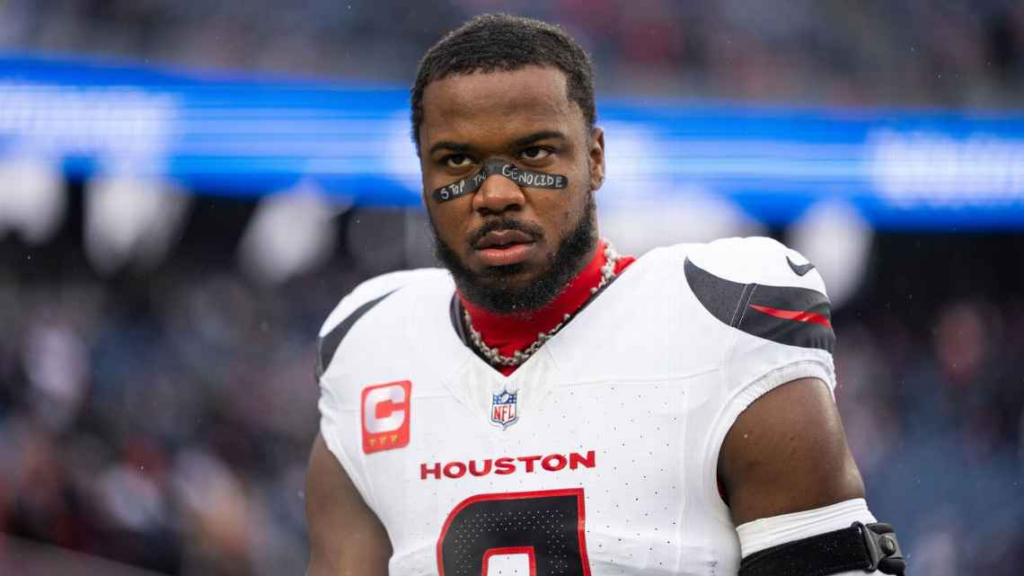
Azeez Al-Shaair, a Houston Texans linebacker, was fined $11,593 by the NFL for wearing a “Stop the Genocide” message on his eye black during the Wild Card game against the Pittsburgh Steelers on Monday, Jan. 12, according to a source reporting to ESPN’s Adam Schefter. The fine was issued for violating the NFL uniform and equipment rules by wearing eye black that contained a personal message.
Al-Shaair wore eye black with the same message days later, on Jan. 18, but stated he took it off due to officials threatening to pull him out of the game against the New England Patriots.
The personal message addresses political concerns over Israel’s policies in Gaza, where tens of thousands have been killed in Israeli military operations following the Hamas attack on Israel in October 2023. Israel has adamantly rejected genocide allegations against it as an antisemitic attack.
When asked by a reporter if he was disappointed about the league fining him, Al-Shaair stated, “I knew that [it] was a fine, and I understand what I was doing. At the end of the day, it’s bigger than me. The things that are going on make people uncomfortable, imagine how [Palestinians] feel? I have no affiliation, no connection to [Palestinians] other than the fact that I’m a human being.”
Al-Shaair is Muslim and has supported Palestinians on the football field by wearing cleats to bring light to Palestinian causes through the NFL’s “My Cause, My Cleats” program over the past few seasons.
The program allows players to highlight social issues and nonprofit organizations during select games. According to AJPlus News, Al-Shaair has also hosted child amputees from Gaza at his games.
Earlier this season, the Texans named Al-Shaair as the 2025 club winner for the Walter Payton Man of the Year Award. The annual award is given to a player who demonstrates excellence on the field while showcasing a significant commitment to philanthropy and community service off the field.
However, according to CBS Sports, personal messages in the NFL are prohibited unless approved ahead of time by the league office. The NFL does not grant permission for players to convey messages pertaining to “political activities or causes, other non-football events, causes or campaigns, or charitable causes or campaigns,” according to Rule 5, Section 4, Article 8 of the league rulebook.
The precautionary fine from the NFL has sparked conversation among sports fans, ranging from those expressing respect for Al-Shaair for standing up against what they view as the genocide in Palestine, to others expressing concern and outrage over athletes’ constitutional rights to free expression being limited, particularly when it comes to political issues.
Sports lawyer and Howard University professor William Hyde broke down why the NFL is allowed to fine a player for a message displayed on their uniform, even if it conflicts with First Amendment rights.
“Technically, the only person that’s supposed to say or do anything on their uniforms is the NFL and the team because that’s what the [NFL Players Association] has negotiated by virtue of the collective bargaining agreement,” Hyde said.
Hyde said that in some sense, some owners and people in the NFL construe the agreements as a license to regulate what athletes can say on their uniforms.
Through the Collective Bargaining Agreement, players assign their group licensing rights to the NFL Players Association, which then licenses these rights to the NFL for use in products featuring six or more players. The NFL owns team-related marks, but players have individual rights, with specific revenue splits for merchandise.
Hyde went on to state that these are the main competing factors when it comes to athletes expressing their First Amendment rights while counteracting the rights the players’ association has given to the league and team owners, as the NFL’s primary goal is to generate income.
“It’s part of labor law. You’ve agreed to be part of a union and given them the right to negotiate what you’re merchandising, your rights to expression, they’ve negotiated and converted it into a fairly substantial chunk of money for all the players to share,” Hyde said. “So, can you take the money and also breach the spirit of the agreement and not the agreement itself? No, it doesn’t work out very well.”
This moment reflects how the NFL has historically responded to athlete protests, including the case of Colin Kaepernick in 2016. Kaepernick, a former San Francisco 49ers quarterback, protested racial injustice by kneeling during the national anthem. His protest ultimately resulted in him no longer playing professionally in the league. This adds to the ongoing reality of athletes having to make personal decisions about publicly protesting on the field under the league’s discretion.
Amid these factors, Hyde explained that there are other ways athletes can protest off the field without jeopardizing the pre-negotiated contract regulations signed when joining the league.
“I think social and political movements can be addressed in other ways than violation because there are certain things [athletes] can do. I mean, if it’s a towel [protest] or something, little stuff, you might be able to do,” Hyde said. “But when you’re on a football field, you’re playing football, when you’re off the field, you have First Amendment rights as a person to do whatever.”
Hyde highlights the point that athletes can participate in other initiatives such as speaking out on podcasts or their platforms, participating in ads, protesting for causes, etc.
Howard men’s basketball point guard Bryce Harris said it was not much of a shock that Al-Shaair was fined, but rather shocking that the fine was only $11,593.
“Stuff like this has happened time and time again. It’s very common for whatever league is in charge, especially the NFL, to try to almost silence the player that’s giving their protests. When George Floyd happened, the NFL was so reluctant to even acknowledge what was going on,” Harris said. “So I’m not shocked that [Azeez Al-Shaair’s] voice was trying to be suppressed, which happens pretty often, especially in sports. It’s another example of the illusion of free speech in our country.”

Harris highlighted that standing up for personal beliefs as a professional athlete is not a simple decision, as many athletes rely on their income to financially support themselves and their families.
“If you come from an environment where you don’t come from a lot of money, you come from a poor family, a lot of athletes’ biggest fears are going back to that poverty so it’s very admirable for anybody who decides to take that risk for the betterment of somebody else,” he said.
Junior football offensive lineman De’Eric Mister shared the importance of athletes speaking out on issues they believe in.
“I think it’s very important to show that we still have our voices and that we’re not afraid to speak out on certain things. I always try to be involved with anything that pertains to speaking out or protesting,” Mister said. “When other athletes do it, I always feel good because it shows that we’re not just athletes, we’re not afraid to speak out and talk about what’s right.”
Historically, it has been an ongoing challenge for Black athletes to find the middle ground between advocating for their beliefs while maintaining alignment with the regulations of their professional sports leagues. However, Al-Shaair hopes this moment will not be met with silence, but rather serve as inspiration for others to speak up and use their platforms.
“If my platform can bring even a little hope to families in Palestine, then that is what I want to use it for,” Al-Shaair said.
Copy edited by Daryl R. Thomas Jr.