

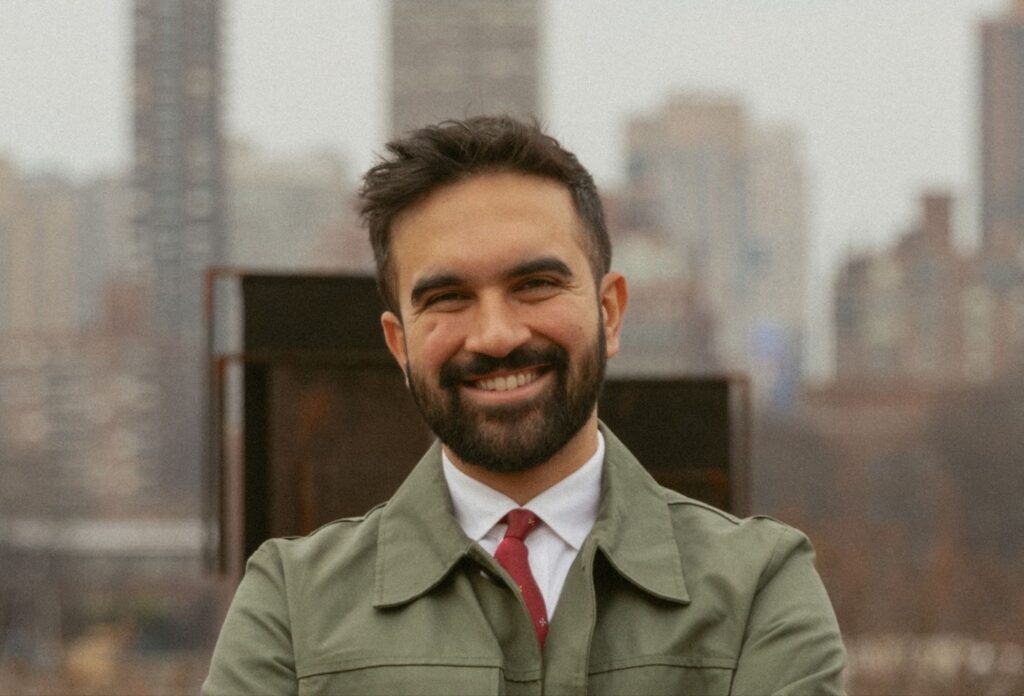
With what was expected to be one of the largest mayoral inauguration crowds in decades – drawing up to 40,000 attendees – Zohran Mamdani was sworn in as the first South Asian and Muslim mayor of New York City at the beginning of this year. At 34, the self-described Democratic socialist from Queens rose from near obscurity to international prominence in a matter of months, mobilizing voters amid a surge of right-wing power and growing concerns over the erosion of American democratic norms.
It is not often that a mayoral race becomes international news. To many supporters, including Bill Austin, a film and television production major at New York University, who encountered Mamdani, Mamdani represents a source of political hope. Mamdani’s prominence serves as an uplifting voice for both the Muslim-American community and America as a whole.
“His election is an indication that people are dreaming of a better world, fighting, not because they fear what they hate, but because they want to uphold what they love,” Austin said. “When I ran into him, there were people saying … that they were thankful for the work he was doing. That meant something: the American people are starting to believe that their lives can be better,”
As the right-wing has coalesced around a recognizable set of political figures and leadership aligned with the MAGA movement, critics like Ezra Klein, a political commentator and journalist, have argued that democratic leadership has lacked comparable cohesion in recent years.
“I think liberalism, which is the mainstream of the Democratic Party, didn’t have an idea after Obama,” said Klein in an interview with The New York Times before Mamdani’s rise.So, now there’s nothing. There’s no recognized leader of liberalism. There’s no singular project that unites liberalism.”
To some, Mamdani’s emergence signals to supporters a generational shift, a sense of urgency and cultural relevance in American politics as many fear democratic backsliding. According to Austin, of Mamdani’s appeal lies in his perceived authenticity, an identity and personal history that many voters find accessible and credible.
“What makes Mamdani’s identity politics more authentic is that he used it to emphasize his policy positions and campaign goals rather than play into his identity,” Austin said.
Before entering electoral politics, Mamdani worked as a foreclosure prevention housing counselor, helping low-income homeowners fight eviction, which gave him direct exposure to systemic failure. During his time as a housing counselor, Mamdani articulated his belief that housing is a human right to the New York City Campaign Finance Board.
“Every day, I’m reminded that all this suffering isn’t inevitable – it’s a choice that our representatives make to put the interests of their campaign donors over the well-being over their constituents,” he said.
Mamdani’s campaign distinguished itself through high social media fluency, using digital platforms as a tool for outreach and a central organizing strategy. Frequently releasing videos in Urdu, an Indo-Aryan language spoken by approximately 78,000 in New York, Mamdani made his identity an intentional part of his politics.
He argued his background, as the son of two brown immigrant parents, is inseparable from his approach to policy, according to the Guardian.
“His number one priority was what he wanted to do, not just who he is,” Austin said. “I think both Mamdani and MAGA are both pretty attuned to the needs of the people. The key difference is Mamdani’s ability to address those needs, as opposed to MAGA’s tendency to exploit them.”
Mamdani’s solidarity has invigorated many, reflected in his declaration following his mayoral election — “If you want to get to one of us, you’ll have to get through all of us.”
Beyond the stylistic appeal of his campaign, Mamdani’s platform is anchored in an ambitious set of policy proposals – several of which critics argue may prove costly and overly complex to implement. Central to his agenda is affordability.
According to The New Republic, Mamdani has pledged to introduce a free citywide bus system and enact a four-year rent freeze on the city’s approximately 1 million rent-stabilized apartments. He has also proposed expanding union-built rent-stabilized housing, creating a network of city-owned groceries focused on local goods and low prices, providing universal childcare for children up to 5-years-old and raising the city’s minimum wage.
Skeptics, however, question the feasibility and financial sustainability of these proposals, especially in the housing sector. According to the Guardian, many have warned that prolonged rent freezes could permanently reduce building revenue, simultaneously raising concern over the logistics of Mamdani’s novel city-owned grocery stores.
Mamdani plans to fund his agenda by increasing taxes on the city’s wealthiest people and businesses. According to the BBC, he has proposed raising the corporate tax by up to 11.5 percent and implementing a flat 2 percent tax on incomes exceeding $1 million.
While drawing strong support from his base, the proposal has faced resistance from many prominent businesses, real estate interests, as well as from New York democratic Gov. Kathy Hochul, who, despite previously endorsing Mamdani, has said she would not support a tax increase on the wealthy.
Despite criticism across the political spectrum, with national unrest and skepticism surrounding his policies, Mamdani’s presence in American politics has galvanized supporters nationwide. Once cast as a political “underdog,” his victory prompted what many view as a seismic shift in local and national discourse – one punctuated by President Donald Trump, tweeting shortly after Mamdani’s mayoral win, “…AND SO IT BEGINS.”
Copy edited by Kennedi Bryant