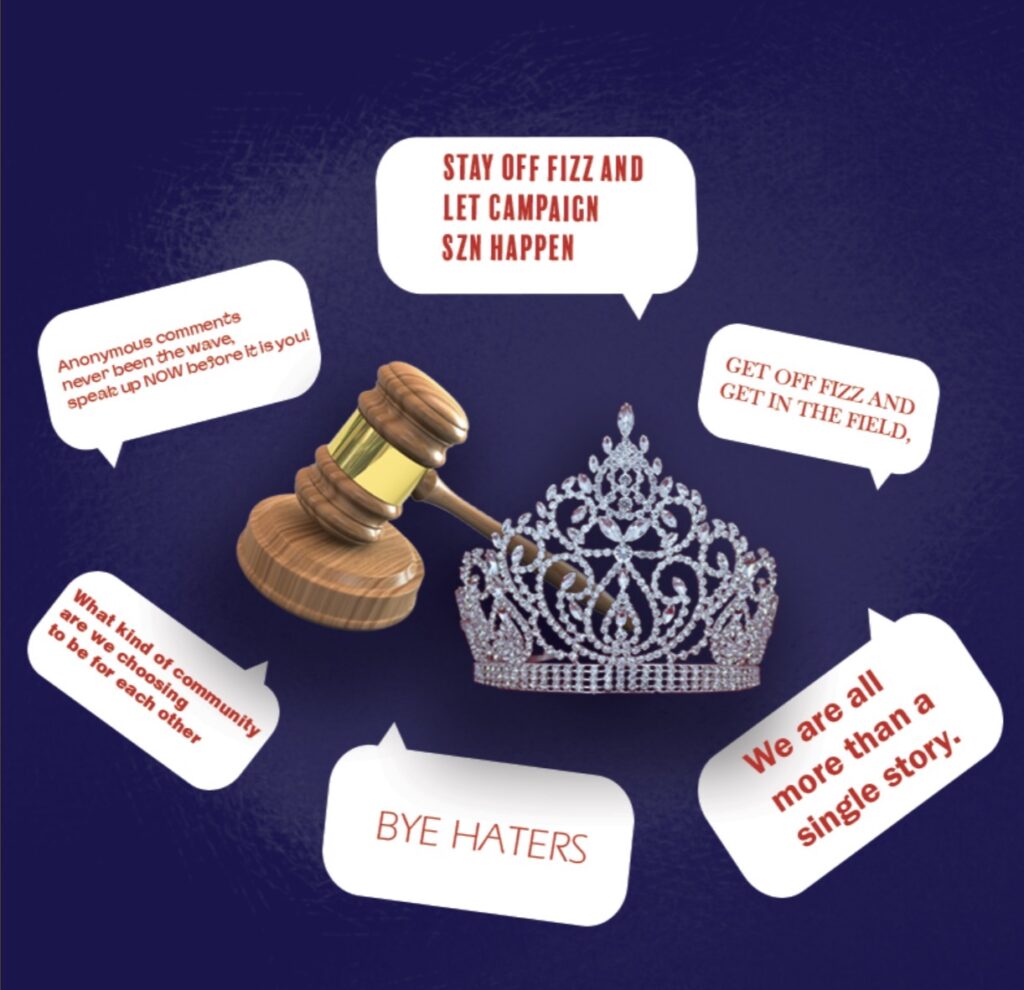
While the student leadership election cycle brings excitement to The Yard – with booming music from candidate tables and free swag – for some candidates, it also marked the beginning of public criticism of their background, character and personality. During the election season, multiple candidates faced online bullying and harassment, leading some to take stances against it.
Leah Peterson, a junior economics major from Fort Worth, Texas, ran to be the 66th Howard University Student Association (HUSA) president, and was accused of being a “MAGA republican” over Fizz within the first week of election season after liking and following conservative influencer Candace Owens’ Instagram content prior to campaigning. Peterson denied such allegations in an Instagram video posted on March 18, stating that she is registered as a Democrat.
“I do engage in different perspectives, but that’s all intentional,” Peterson said in the video. “Awareness is not the same as alignment,” she added.
Peterson has run for an elected position twice before this season, both of which were overwhelmingly positive experiences; her favorite part being interactions with new people while tabling.
“But the culture of campaign season for me this year has been very stressful and depressing,” said Peterson in an interview with The Hilltop.
Despite her quick rebuttal, hundreds of users had already engaged with posts rooted in misinformation. Such posts have since been removed from the Fizz platform, likely by app moderators.
“For a lot of people, that was their first impression of me, which is not ideal,” said Peterson, who said she felt that she was able to still connect and engage with students despite allegations.
Peterson once again was the target of a negative Fizz post later in the same week, when a user questioned how her resume mattered in “the real world.”
“I don’t take things personally because I know people are going to talk, but it definitely impacted me on top of everything else,” said Peterson, who felt more nervous about the way she communicates in fear of being purposefully misconstrued.
Melvin “Sancho” Hodges, a freshman philosophy major from Atlanta, experienced something similar during the fall 2025 elections when he ran to be College of Arts and Sciences (COAS) Freshman Council Secretary. During one of the crossfires, a debate-like forum for candidates, Hodges ended a response saying he was incomparable to his opponents.
Without the context preceding the statement and his further explanation of his point after an audience member objected to the comment, clips and commentary from that specific moment circulated around Fizz, which ultimately made Hodges paranoid of those around him on campus.
“I would walk anywhere, and I didn’t know who liked me and who didn’t. That weekend, I spent at my aunt’s house because I didn’t feel safe,” said Hodges, explaining the extreme feeling of ostracization during that period of time.
“When I used to think of cyberbullying, I’d be like ‘just turn off the phone,’ but it’s way more layers than that,” said Hodges.
While Hodges regrets the way his crossfire statement was phrased, he doesn’t feel that it warranted the reaction incurred.
“The people you see in those graphics and videos are students just like you,” said Hodges. “Mistakes are going to be made, feelings might be hurt, but it’s not a reason to be disrespectful or inhumane.”
Ssanyu Lukoma, a junior broadcast journalism major from New Jersey, was elected the 88th Miss Howard University. During her campaign, Lukoma encountered xenophobic comments via Fizz about her legitimacy to run as an African Caribbean student as opposed to a “foundational Black American” or a person whose Black lineage traces back multiple generations in the United States.
To Lukoma, constructive and appropriate dialogue on candidates turns to cyberbullying and harassment when it comes from a place of malice.
“There is a tasteful way to say anything, and when you choose not to say it in a way that considers the feelings of the person,” said Lukoma, “then you are letting malice overtake the way you are interacting.”
Lukoma similarly made a video denouncing cyberbullying and harassment not only against her, but also against other candidates.
“At the end of the day, we’re all students, we all spent time, money, energy, and lost sleep – we’re doing everything we can to put on the best campaign possible,” said Lukoma in the video posted March 17.
Lukoma believes that volatile election culture can be changed by fresh perspectives to student leadership, specifically ones that are physically present and interacting on campus.

“I think we have such a polarizing political culture because we turn these student leaders into caricatures instead of people we can have a genuine conversation with,” said Lukoma in an interview with The Hilltop.
Despite their brushes with personal attacks and derogatory commentary, each still stayed in their respective races, with a mission of changing campus culture.
“We pride ourselves on being at this school we call The Mecca, this pinnacle of excellence,” said Peterson. “Sometimes when we’re chasing excellence, we can get lost in how we are getting there. I just urge everyone to continue using their moral compass set up in their heart,” Peterson added.
Copy edited by D’Nyah Jefferson – Philmore