As global competition intensifies and federal investments in research continue to shape the future of innovation, historically Black colleges and universities (HBCUs) remain largely excluded from the funding pipeline, receiving less than 1 percent of federal research and development (R&D) dollars. Now, a new bipartisan effort in Congress aims to change that.
Senator Raphael Warnock (D-GA), a graduate of Morehouse College and the only HBCU alumnus currently serving in the U.S. Senate, positioned himself as a leading advocate for these institutions. He introduced the HBCU Research Capacity Act alongside Senator Katie Britt (R-AL), through the legislation designed to streamline federal grant access and expand research opportunities for HBCUs nationwide.
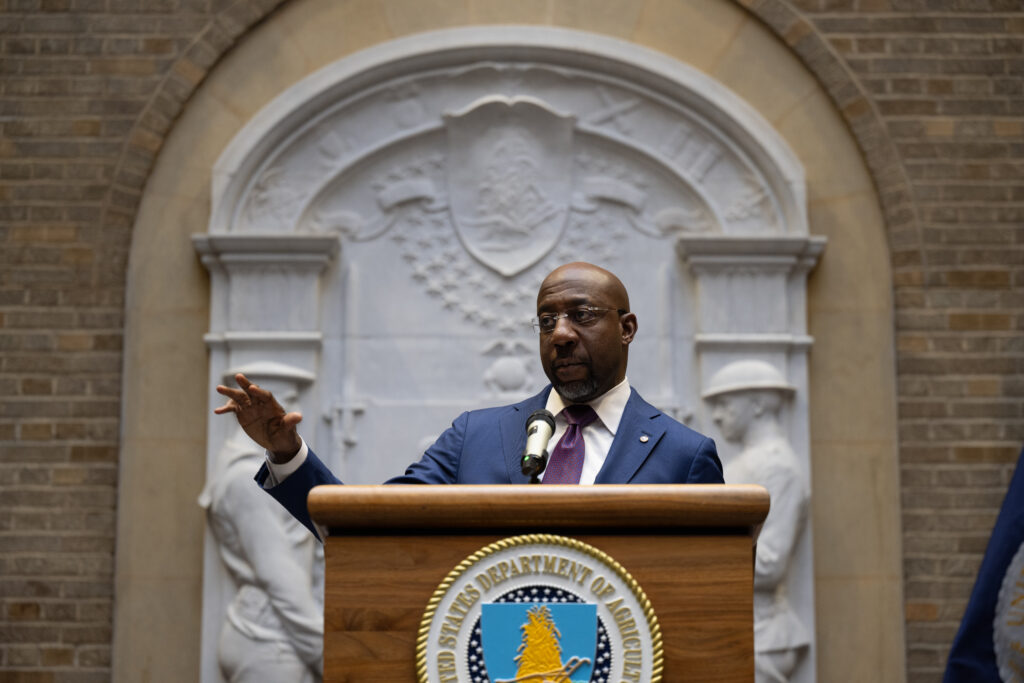
In a press conference with HBCU student journalists, hosted on March 24, Warnock framed the bill as both an equity measure and a national priority.
“HBCUs punch way above their weight; they have been doing so much for so many people, with so very little for so long, they make a way out of nowhere,” Warnock said.
The legislation would establish a federally coordinated clearinghouse, a centralized website compiling HBCU-eligible STEM research funding opportunities. The goal is to simplify a process that many institutions struggle to navigate due to limited administrative capacity.
Announced on March 25, the bill marks a rare moment of bipartisan alignment on higher education policy. Britt emphasized the broader impact of investing in HBCUs.
“I’ve seen firsthand how impactful these institutions are,” Britt said in a statement. “I am proud to co-lead this commonsense legislation, which will help these institutions grow their research capacity and continue paving the way for generations of students.”
To accompany the bill’s introduction, the senators hosted a roundtable with 30 HBCU presidents, underscoring the urgency of federal support. Leaders from institutions across the country highlighted the need for structural changes to ensure HBCUs can compete for research funding on a larger scale.
At the core of the legislation is the idea that access, not ability, is the primary barrier facing HBCUs. Many institutions lack the infrastructure that larger universities rely on to secure federal dollars.
“They [HBCUs] don’t have entire departments devoted to grant writing,” Warnock said during the press conference. “What this bill does is streamline the process and put that information directly in their hands.”
The clearinghouse would not only list funding opportunities but also share best practices for building research capacity. It would be administered by the Department of Education in coordination with federal agencies, with requirements for regular updates to both Congress and participating institutions.
For universities like Howard University, currently the only HBCU with R1 research status, the bill could help sustain progress. For others, it may provide a pathway toward achieving that designation.
“The fact that we are where we are in terms of R1 universities is completely unacceptable,” Warnock said.
Student journalists used the press conference to directly challenge whether the proposed legislation would lead to meaningful change or simply repackage existing barriers.
Joshua Bass, a student journalist for The Maroon Tiger at Morehouse College, questioned whether creating a centralized clearinghouse would actually increase funding for HBCUs or simply improve access to information without addressing the deeper issue of inequitable distribution. His concern highlighted a broader skepticism: whether access alone is enough to overcome systemic disparities in federal research funding.
Warnock acknowledged the limitation but defended the approach as a necessary starting point. The proposed clearinghouse, he argued, would help institutions “better coordinate, plan and implement their strategy for winning research dollars.”
Still, the exchange underscored skepticism among students about whether incremental reforms are enough.
Dacia Garner, a student journalist for The A&T Register at North Carolina A&T State University, raised a separate, but equally pressing issue: awareness.
“A lot of college students may not even realize that we receive less than one percent of the research funding,” she said, pointing to a gap not just in resources, but in public understanding.
Garner pushed further, asking where HBCUs should stand when it comes to research funding and opportunities, especially as institutions like Howard University remain among the few HBCUs with R1 research classification. Her question reframed the issue from one of access to one of equity and expectation.
Together, the questions highlighted a generational demand for more than symbolic action. While lawmakers frame the bill as a step forward, students made clear that they are looking for measurable outcomes, more funding, more research opportunities and more institutions reaching R1 status.

“We do this not out of any sense of charity,” Warnock said in response. “We do it because it’s the smart thing to do.”
Despite pressure from students, the challenge remains: ensuring that “smart policy” leads to tangible investment.
Warnock repeatedly framed the bill as essential to U.S. economic and global competitiveness. With countries like China rapidly expanding their research capabilities, he argued that the United States cannot afford to overlook the talent cultivated at HBCUs.
“If America is going to maintain its competitive edge, we need all of our people,” he said.
HBCUs enroll about 10 percent of Black undergraduates but produce nearly 20 percent of Black graduates and a disproportionate share of Black professionals, including roughly 40 percent of engineers and up to 70 percent of Black doctors.
Support for the legislation extends beyond Congress. Organizations like the Thurgood Marshall College Fund (TMCF) and the United Negro College Fund (UNCF) have praised the bill as a step toward addressing long-standing inequities, while also emphasizing that more work remains.
TMCF President and CEO Dr. Harry L. Williams stated the bill would “connect HBCUs with federal research opportunities,” helping “unlock potential” and “yield generational dividends” through increased research investment.
Warnock’s push for HBCU funding is not new. According to his office, he has secured more than $265 million for Georgia’s 10 HBCUs and contributed to over $17 billion in federal investments for HBCUs nationwide. He also played a role in shaping provisions in the CHIPS and Science Act to expand access to federal STEM funding.
“HBCUs are incubators of diverse excellence,” he said. “This bipartisan bill will make securing federal dollars for their research efforts that much easier.”
Copy edited by Kennedi Bryant