

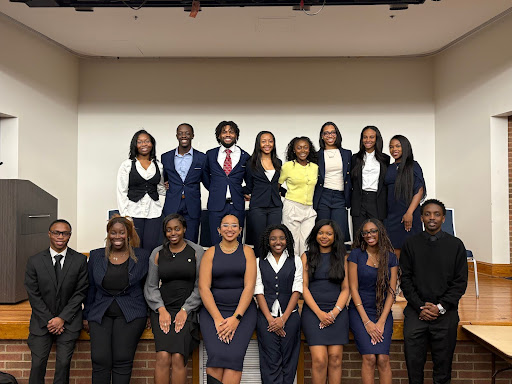
The Howard University Elections Commission (HUEC) recently held its second major press conference for the 2025-2026 academic year, delivering a mandate that seeks to alter the relationship between the student government and the student body.
Commissioner Willie White III and Associate Commissioner Jae’Dyn Smith described their vision for a culture shift, one that demands a transition from the performative “clout chasing” of traditional campaign seasons to a standard of ethical, service-oriented leadership.
White, a senior honors political science and sociology double major from Blackshear, Georgia, opened up with a candid reflection on The Mecca’s political atmosphere. He noted that every year, as the election season approaches, “the vibes on campus shift.” Students who were previously “invisible” suddenly emerge for massive community service projects; Instagram feeds become flooded with high-budget photo shoots; and “messy” comments on apps such as Fizz become the primary source of student entertainment. While these moments provide entertainment for the community, White argued they often stray from the true intentions of leadership.
“We have seen elections become less about leadership, service, and accountability and more about visibility, popularity, and proximity to power,” White said.
The 2025-2026 Commission said they aim to dismantle this cycle, focusing instead on whether candidates have consistently done the work, understand the needs of the people, and are prepared to lead with integrity and fulfill their promises to the community.
The dialogue continued when student media entered the conversation. Jordan Williams, a graduating senior political science major from Jacksonville, Florida, and the founder of “New To The Mecca”, a student-run social media platform, asked how independent student-led media platforms can aid HUEC in this upcoming season.
The Commission proposed the idea of “polling,” utilizing platforms like New To The Mecca to conduct live surveys to understand not just who students are voting for, but the “why” behind their choices. This partnership aims to counter “campaign elitism” by providing data on candidate platforms rather than social media following. By amplifying candidate information through established student platforms, the Commission hopes to make the election process more accessible to those who may not have the privilege of high-budget campaigns.
When asked about the intrinsic value of serving on the Commission, Smith, a junior public relations major from Dallas, Texas, described his role as that of a “safeguard.”
Noting that the history of Howard’s student government is “literally in the soil,” he emphasized that his foundation of leadership directly informs the Commission’s current mandate. For those currently serving, that history translate into a modern responsibility to protect the democratic process
“At least from my perspective, being on the Commission, being able to safeguard the election space and influence elections in a way that upholds democracy and upholds equity is very, very important,” Smith said.
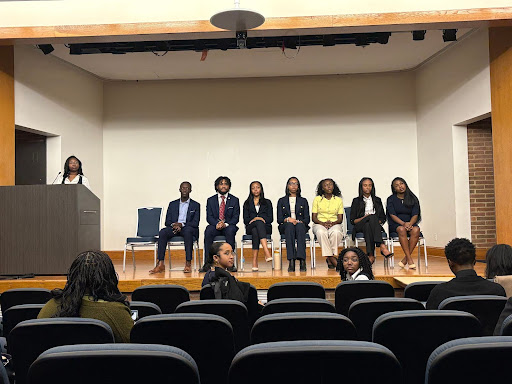
Smith also said he seeks to ensure that the democratic process remains open to any student with the qualifications and the desire to lead, regardless of their financial status or background. He also touched on the long-term impact of this work beyond Howard.
“I always say, college is like the real world,” Smith stated. “This is kind of your practice ground for what you’re going to do.”
The Commission said the integrity of the 2026 general elections depends not just on the Commission’s oversight, but on the student body showing up to vote. As Smith put it, “our participation is our power.”
In April 2025, the entire Commission was fired by HUSA Executive Order due to “continuous concerns” about procedural fairness and a failure to adhere to the election code. This was a controversial period where campaigning was suspended, over 30 strikes were issued against a single slate, and the student body was left in shambles during a high-stakes runoff.
White noted that past seasons were often corrupted by “code twisting” and a perception of the Commission as a sort of “empire” that operated without true accountability. By reviewing these past failures and the current “local landscape” of student politics, the 2025-2026 Commission identified a need for a system where rules are fixed and finances are public.
To support this philosophy, the Commission is introducing structural reforms that enforce accountability from day one. The Treasury Department’s new mandate for public financial disclosures and budget templates ensures that campaigns are no longer “secretive” operations where influence can be bought.
Meanwhile, the Violations Department’s “strike journey” documentation and compliance checks provide a clear path for candidates to navigate the rules. The newly established Department of Policy and Research aims to raise the bar by providing “Crossfire Reports,” summarizing candidate platforms so that the student body can make decisions based on policy rather than relying on biased social media posts.
As the 2026 general election approaches, the HUEC is not just asking for votes; it is asking for a
fundamental change in how the student body views its own power.
Copy-edited by Daryl R. Thomas Jr.