

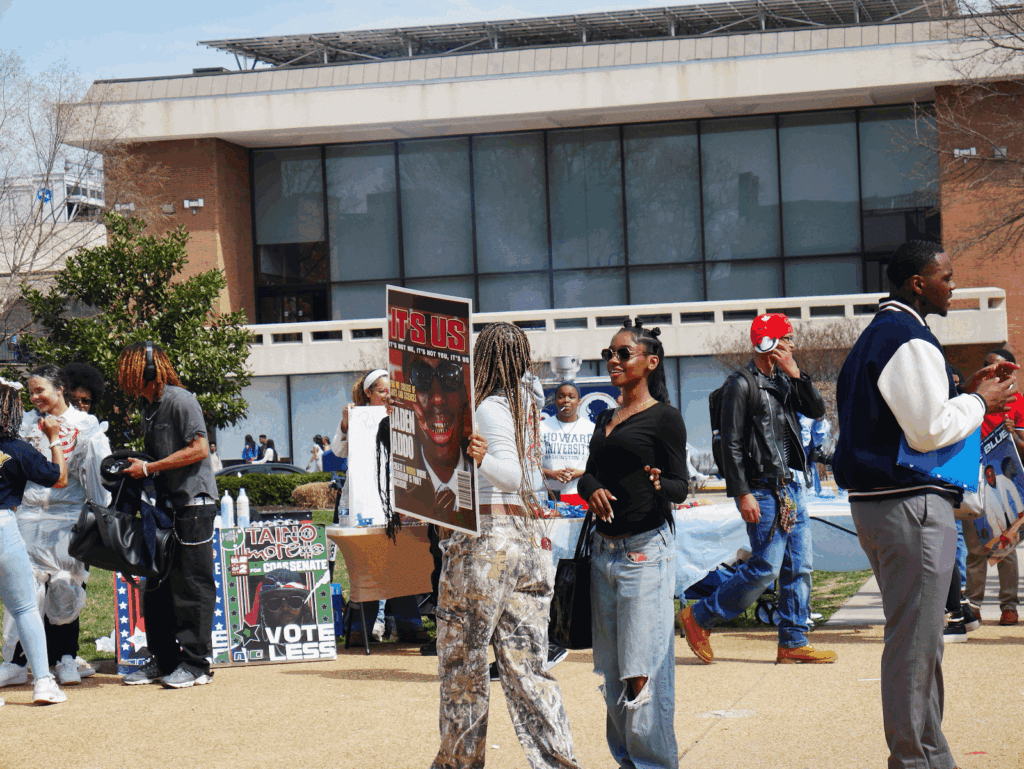
After the Howard University Elections Commission announced most of the student leadership election results last Friday, a series of campaign violations alleged by the commission prompted them to suspend campaigning for the HUSA executive positions.
In response, the Howard University Student Association (HUSA) called for an executive order to effectively fire the Elections Commission, citing concerns about its handling of the election procedures. The order was signed by current HUSA President Jay Jones.
Jones and the HUSA Director of Governmental Affairs and Policy, Nikkya Taliaferro, said the order was put in place as a “last resort” due to continuous concerns of the Elections Commission’s conduct within “procedural guidelines” from the beginning of election season.
The removal of the Elections Commission was due to growing concerns by HUSA leadership over how this year’s election was being handled, following a surge of complaints from the student body, according to Jones and Taliaferro.
The Elections Commission, which is overseen by the Elections Committee and Judiciary, faced criticism from HUSA leadership for allegedly not adhering to procedural guidelines. The decision reflected a broader concern that the election may not have been managed in accordance with established protocols.
Taliaferro said she had a meeting with Elections Committee chair Salimah Scott, on March 18, where she was alerted that the committee and commissions had not yet had a meeting at the time. She said this was the beginning of the concern from the Executive Branch.
They initiated concerns regarding oversight of the Elections Commission and whether they were adhering to the procedural guidelines through various meetings with the Elections Commission throughout campaign week. On the day of the election results, they reached out for a meeting in which they were told the commission would not be available until yesterday.
This created further concern within all three branches of HUSA–Executive, Legislative and Judiciary.
“This was a planned, coordinated order that happened between all branches of government because we have true concerns for the integrity of the Elections Commission. I think that any statements that this isn’t within the interest of the students would be false,” Taliaferro said.
However, according to the associate commissioner Jada Sweeting, she does not recall any meeting with the HUSA Executive Branch wherein they listed concerns about the way the Elections Commission was conducting this year’s election.
Sweeting said that the only people they met with prior to the election cycle would be the Elections Commission advisor and head of campus life, Walter Servance. She mentioned that they’d occasionally meet with the Elections Committee chair.
“We have always been open to communication. We also made it clear during our State of the Union address that our goal was to improve a lot of the systems within the Elections Commission. Which we did,” Sweeting said.
Although the Elections Commission is in charge of conducting elections, viewing public violations and organizing, they are overseen by the Elections Committee which is made up of the HUSA Senate, who are then overseen by the Judiciary, which is a group of undergraduate and graduate students put in by the current HUSA president and confirmed by the Senate.
“The sudden and arbitrary abandonment of these standards by the current administration fundamentally undermines the fairness, ethics and credibility of our electoral processes,” the Elections Commission said in a statement regarding the order.
There are concerns among the public about potential violations in this year’s elections, sparked by the Elections Commission’s first statement posted on Instagram on March 28. Neither parties were able to explicitly say what the violations were and who made them due to the multiple cases being active within the Judiciary Branch.
Head of Public Violations, Tatyana Mayo, declined to comment about the matter due to the status of the executive order and other election-related matters.
The Elections Commission justified its actions in a statement by citing the need for “pending deliberation and conclusion” in collaboration with the Howard administration to ensure election integrity and fairness.
The commission called for the original cease and desist in order to “allow candidates proper due process and give them time for the proper appellate procedures to take place so that we could verify their eligibility and candidacy,” Sweeting said.
According to Sweeting, this was in order to prevent a prior issue from the previous year in the Judiciary case of Taliaferro v. Fuller from repeating in this year’s election.
In the case between former HUSA presidential candidate Jolie Fuller and former head of violations Taliaferro, the Judiciary refused to recall the election and apply proper violation and appellate procedures because the election results became public before the process could take place, Sweeting said. As a result, strikes and violations were unable to follow the proper appellate procedure.
Jones’ executive order that fired the Elections Commission, order number 2025-01, also delegated the responsibility for managing the election process to HUSA’s three branches of government, Judiciary, Executive and Senate.

Jones and Taliaferro said all current election results still stand as the voting count was deliberated from a third-party service, ElectionsBuddy, that is solely coordinated between campus life and the university.
They also said nothing will change in terms of the internal process outside of who will be the communication for the election process. All communication will be through Servance, according to Taliaferro.
“We are not trying to disrupt any processes within the election. All we are trying to do is ensure procedural fairness as well as ensure that we are at the best of our ability, making sure we maintain and uphold the integrity of our election,” Jones said.
Jones also emphasized the Executive Branch has no intentions of involving themselves in any of the other election processes.
“We are not reversing strikes, we are not declaring or determining who is going to be on the upcoming run-off, we are not removing students from the ballot. That is not our role within this,” she said. “We have no interest in trying to interfere with those processes.”
According to the Spring 2025 Elections Code, runoff elections are required when no candidate receives “50 percent plus one” of the votes cast. In such cases, only the top two vote-earners proceed, and a simple majority is needed to win.
The 2013 Elections Code similarly mandated runoff elections if no candidate secured at least 51 percent of the vote for executive positions. This procedure, long a part of Howard’s elections, ensures winning candidates represent a majority of student voters.
In past runoff elections that resulted in a tie, the winner was decided by a coin toss, witnessed by the Elections Commissioner and the HUSA Senate Elections Committee. A similar event occurred in 1973.
Sweeting said, “We are committed to maintaining the integrity of the Howard University student elections more so than any commission that has come before us.”
She highlighted several changes made to improve fairness, including clearer definitions of endorsements, mandatory candidate fairs and a new candidate resource hub designed to help students better understand the candidates.
The HUSA executive run-off election is postponed until further notice. The election results and the percentage of the Howard community that voted can be found here.
Copy edited by Camiryn Stepteau