

Jerome Simonson, a freshman political science major from Jacksonville, Florida, walks into the Chick-fil-A in the Armour J. Blackburn University Center every week to get his favorite chicken sandwich – despite the controversy that surrounds the restaurant on Howard University’s campus.
As a member of the LGBTQ+ community, Simonson recognizes the controversy surrounding the organization and the community, yet eats there anyway.
“It’s a matter of personal decision. If it really weighed that heavy on my heart, I would stop eating it, but it doesn’t,” Simonson said.
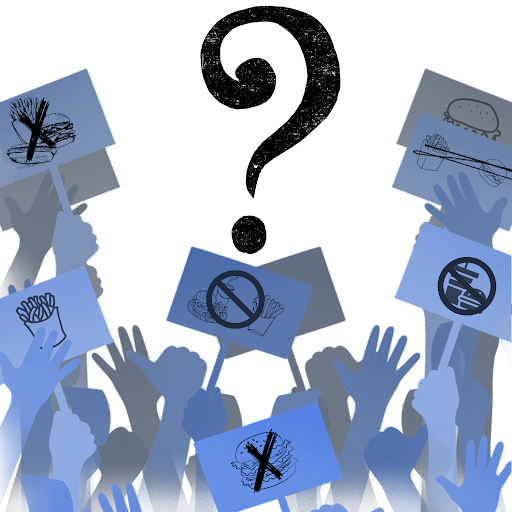
Howard students are known for their activism. Since the early 1900s students have led protests, including one to remove Chick-fil-A off campus. Today, students critique businesses whose morals don’t align with theirs, including McDonald’s, Target and Chick-fil-A, but many still choose to spend their money there.
The most recent campus Chick-fil-A opened in Sept. 2024, two decades after the first one originally opened, according to The Hilltop archives.
The original location was also located in Blackburn Center’s Punchout, but after students boycotted the restaurant for making homophobic remarks, the Chick-fil-A was closed.
Howard’s Instagram announcement post of the re-opening of the Chick-fil-A drew mixed reactions. Many celebrated the return of Chick-fil-A to Howard’s campus but some were disappointed to see Chick-fil-A even associated with Howard.
“Disassociate my alma mater from this bigoted company,” said Instagram user @eric.pipols.
“Could’ve used the money to uplift a local black business,” said another Instagram user, @zeppistemology.
LeVita Bassett, executive director for Auxiliary Enterprises at Howard, said in a statement to The Hilltop that the university’s decision to open the restaurant in 2024 was supported by a survey conducted by the Office of Auxiliary Enterprises in partnership with the former dining services vendor, Sodexo.
“The survey results reflected a strong interest in having a nationally recognized brand on campus and demonstrated significant demand for a full-service Chick-fil-A,” the statement read.
The statement also said the success of the previous Chick-fil-A further supported their decision due to “sustained interest from students and the broader campus community.”
Basset and the Office of University Communications did not respond to requests regarding the amount of students who visit the campus Chick-fil-A daily before this issue of The Hilltop was sent to press on Feb. 26.
Michael Roy, an adjunct professor of communication studies at Howard and 2012 alumnus, said he remembers the previous Chick-fil-A and reiterated that the closure was due to student protest.
“Folks were protesting. …[Students] said, we shouldn’t have them on campus because they make people uncomfortable. I remember that’s when we started calling them ‘bigot burgers,’” Roy said.
Angela Minor, assistant chair of the school of communications, said she remembers the previous Chick-fil-A closing with no notice.
“It closed overnight. It wasn’t an announcement. It was very abrupt,” she said.
In 2012, protests across the country began after reports came out that the WinShape Foundation, a Christian nonprofit founded by Chick-fil-A’s founder and his wife, donated over $5 million to organizations opposing same sex marriage. WinShape also denied same-sex couples the opportunity to participate in the marriage retreats it provides.
In 2013, Shane Windmeyer, the executive director of Campus Pride, a national non-profit organization for LGBTQ+ college students, published an article on HuffPost where he said he was provided with WinShape’s 2011 “990” tax statements. Windmeyer said these statements revealed that the nearly $6 million in outside grant funding no longer lists the anti-LGBTQ groups and instead focuses on youth, education, marriage enrichment and local communities.
Although the restaurant cut monetary ties with these groups, some say it’s not enough, including Tilanna Peterson, a freshman majoring in criminology and Spanish from Guantanamo Bay, Cuba. She said Chick-fil-A will always be known for its homophobic rhetoric.
“I don’t like to spend money in places that don’t align with me; it’s my dollar, if I can save my dollar from going to this place, I’m going to save my dollar,” Peterson said.

Howard students had a total economic impact of around $1 billion on D.C. in 2023, with students spending over $25 million on retail and consumer services, entertainment, dining and other convenience goods, according to Howard University Real Estate Development & Capital Asset Management.
Patrick Kennedy, who has worked in economics for two decades, said a way to contextualize this number is looking at Washington, D.C.’s gross domestic product (GDP). GDP measures the total market value of all goods and services produced within a state’s or country’s borders.
In 2024, the District’s GDP was $148 billion, and Howard University contributed $1.154 billion to that number.
According to the United Negro College Fund, Howard’s spending creates a powerful ripple effect; every dollar spent translates into $1.60 of total economic output for the D.C. area.
Kennedy said that while Howard students can make an impact with boycotting, there is a difference between short-term and long-term impact.
“It can be very difficult for a boycott to achieve the long-term impact [but] it is possible, especially if it is politically motivated,” he said.
Zuri Bellinger, a freshman political science major from Bavaria, Germany, said he justifies his Chick-fil-A dining dollar purchases by differentiating between his personal values and the owner’s values.
“CEOs are entitled to their own political views even if we disagree with them,” Bellinger said, “It’s important to differ between the views of the individual and the views of the company as a whole.”
Bellinger argues that the actions of a company hold much more weight than the actions of a CEO.
He added that Howard students aren’t entirely at fault. Bellinger said that a lack of food and retail options near campus may force students to shop at places they may not align with.
Chick-fil-A accepts cash and credit, as well as dining dollars and Bison Bucks, funds available for students and staff via their Bison One Card, without sales tax. On campus students are required to have a meal plan, and all available meal plan options provide dining dollars.
After the closure of Wonder Plaza, which housed Negril Jamaican Eatery, Chipotle Mexican Grill, Subway and Potbelly Sandwich Shop in 2025, there are limited non-Howard-related food places left.
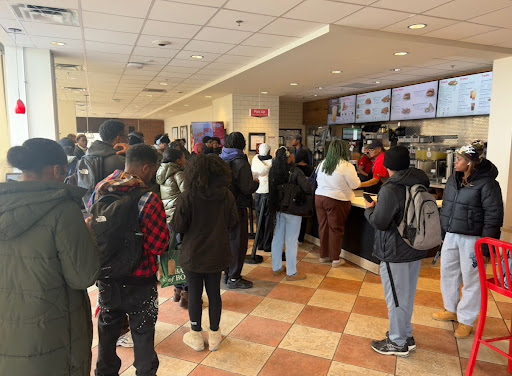
While there are over 20 restaurants within half a mile from The Yard, according to Apple Maps, the immediate locations that many would consider on campus are now closed. This leads students like Simonson to eat at places currently being boycotted, like Chick-fil-A and McDonald’s.
“As a member of the LGBTQ [community] myself, I think [it] is a bad thing for [students] to be supporting these companies, but at the same time, the only resource that is on campus is Chick-fil-A.”
Howard has two dining halls on campus, as well as five eateries in Blackburn where students can use Bison Bucks or Dining Dollars.
Many students, like Peterson, are also boycotting McDonald’s due to its Israeli franchise, Alonyal Limited, announcing in Oct. 2023 that they would be providing free meals to Israeli soldiers after the attack in Gaza.
After a one percent drop in global sales in 2024, McDonald’s announced that it was buying back all of its Israeli franchises from Alonyal Limited. However, some still felt the need to boycott after the company announced in January 2025 that it was retiring its diversity, equity and inclusion pledge.
Honesty Allen, a freshman radiation therapy major from Brooklyn, New York attributed her spending at McDonalds to how easy and accessible it is.
“It’s close and cheap and that’s hard to find anywhere else,” she said.
Others, like Chloe Eason, a freshman psychology major from Chicago, Illinois, who has participated in the boycotts of these restaurants and is a part of the LGBTQ community, disagreed with Allen. She said students do not boycott because there are no direct consequences for doing so.
“No one is going to care until it is directly affecting them,” she said. “If something is not affecting somebody personally, or taking money out of their pocket or messing up with their education, they’re going to turn a blind eye.”
The People’s Union USA began leading economic boycotts in early 2025. Every month, they come out with a new “black out list” full of companies they believe citizens should stop supporting, for that month or longer. With companies like Target and Starbucks ending up on the permanent blackout list.
The organization encourages boycotts and black outs being a successful way to protest.
“Every dollar we withhold is pressure they feel,” said the October 2025 blackout list.
Like others, Minor believes that Howard students have the power to hold these organizations accountable, as was the case with the first Chick-fil-A on campus.
“Once it got out that Chick-fil-A was one of those restaurants that did not support the LGBTQIA community, in true Howard fashion, students rose up and held them accountable for that,” Minor said.
Some are surprised to see students financially supporting organizations such as Chick-fil-A at a university as politically active as Howard. Just last month, many Howard students participated in an anti-ICE protest march through D.C.
Bellinger said students should be doing more and that posting on Instagram isn’t enough.
“I’ve met a lot of students who aren’t really politically active, who just don’t care and generally don’t want to care,” said Bellinger. “At the same time, I’ve met some students who [say they are] so politically active, but then they don’t do things that actually represent that, like posting something on Instagram – that’s not gonna cut it.”
Peterson agreed. She said that she watches her peers post on social media that they support these protests but continues to see them justify spending their money at the places they’re advocating against.
“That’s performative activism. If you want to stand on what you believe in, then do that,” Peterson said.
Performative activism became a heavily researched topic in 2020 during the Black lives matter (BLM) movement after the #BlackOutTuesday began circulating on Instagram. It was intended to be a day created to share Black content and information about the BLM movement but soon turned into posting black squares with the hashtag.
This hashtag soon became full of black squares only, drowning out the voices at the front of the movement trying to make a change.
Organizations such as Raleigh International, a sustainable development charity that empowers young people, spoke out about the dangers of performative activism. They claimed that posting online lets you off from doing the real work that is needed to make a change and people need to use their privilege of silence to become real activists.
Some, including Peterson, believe many students who post articles, clips or other content on their social media don’t do anything else like donating, marching or not spending money at corporations they don’t align with to support causes.
Others, like Simonson, believe that students can be performative in their picking and choosing of which companies to boycott.
“Some people, they’ll [act] holier than [you] and say, ‘I’m not supporting Chick-fil-A because of their values,’ but then they’ll go shopping at Target,” said Simonson. “…At the end of the day, if you’re going to have that viewpoint, it should apply to all companies.”
People began boycotting Target in early 2025 due to the company rolling back on diversity, equity and inclusion initiatives and its lack of support for Black businesses.
After visiting Target on multiple occasions, several Howard Students declined to speak to The Hilltop about shopping there during the boycott.
Copy edited by Daryl R. Thomas Jr.