

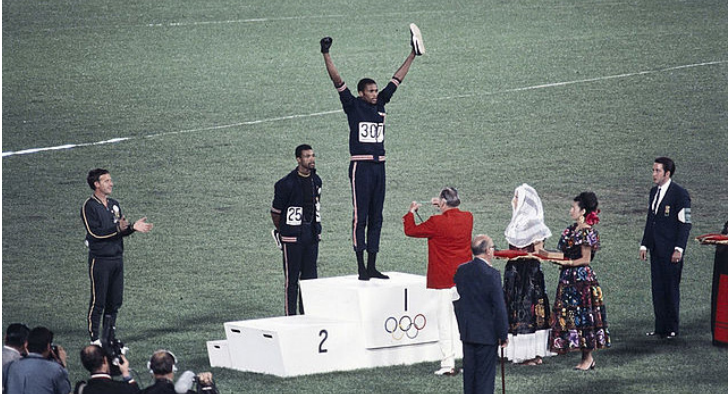
during the award ceremony of the 200 meter race at the Mexican Olympic Games. (Photo courtesy of Angelo Cozzi via Wikimedia Commons)
The Howard University Department of Athletics has implemented new pregame protocols requiring student-athletes to stand during the national anthem or remain in the locker room, according to women’s basketball associate head coach Brian Davis.
The decision followed the women’s basketball game against the United States Military Academy on Dec. 29, in which the team chose to kneel during the national anthem. The team has knelt at every game since 2020 in protest of social injustice.
Vice President of Athletics Kery Davis addressed the situation in a written statement.
“There have been thoughtful internal conversations between athletics leadership, coaches and student-athletes regarding pregame protocols. The current approach is about supporting our students’ freedom of expression while upholding mutual respect for all communities.”
Brian Davis said the women’s basketball program and its athletes understood the magnitude of playing the United States Military Academy.
He said players decided they still wanted to kneel during the game and that their intentions were not to be disrespectful. He added that the program as a whole has family members who served in the military.
“Our program has been kneeling since COVID, especially when all the social justice things were happening,” Brian Davis said. “All the young men and women Black of color [who] were passing away from the hands of police brutality, we decided to take a stand against social injustice.”
Brian Davis said kneeling is part of a movement the team has supported for years. He said the team discusses its values annually and gives players the option to participate.
“I think that their personnel kind of took it the wrong way and tried to take it somewhere where it wasn’t,” Brian Davis said. “We didn’t want to disrespect anybody. That wasn’t our intent. But if we did, we definitely apologized to them, and let them know where we stood with it.”
Under the new protocol, the women’s basketball team will now remain in the locker room during the national anthem for the remainder of the season to avoid controversy, according to Brian Davis.
“We don’t want to bring any bad light to Howard University, so we just decided to stay in the locker room now for every game, home and away and we will continue to do that throughout the rest of the season,” Brian Davis said.
Kneeling during the national anthem as a form of protest is not new at Howard. In 2016, members of the Howard University cheerleading team joined the social movement started by then-San Francisco 49ers quarterback Colin Kaepernick, who began kneeling to protest against police brutality and racial injustice towards African Americans in the United States.
Rather than standing with their hands over their hearts, the Howard cheerleaders took a knee in solidarity with the movement, drawing national media attention from outlets such as ESPN, CNN, Complex and BET.
Standing up for social movements and publicly protesting is a part of Howard’s history of student-led activism, with alumni and protest leaders organizing major demonstrations against university administration, housing crises and national social injustices.
Protests created by revolutionary leaders on campus include key figures such as 1960s activists Ewart Brown and Tony Gittens who led the first famous administration building takeover in 1968, as well as recent protests where students marched the streets of Washington to reject the current Trump administration and the U.S. Immigration and Customs Enforcement’s (ICE) presence within the community, resulting in the killing of Alex Pretti and Renee Nicole Good.
Junior goalkeeper Ireal Wyze-Daly, said the soccer team’s initial reaction to the news was shock. A meeting was held to discuss whether the team would stand in solidarity with women’s basketball or comply with the department-wide expectation.
“We were asked to hear our thoughts on it and just have a conversation about our opinions on how we would go ahead with supporting or not supporting women’s basketball if there were consequences or there weren’t consequences,” said Wyze-Daly, a human performance major from Trinidad.
He said some players were unhappy with the new protocol, while others were equally not as concerned.
“Personally, I don’t stand for the national anthem, I don’t really believe the messages within the national anthem,” Wyze-Daly said. “Also, not being American, it doesn’t really align with my beliefs or morals, considering the Black history in America and the oppression that has occurred.”
The soccer team voted to support the women’s basketball team and expressed disagreement with losing the ability to protest. However, he said the team will continue standing for the national anthem.
“If they can take away our right to protest, what else can they take away? I would never believe that coming to Howard, the biggest HBCU in the world, The Mecca, would basically be forced to bow down to the white oppressive system,” he said.

He added that players were told individual acts of kneeling could carry consequences for the entire department.
“They communicated to us that if one person kneeled or did not stand, or protested in some way, that the entire athletics [department] could suffer from it, and that’s over 500 student-athletes,” said Wyze-Daly.
Although he believes in protesting, Wyze-Daly isn’t willing to jeopardize team funding to do so.
“It wasn’t a threat; our coaches just gave us the consequence of what could potentially happen, and it was scary, and I think it’s important to consider other people’s opinions when you could directly affect them.”
Wyze-Daly feels disappointed and sad although he is not blaming Howard. He said HBCUs were created to provide a safe educational haven for Black students from around the world.
Kery Davis reiterated the athletic department’s position further in his statement.
“Howard University continues to encourage civic engagement, dialogue and advocacy in ways that align with our university’s mission of truth and service,” Kery Davis said. “Our foremost responsibility is to ensure that our student-athletes feel supported, heard and empowered.”
Brian Davis said the women’s basketball program is currently in the process of supporting other causes that are important to its players, as the team doesn’t want to silence its athletes’ voices, but rather encourage advocacy within institutional guidelines.
“We are going to continue to fight for injustice, we want to make sure that we stand on what we believe in,” Brian Davis said. “That’s one of the reasons why you come to Howard.”
He stated that due to protection reasons, the women’s basketball team is not allowed to comment on this topic.
Copy edited by Daryl R. Thomas Jr.