


Over the summer, Howard University students said they struggled under the pressure of having limited time to reduce their balances. Raven Troupe, a junior sports management major from Chicago said the possibility that the money she owed would be sent to collections was constantly on her mind.
“When I first found out, it was just like a little time bomb in the back of my head,” Troupe said.
On June 4, around 1,000 Howard University students received an email from the school warning them that overdue balances on their accounts would be sent to collections. With a deadline of June 30, these students were given 26 days to pay back the thousands of dollars many of them owed.
Four months later, it is unclear if their balances were actually sent off to the outside agency.
A collection agency is a company that collects debt on behalf of a creditor and its main job is to contact a debtor to pay the owed funds.
When someone has a collection account, it is considered a serious delinquency that can remain on their credit report for up to seven years, even after their dues are paid off.
Falating Nwagwu, a financial advisor for Leadwood Financial Services, said that having debt sent to a collections agency is an unfair practice because amongst all credit bureaus, a person will be then known as an “irresponsible creditor.”
“This is a systemic issue. This isn’t an issue that reflects on people’s willingness or ability to pay back their debts, like their student loans, it’s a systemic issue because the loans are predatory in nature,” said Nwagwu.
Nwagwu, who graduated from Howard in 2015 with a bachelor’s degree in business administration, said having student loan debt is just what happens in today’s society.
“Avoiding student loan debt is similar to avoiding school at this point. School is increasingly expensive,” he said. “…Some people were privileged enough to get school paid for them. Others had to take out a bunch of student loans and the government knows that…The student loan market is super predatory.”
Milan Moore, a senior psychology major from Richmond, Virginia, received an email from the Office of the Bursar in June informing her she had a balance of $4,800 from the spring 2025 semester. A hold was placed on her account which hindered her from preparing for her final year at the university, she said.
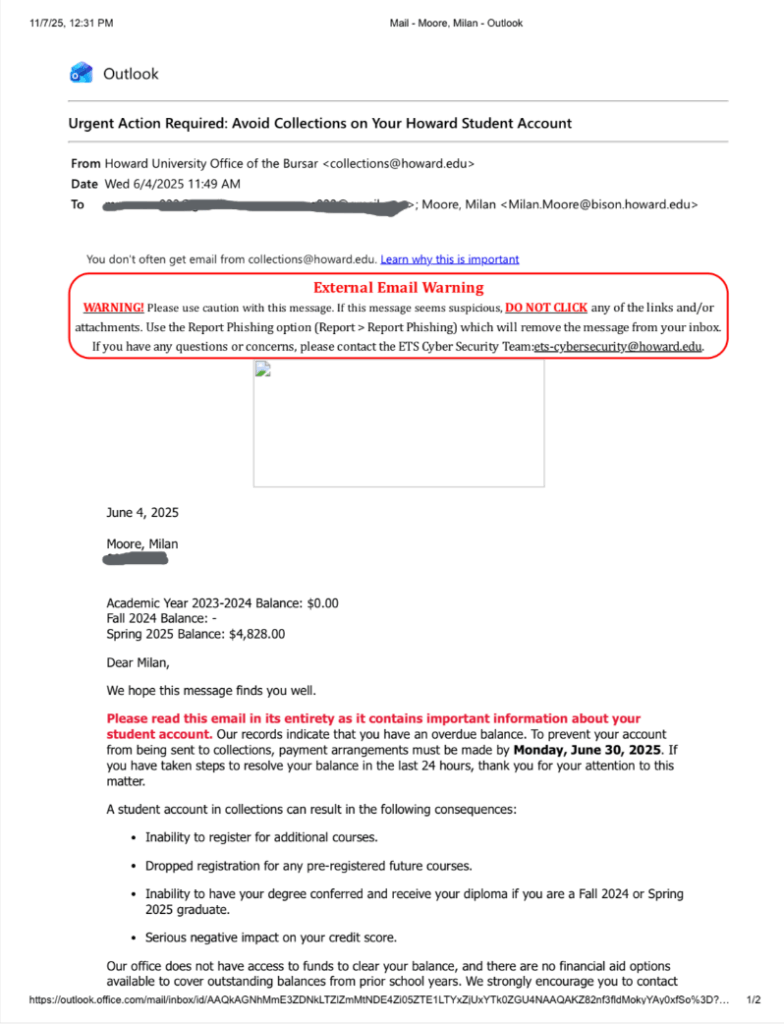
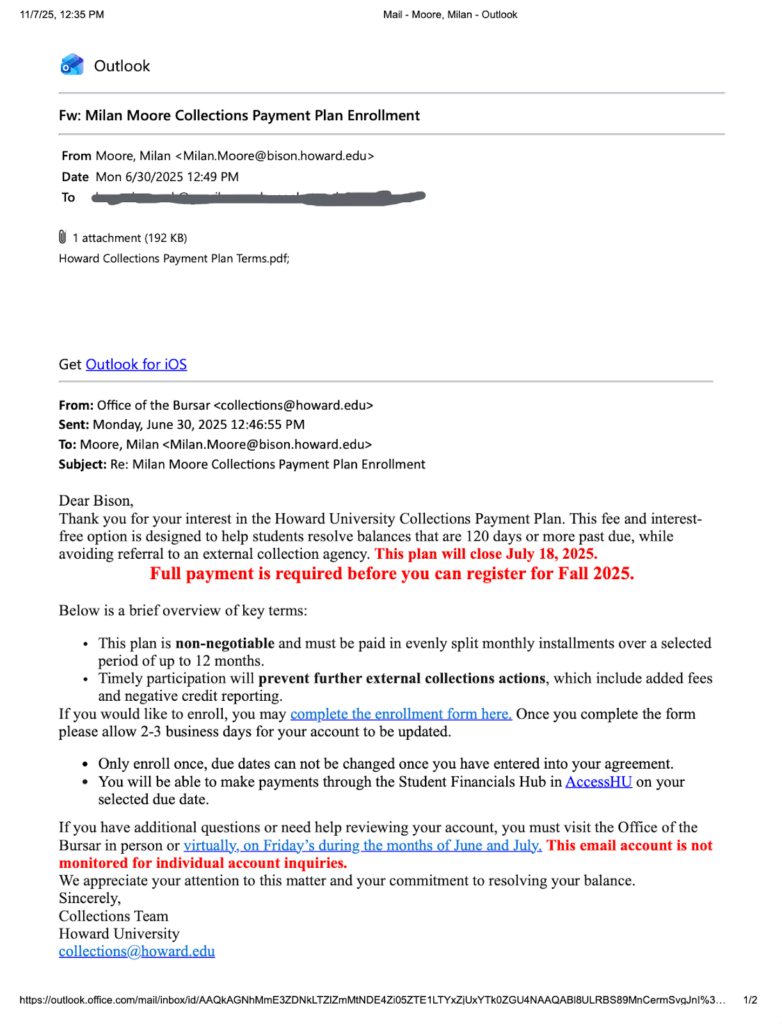
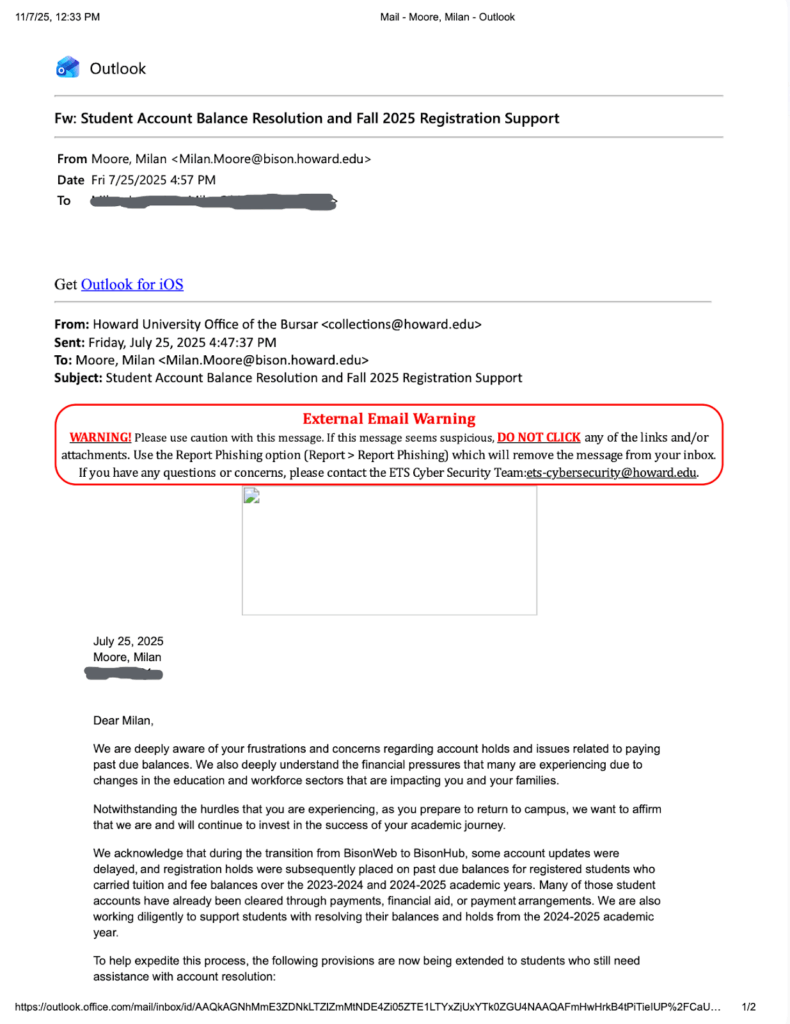
Emails received by Milan Moore from the Office of the Bursar informing her that she is at risk of her debt being sent to collections and offering a payment plan. (Documents provided by Milan Moore)
“They told me I had to make my payment arrangements by June 30 and that there was nothing the Bursar [Office] could do,” Moore said. “…I couldn’t register for classes, couldn’t get housing or anything for the upcoming school year until it was completely paid.”
Aiyanna Smith, a sophomore physics major from Houston, Texas, had a similar experience when she received an email two weeks before Howard’s registration for classes opened.
“I just got an email saying, ‘Hey, there’s been a hold placed on your account because your amount is not under $5,000, so you can’t register,’” Smith said.
She added that she was disappointed by Howard’s “expectation that people just have these thousands of dollars just sitting there ready to spend, to pay their tuition.”
Some students say they were aware of their balances, but were not aware of the limited time they would have to pay back their debt and the consequences that would follow if their balances were not reduced.
Brandon Black, a junior political science major from Chicago said he attempted to pay his bill through an external non-profit organization that provides college students with guidance and financial assistance but he did not receive the financial support he needed.
After this fall through, he said he was sent on the ‘Howard run around,’ attempting to get his bill paid off before any email about collections was sent. He said he acknowledges that everyone has to pay but wishes that there was some grace.
“I understand that as students we have obligations to pay those bills and I’m not negating that fact, but I do think it’s important to take note if you see a student trying,” Black said.
Heaven Upshaw-Peters, an elementary education major from Macon, Georgia, said she attempted to get a Parent PLUS loan — a federal loan offered to parents of undergraduate college students in paying for their education expenses — to aid her in paying her overdue balances.
Upshaw-Peters said she did not discover until it was too late that she could still take out federal loans if her parents didn’t get approved. Since she had applied for the Parent PLUS loan before being informed of her other options, she said it had already negatively impacted her family’s finances.

“There was already a hit on my mother’s credit score,” she said.
One option that was communicated to these students through the Office of the Bursar was a payment plan, but students, including Moore, said that it wasn’t flexible.
“[I] could either make a lump sum payment or [I] could split it into two. There were no options to do it over the course of a couple of months,” she said.
Moore made an initial payment of $2,400 so that she could enroll in a payment plan to prevent her debt from being sent to collections. In order to afford the second payment and remove the hold from her account, she started a GoFundMe. She said the support from her community allowed her to return to Howard this school year.
Despite students fighting to avoid their overdue balances being sent to collections, it is still unclear whether anyone’s overdue balances ever actually reached that point.
“I don’t even know if they ended up doing that,” said Moore.
After the deadline, all the students The Hilltop spoke with said they never received a follow-up email about balances actually being sent to collections and after multiple requests for comment, the university did not respond in time for publication.
After the possibility of collections began to gain traction on social media last summer, the Howard University Office of University Communications posted a statement on Howard’s official Instagram.
“Of the 1,000 students with holds on their accounts due to balances carried over from the 23-24 academic year and who were registered in the 23-24 and 24-25 academic years, half of those accounts have been resolved due to students’ payments, financial aid or payment arrangements, and holds are being lifted on their accounts,” the statement read.
After this statement, some people in the comments of the post were even more upset with the university. They said they felt as though Howard was taking credit for helping students who went completely unsupported as they struggled to manage their finances.
Robert Abron, a sophomore political science major from Atlanta said he has peers who are still trying to figure out how their bills will be covered because “this university does a terrible job advocating and supporting all students.”
As a low-income student, Abron has relied on a Parent PLUS loan and scholarships to afford Howard tuition.
“ I have no hope for the university to even support me if I did need the help,” Abron said.
While the university said some holds were being lifted, before then, students were still left trying to come up with thousands of dollars in such a short amount of time.
“There were so many people making GoFundMe’s and people on the Howard Facebook pages just asking for help. It just felt like the school wasn’t really trying to accommodate the number of people that needed aid,” said Moore.
Copy edited by Damenica Ellis