


In early June, Artavious Thompson, a junior psychology major from Memphis, Tennessee, received an unexpected email that his student account balance had nearly doubled overnight.
“At the end of the spring semester, I owed $6,329,” Thompson said. “But then I got an email on June 4 saying I owed $12,000 and had less than 30 days to pay it back.”
Thompson isn’t the only student facing a sudden, steep bill.
According to The Dig, a news hub created by the Office of University Communications (OUC), about one thousand students have experienced delays in their accounts due to Howard’s transition from BisonWeb to BisonHub.
In a statement to The Hilltop, the OUC said the university first became aware in February of “challenges with the transition of outstanding balances from BisonWeb to BisonHub.” Once identified, the university “began to communicate with students to ensure they were aware of their current balance” and issued email notices.
The original deadline for payment was June 30, 2025. After that, bills would be sent to an external collections agency, or a business that is responsible for recovering outstanding debts.
Howard’s Student Financial Responsibility Agreement stipulates that students would then be responsible for paying a collection agency fee, which could be up to “30 percent of [their] delinquent account.”
According to The Hechinger Report, collection agency fees can result in students owing thousands more than they initially did. This, in turn, pushes students deeper into debt, making it harder to pay bills on time.
Tiffany Tatu, a senior music history major from East Stroudsburg, Pennsylvania, stated that this situation has affected not only her finances but also her mental health and described the anxiety it has caused.
“My family and I have been very stressed about the entire thing,” she said. “I’ve had to consider either transferring or taking a semester off to pay off this balance so that I can actually go back to Howard.”
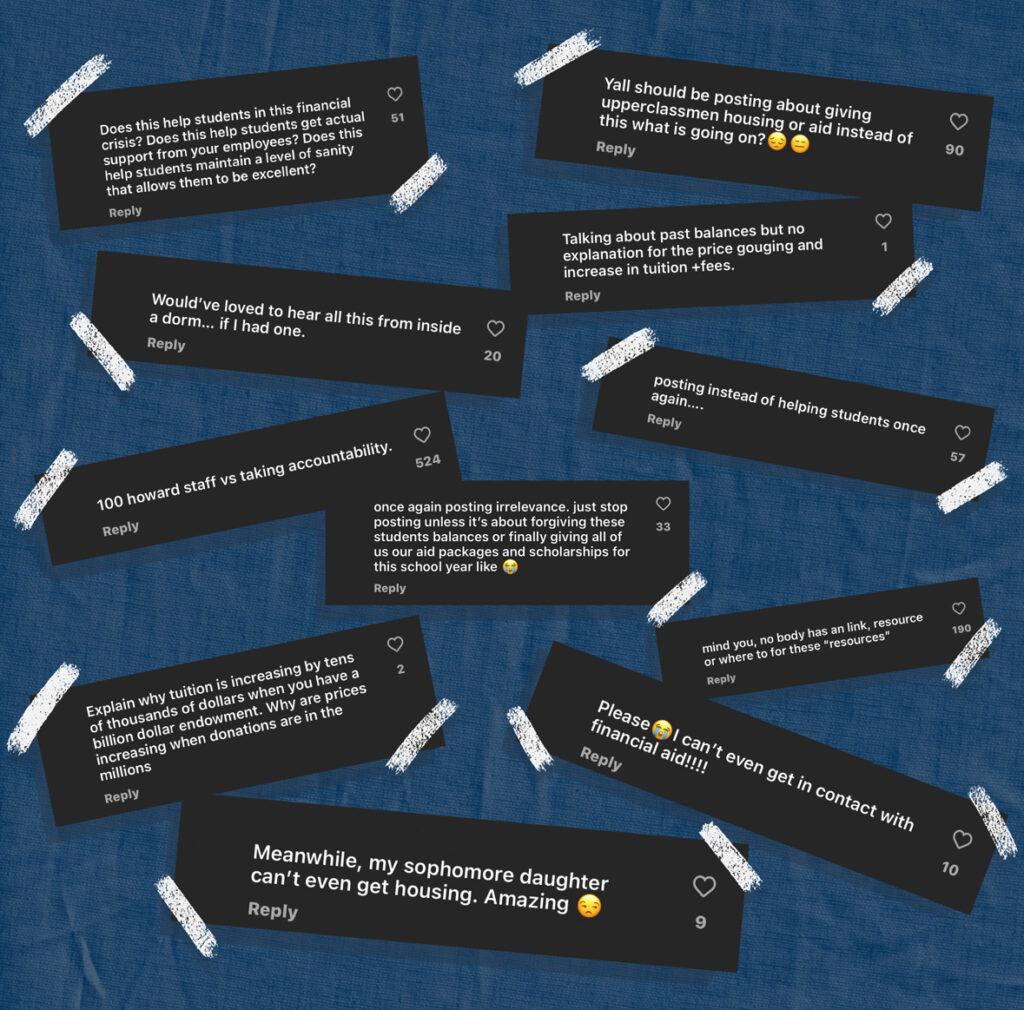
In response to the June 30 deadline, students took to social media to express frustration with Howard’s handling of the situation. Platforms such as TikTok and Instagram flooded with posts from students criticizing the university’s financial management. Bijou-Elyse Wallace, a junior political science and criminology double major from Springfield, Massachusetts, posted an Instagram story stating that Howard is “for the Black community that can afford to continue to be on their bankroll.”
Wallace told The Hilltop that this incident is not out of the ordinary.
“This is not the first time something like this has happened to me,” she said, citing to this day an undispersed refund check and a housing bill that was only posted on its due date. Wallace also said that during her freshman year she dealt with billing inconsistencies when her family paid her balance but later found out that she owed more than what was previously communicated. Other students commented on Howard’s official Instagram page, using hashtags such as “#pushingouthepoor” and “#showusthenumbers.”
Student organizations also spoke out. “New to the Mecca,” a student-run group that reports on Howard-related news, posted a statement on Instagram on behalf of several freshmen organizations, including Gentlemen of Drew Social Club, Ladies of Quad Social Club and Men of George Washington Carver. The statement criticizes the university’s handling of the issues and calls for increased effort in the future like acknowledging harm caused by the university to students, establishing clearer timelines and collaborating directly with student organizations.
“This is not the Howard we were introduced to,” the statement read. “As freshman organizations, we span every major, every city, and every class year, and we are united in saying: THIS IS UNACCEPTABLE.”
Devon Selmon, president of New to the Mecca and a senior African American studies and criminology double major from Minneapolis-Saint Paul, Minnesota, further explained the group’s stance.
“The way Howard handled the situation is unacceptable,” Selmon said. “We all recognize that it costs to go here. However, the least that the school could do is give us the right tools and support to make sure that we can figure out how to afford it.”
Selmon emphasized the impact on students with less resources.
“It pushes out those students that are from lower-income families, or those students that are first generation, or those students that don’t have the support of family members,” he said.
Ubiquity, an Afrocentric student-run organization, made an Instagram post on July 24 expressing dissatisfaction with Howard and providing emergency funding and affordable housing opportunities to students. “We are beyond disappointed that our beloved institution’s continuous lack of communication and preparation has left our fellow Bison unable to return to campus and without housing, yet again,” the caption of the post read.
A student coalition called “Whose Howard Is It?” was formed, calling for increased financial aid, more student involvement in decision-making, better communication and the resignation of Cynthia Evers, senior vice president of Student Affairs, and Lydia Sermons, vice president and chief communications officer.
“This is not how our HBCU should respond, not in this political and economic climate, where minority communities are under constant attack,” read a July 19 post from the student group.

Students have also used social media to raise money to continue their education. The “Whose Howard Is It?” account links to student GoFundMe pages in its bio; several have raised thousands.
On July 23, Howard posted a statement on Instagram from the OUC saying that the university is “working to ensure” that all holds on student accounts are resolved “prior to the start of the academic year.”
Two days later, they sent out a mass email with an updated statement.
“Howard University remains dedicated to addressing financial challenges impacting student accounts,” the email read. “More than half of [the accounts affected] have been resolved… we are actively working to resolve all remaining concerns.”
According to the email, Howard has extended its payment plan enrollment to allow students with overdue balances to join a payment plan in place of immediately paying the amount owed. Now, once they have submitted a payment plan, students with balances at or below $5,000 are able to register for classes and secure housing, while those with balances above $5,000 are “encouraged to submit plans for individual review.”
Students on active payment plans will not be referred to collections, and the Bursar and Financial Aid offices will offer extended hours and additional staffing.
But students say the problem goes beyond billing accommodations. They point to the rising cost of attendance: since 2022, the estimated cost of attendance for an on-campus undergraduate rose by more than 22 percent, to $64,142. Per Pew Research Center data, that is more than $10,000 higher than the median household income for African Americans in 2023.
Thompson stated that the additional funding doesn’t seem to be benefiting the student experience. “Where are the funds going?” he said. “With how much money we pay, we should be getting more resources.”
Students say institutional financial aid has not kept pace with rising costs; some report decreases in aid. “They canceled about $5,000 of my aid,” Thompson said. “If you’re going to keep increasing tuition, why isn’t the financial aid increasing too?”
Tatu agreed, saying, “Every semester they’re asking for more and more money, but they’re not offering enough financial assistance to accommodate for it.”
“It puts students in a really hard position, especially if they’re an upperclassman and just trying to graduate,” she added.
Howard’s Office of University Communications said the university provides more than $210 million in institutional aid annually. In their statement to The Hilltop, they also said that the Tuition and Aid Working Group, a task force geared towards strengthening both “financial literacy” and students’ “ability to afford a Howard education,” is evaluating financial programs and support for students.
OUC did not elaborate on who the task force consists of or what programming is being evaluated.
Students say that there is still work to be done.
“Howard needs to do a better job supporting low-income students,” Wallace said. “Right now, it feels like the people we are in direct contact with do not care about what students and parents are going through.”
Thompson and Tatu agreed.
“Every university has their problems, but I feel like the lack of actually taking accountability is why we’re in the place we’re in right now,” Thompson said. “There would be no social media outrage if there was nothing to be outraged about.”
Tatu said she believes the university lacks communication skills and support, “because even when I went to the financial aid office for help, I was just told, ‘Well, you better get started working on that $4000.’ I wasn’t given any resources or anything like that.”
Thompson, Wallace, Selmon and Tatu all called on the university to take accountability, include student voices and provide more resources to students.
Selmon identified three things that the university can do to accomplish this: acknowledge the harm to students, make timelines and notifications for billing clearer and provide support to the student organizations that are already “mobilizing and doing outreach.”
“We’re not being properly represented as a student body,” Thompson said. “Students need to be advocated for properly when decisions are made.”
Tatu addressed the need to create additional forms of support for students, saying, “Even if they don’t have the money, I feel like there needs to be more outreach on outside resources that they could use to help students.”
Wallace demanded that less responsibility be put on students’ shoulders. “This shouldn’t fall on students to manage,” she said. “For the future, I want Howard’s administration to prioritize communication, provide clear timelines for billing and refunds, and create real accountability measures.”
Copy Edited by D’Nyah Jefferson – Philmore