

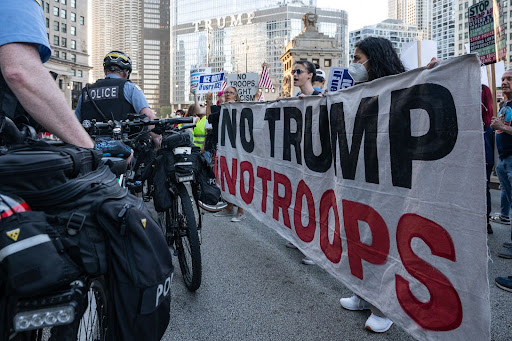
The Trump administration has increased the use of militarized approaches in U.S. governance, including extended National Guard deployments, federal policing and surveillance in major cities such as Washington, D.C., Memphis, Tennessee and Chicago.
Militarism, defined as the growing adoption of military-grade equipment, tactics and training by law enforcement to gain power, has begun to reshape law enforcement, with government agencies such as the National Guard adopting this aggressive and confrontational style of policing.
In Oct. 2025 border patrol agents released tear gas on a crowd of protestors in Chicago’s southside following a high-speed chase, demonstrating an excessive use of police force. National Guard soldiers train for combat with potential civilian threats and crowd control without formal education on citizens’ rights and deescalation.
This reliance on force and intimidation to maintain order has raised public concern that the country is drifting toward a fascist-like system, in which power is centralized under a dictatorial leader and opposition is forcibly oppressed.
Professors such as Stanford University’s Larry Diamond, declared that the threat of facism is back in the U.S.. Diamond notes that, in the 20th century, elected officials capitalize on political division and diminish public confidence in authority in the 20th century, echoing patterns seen in the 1930s.
On Aug. 11, President Donald Trump declared a crime emergency in Washington, D.C., and issued an executive order invoking Section 740 of the District of Columbia Home Rule Act to federalize the Metropolitan Police Department (MPD).
Subsequently, Trump authorized the deployment of approximately 800 National Guard troops to support law enforcement operations by patrolling areas across the capital, such as the National Mall and Union Station.
The Trump administration said the deployment was a necessary measure to restore order, despite a declining crime rate.
Civil rights groups, including Human Rights Watch, argued that military involvement in civilian societies is dangerous and unwarranted, particularly in cities with predominantly minority populations. The organization cautioned that such actions heighten tensions and divert resources away from essential community services.
“As we have seen around the world, military takeover of local law enforcement is a harbinger of authoritarianism,” said Tanya Greene, U.S. program director at Human Rights Watch.
Since then, Trump intensified federal law enforcement operations in Chicago, issuing an executive order Oct. 6 titled Department of War Security for the Protection of Federal Personnel and Property in Illinois.
The order federalized 300 Illinois National Guard members and dispatched 400 troops from Texas to assist in immigration enforcement operations in Chicago. The Trump administration cited escalating violence and obstruction of federal operations with relation to deportation efforts as justification for the deployment. The federal action has sparked widespread controversy. Illinois Governor J.B. Pritzker and Chicago Mayor Brandon Johnson filed a lawsuit to block the deployment, claiming that it undermines local authority and violates constitutional rights.
Former Illinois Representative and adjutant general of the Chicago National Guard, Major William Enyart, has voiced his disapproval of the growing use of deployments to fight domestic crime. Earlier this month, Enyart testified before the Senate Judiciary Committee to dispute Donald Trump’s National Guard deployments.
“Every dollar spent deploying the National Guard for a job that can be performed better and at a lower cost by civilian law enforcement is a dollar that cannot be spent on training and preparing these soldiers for their critical missions defending the country and responding to natural disasters,” he said.
The National Guard does not receive training in de-escalation, gathering evidence for investigation or criminal investigation. Traditionally, the Guard has responded to domestic events such as national disasters, the COVID-19 pandemic, anti-racism protests and international U.S. military operations. Most notably, three days after Hurricane Katrina ravaged New Orleans, 23 states sent over 51,000 combined troops to the area.
Enyart added that the recent deployments have hidden costs on the soldiers’ lives.
“Soldiers are not signed up to be cops,” Enyart said. “These are part-time soldiers who have jobs; they’re teachers, lawyers, farmers and shopkeepers. For most people, the wages they make in the National Guard are less than what they make working.”
Soldiers who joined the Guard to respond to natural disasters or defend the nation, Enyart expressed, are sacrificing pay and family time to perform city maintenance tasks such as picking up trash and laying mulch.
Enyart claims that Trump is using the National Guard to divert attention from economic fallout over recent tariffs, growing speculation about ties to the Jeffrey Epstein files and to normalize heavy militarization in civilian spaces.
Concerns about militarization continue to grow as the White House deployed the Tennessee National Guard to the state’s second-largest city, Memphis, earlier this month.
The guard is slated to “support public safety and law enforcement operations in Memphis” along with the federal “Memphis Safe Task Force” established in a White House memorandum last month. The federal task force aims to decrease crime in Memphis through heightened policing, prosecution and criminal investigation against gangs and criminals.

Leila Chambers, a freshman computer science major and Memphis native, said she is skeptical about the increased federal presence in her hometown.
“I don’t think it’s very effective,” said Chambers. “I don’t think incriminating people and putting them in jail is effective in general. If anything, reforms are more effective at keeping Black men out of jail and the criminal justice system.”
National Guard deployments in Washington, D.C. cost taxpayers over $1 million per day, so Memphians such as Chambers have argued that taxpayer money should, instead, fund long-term crime prevention efforts such as youth programs and criminal justice reform.
As Memphis jails overflow, including 201 Poplar, citizens are demanding long-term solutions to stop crime before it presents, not afterwards.
As the White House deploys the National Guard to more states, some citizens argue that this increased militarization is not a short-term effort to decrease crime but rather the beginning of an authoritarian rise in the United States.
Professor Clarence Lusane, chair of the International Affairs Department at Howard, spoke about what increased militarization means for the political landscape.
“What the White House is doing has absolutely nothing to do with crime prevention. This is an effort on the part of Donald Trump and people around him to increase their autocracy and their power,” he said. “This is authoritarianism; even though Donald Trump was elected to office in a democratic fashion, they are very rapidly acting in anti-democratic ways.”
This trend towards authoritarianism, according to Lusane, transcends militarization of the country and sending troops to different cities — it also includes Trump’s attacks on media, law firms and universities.
For young people navigating this shifting political landscape, Lusane reminds students that individual engagement matters.
“Politicians that carry out public policy can be impacted and can be influenced by what you do as an individual,” he said. “Whether it’s voting, donating to a campaign, participating in a protest or demonstration, or making phone calls, there are many different avenues to make an impact.”
Copy edited by Damenica Ellis