

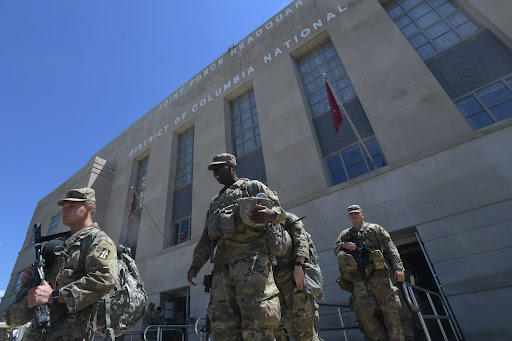
President Donald Trump announced on Aug. 11 that he would deploy the National Guard to Washington. The National Guard is expected to occupy the city and control the Metropolitan Police Department (MPD) for 30 days, sparking protests and city-wide opposition.
In a press conference with Attorney General Pam Bondi and Secretary of Defence Pete Hegseth by his side, Trump invoked section 740 of the District of Columbia Home Rule Act— Emergency Control of Police. Section 740 enables the President to utilize the MPD for federal purposes when “special conditions of an emergency nature” are present.
The Trump administration has seized federal control of the nation’s capitol under the guise of “restoring public order and safety.” An article by Newsweek describes this as one of the most aggressive federal interventions in local law enforcement in recent history.
“I’m announcing a historic action to rescue our nation’s capital from crime, bloodshed, bedlam, and squalor, and worse. This is liberation day in D.C, and we’re taking our capital back,” Trump declared.
A White House fact sheet lays out its plan to mobilize the District of Columbia National Guard to “address the epidemic of crime in the Nation’s Capital.” The document alleges that Washington D.C., has been under siege of out-of-control violent crime, seemingly ignoring the fact that violent crime is actually on the decline.
According to the MPD, violent crimes in 2025 are down 26 percent from 2024, and the United States Attorney’s Office for the District of Columbia reported that violent crime hit a 30-year low in 2024.
Following the president’s breaking announcement, MPD’s Chief of Police Pamela A. Smith joined Washington, D.C. Mayor Muriel Bowser for a news conference. Bowser described the deployment as unprecedented, but not surprising.
“While this action today is unsettling and unprecedented, I can’t say that given some of the rhetoric or the past, that we’re totally surprised,” Bowser remarked.
When asked to what degree the city would cooperate with the federal occupation, or if there were plans or legal efforts to resist the deployment, Bowser said that the city is planning to comply, citing the Home Rule Act.
“In the case that there is a declared emergency, it allows the president to make those requests, and it says that the mayor shall comply with those requests,” Bowser said.
Bowser then opened the podium to Chief Pamela A. Smith, who echoed Mayor Bowser’s plans to cooperate with the federal government. Smith said that her role was to work collaboratively with federal partners.
According to Smith, the efforts of federal law enforcement began in Washington on the night of Aug. 7. A day before the Aug. 11 conference, Smith spoke with the director of the U.S. Marshal’s Office, who was overseeing the operational component of the deployment.
“In that conversation, it was very important for me to ensure that not only do we work collaboratively with our federal partners, but we offer up areas across our city where we can work with them in areas where we want to reduce crime,” Smith said.
Smith added that there will be more intense planning efforts to allocate resources.
Trump’s implementation of Section 740 has drawn attention to Washington, D.C.’s lack of governmental autonomy. Since Washington, D.C. is not a state, it does not have control of the National Guard or Congressional representation.
“My message to residents is this: we know that access to our democracy is tenuous. That’s why you have heard me and many Washingtonians before me advocate for full statehood for the District of Columbia,” Bowser said.
Trump’s agenda to “clean up Washington,” has repeatedly targeted homeless individuals. In 2023, Trump claimed that Washington D.C. had been “surrendered to the homeless.” Recently, in an Aug. 10 recent post on Truth Social, Trump called for the removal of homeless people.
“I’m going to make our Capital safer and more beautiful than it ever was before. The homeless have to move out, IMMEDIATELY. We will give you places to stay, but FAR from the Capital,” Trump said.
Amidst the federal takeover, encampments for the unhoused are being cleared out.
Pushback against the federal occupation
In response to Trump’s historic crackdown, demonstrators took to the streets as part of the “Free DC” rally and press conference on Aug. 11. Free DC is a movement that advocates for D.C. residents’ right to self-determination and self-governance. In accordance with its mission, Free DC contends: “DC is our home, Trump can’t have it.”

On Aug. 13 protestors gathered around a federal check point on 14 Street and chanted “get off our streets” at officers that occupied the street.
Aside from physical protests, civil rights and social service organizations have outwardly condemned the federal takeover.
The American Civil Liberties Union of Washington, DC (ACLU DC) released a statement attributed to Executive Director Monica Hopkins, which criticized the deployment of the National Guard as a “phony justification” for abusing emergency powers.
The statement says that Trump’s actions indicate an overarching agenda of “federal control” over majority black and brown cities in America.
“The president foreshadowed that if these heavy-handed tactics take root here, they will be rolled out to other majority-Black and brown cities, like Chicago, Oakland and Baltimore,” Hopkins said.
Alicia Yass, the Supervising Policy Council for the ACLU DC, similarly expressed that this is not solely a Washington D.C. issue. She stated that Trump’s desire to roll out federal tactics in other black and brown cities should alarm everyone.
“We are seeing that D.C. is just the next step in the president’s plan to attack Black and brown majority cities. We need to recognize that the president is targeting communities that he does not respect or support,” Yass said.
Likewise, in an immediate press release, the DC Appleseed Center for Law and Justice characterized Trump’s actions as “profoundly undemocratic.”
“This executive action taken today reflects the current administration’s drive for power and control versus a genuine need to improve local safety in the district,” according to the statement.
Safety Concerns
The DC Appleseed Center for Law warned that National Guard intervention will create more danger for Washington D.C. residents because federal law enforcement officers are not trained for local law enforcement.
When asked what measures residents can take to navigate a federalized Washington D.C., Yass emphasized the importance of people exercising their constitutional rights.
“You still have the right to remain silent, ask if you are under arrest, or ask if you are free to leave. The national guard is not trained as law enforcement so people need to exercise caution and protect their own safety,” Yass said.
Howard University has also responded to the deployment, issuing a campus-wide safety advisory on Aug. 12.
In a letter from the university’s Department of Public Safety, officials warned students and faculty of the increased presence of federal law enforcement and the D.C. National Guard throughout the city.
“The White House has also enacted an executive order to increase the presence of federal law enforcement officials in the city and a federal takeover of MPD,” the statement reads.
“We encourage everyone to make safe choices and steer clear of situations or activities that could result in adverse encounters with law enforcement personnel.”
The message urged students to remain vigilant, avoid dark or isolated areas and comply with law enforcement directives. It also reminded the Howard community of the university’s safety resources, including the Bison SAFE app and the POM safety devices, and highlighted available mental health services for students, faculty, and staff.
Howard’s public safety team emphasized that while they work closely with MPD, there are “many other federal law enforcement agencies operating outside of our campus,” underscoring the expanded law enforcement presence beyond the university grounds.
Regarding the issue of crime and public safety, Yass offered alternatives to law enforcement enforcement in keeping the community safe.
Yass championed the Office of the States Superintendent of Education (OSSE) Child Subsidy Program, which allows parents to work and provide for their families, along with the Attorney General’s Restorative Justice Program, which has reduced re-offending by 15 percent.
“It’s been proven time and time again that building up communities is what makes them safer. Allowing people to have economic security, good education, and pathways to stable jobs are all necessary for building up the community,” Yass said.