

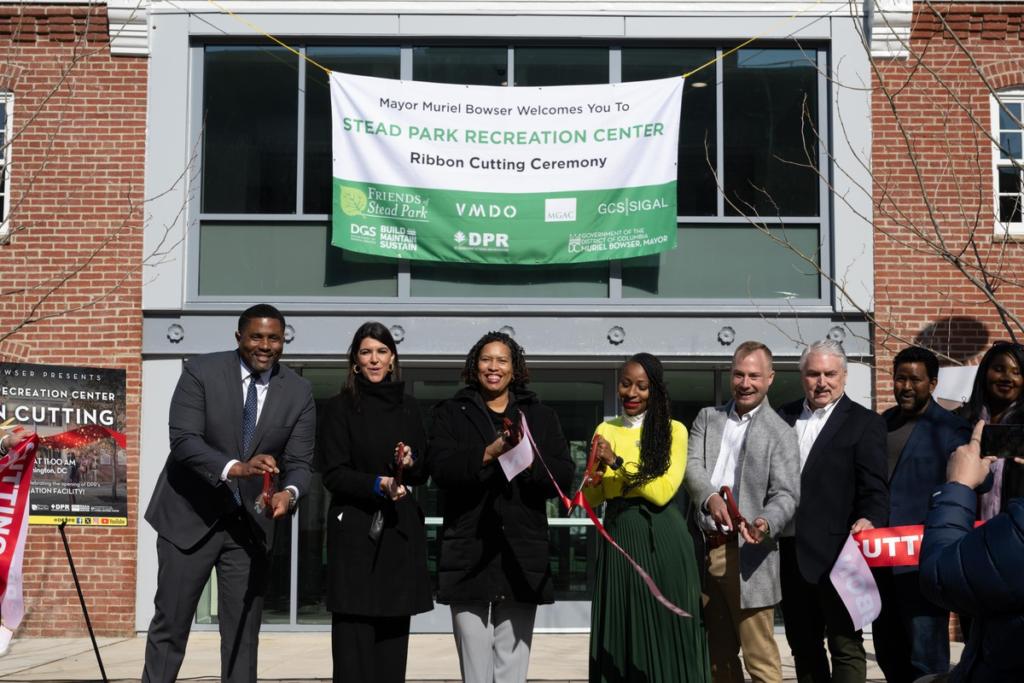
Last Thursday marked the grand opening of the Stead Park Recreation Center in Ward 2, the first net zero recreation center in D.C. and part of a movement toward increasing the number of net zero buildings.
With a budget of $15.4 million, this project began in 2017 through a generous contribution from the District to Stead Park, supplemented by a half-million dollar grant from the nonprofit community member group, Friends of Stead Park. The recreation center features traditional facilities and amenities, including a playground, basketball court, fitness center and splash park.
“Projects like this are good news for the environment, good news for taxpayers and builds on Stead Park’s legacy of serving residents of all ages,” Mayor Muriel Bowser said via X.
Director of D.C. Department of General Services Delano Hunter told NBC Washington that Stead Park will achieve its net zero goal through a solar canopy and geothermal wells, which will allow for the park to function completely from energy produced on site.
As part of the District’s goal to reduce carbon emissions, Stead Park joins the ranks of nearly seven public schools that have attained net-zero status, with numerous additional environmentally conscious development projects underway.
Stead Park, overseen by the D.C. Department of Parks and Recreation (DCR), receives partial financial backing from a private trust established by Robert Stead. Stead Park consists of a playground, a multi-use playing field, basketball courts, picnic areas, a splash park, a performance stage and indoor recreation facilities.
“This was really a community-driven effort to make sure that Stead Recreation Center is really most responsive to what this neighborhood and what the city really needs, which is access to excellent, safe recreation space,” D.C. Ward 2 Councilmember Brooke Pinto told NBC Washington.
“With all of the problems facing the youth today, one of the main problems people overlook is climate change,” Hampton University alumna and Ward 2 resident Melanie Kee told The Hilltop.
“I love to see money being spent to give kids a safe place where they can advance their social and educational development, while also helping the environment to ensure those same children will have a community in the future,” Kee said.
Robert Stead, a distinguished architect, died in 1943 and in his will, he specified that a charitable trust be established for the purpose of creating a playground for children of Washington, D.C. This vision culminated in the vision of Stead Park in the 1950s, following Robert Stead’s request to honor his late wife, Mary Force Stead, through the development of a playground.
The Mary Force Stead Playground officially opened on Nov. 12, 1953, in a ceremony attended by District officials, members of the Stead family and 400 neighborhood children. The joyous occasion marked the realization of Robert Stead’s altruistic idea and emphasized the importance of providing recreational spaces for the community’s youth.
Stead Playground emerged as part of a collaborative effort between the National Capital Planning Commission (NCPC), formerly known as the National Capital Park and Planning Commission (NCPPC), and the creation Board during the 1940s. This joint initiative aimed to address recreational facilities in neighborhoods grappling with high rates of juvenile delinquency, highlighting the pivotal role of accessible playgrounds in fostering community well-being.
Copy edited by D’ara Campbell