

A South African flag waved high in the air and moved down the runway. It was an introduction to the stage, and it was one out of nine displays of unity in African cultures.
For Fatima Mncube-Barnes, Ed.D., South Africa was not simply one of the nine countries represented on the runway, it signified home.
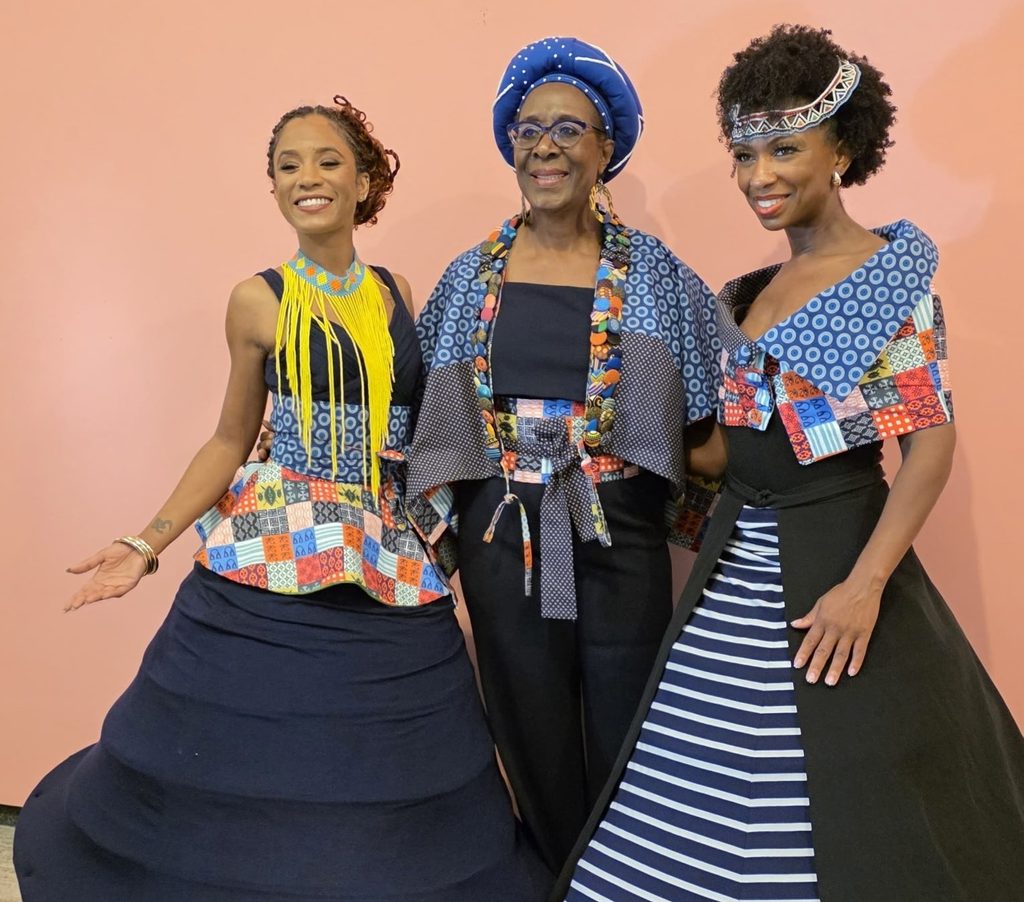
Mncube-Barnes, the executive director of Howard University’s Louis Stokes Health Sciences Library, brought her South African heritage to the inaugural Pan-African Fabric & Fashion showcase at the Smithsonian National Museum of African Art on Saturday. The showcase brought together nine designers representing nine African countries, each interpreting The Pan-African Fabric, a contemporary textile created by visual artist and creative director, Shiri Achu.
Mncubes-Barnes’ design, titled “Classy Funky,” highlighted the Basoho people of Lesotho through a fancy shawl, peplum skirt and a matching belt. She paired the garments with shweshwe, a cotton fabric rooted in Southern African culture, alongside Achu’s textile. For her, fashion has become another form of education.
Since joining Howard in 2016, Mncube-Barnes has worked in higher education while continuing to share South African culture through events, such as Juneteenth or through Heritage Day. Her academic background in instructional design and technology also influenced her interest in fashion.
“I always want to showcase traditional outfits of the 11 official languages of South Africa,” Mncube-Barnes said.
Her participation in the showcase began with her relationship with Achu, who she met in D.C., when Achu hosted South African musician and orator Jessica Mbangeni for a Freedom Day event at the South African Embassy.
Achu’s Pan-African Fabric Initiative eventually gave Mncube-Barned another opportunity to connect her cultural identity with her creative work. Achu distributed the fabric to representatives of African Embassies in Washington, D.C. encouraging them to create designs connected to their countries.
The project began with a color palette Achu created in 2023, which had 12 colors. It started with her wearing a shirt of a color from the palette each month. From there, the idea grew into a textile incorporating cultural symbols from different regions of Africa. Achu said she researched symbols and the traditions across the continent, selecting imagery she believed would be recognizable to people from different African cultures. The finished textiles became shared between the designers with their different cultural backgrounds.
“It just so happened that it was nine,” Achu said when asked how the project came to involve nine countries. “It’s just how it landed.”
Rather than producing identical interpretations, the designers transformed the same fabric through their own cultural perspectives.
Afua Sam, a Ghanaian designer, whose collection was titled “Threads of the Invisible Hands,” used jute fabric, a durable and sustainable natural textile made from the jute plant, to honor farmers and market women. She paired the material with braiding which she said referenced the idea of a crown.
“I want to show people that African fabrics can be worn in different ways,” Sam said.
The different interpretations were part of what stood out to Achu after watching the designs come together on the runway. She said that she was particularly moved when the designers and the models all walked out at the end together, collectively.
“Everybody had their own interpretation, which was beautiful to see,” Achu said.
For Andromeda Osama-Peters, Miss Universe Ghana, the flags were one of the most memorable parts of the showcase. Osama-Peters, who is from Cape Coast, Ghana, said she felt especially connected to the event after discovering that she and Sam were related through their grandfathers.
“It felt special, because I felt like I was walking not only for Ghana,” Osama-Peters said. “Being Miss Universe Ghana is like I carry Ghana with me in every space I go into.”
Seeing the flags come out for each country before the designers came together was for her, “peak inspiration.”
“You don’t see representation everywhere,” Osama-Peters said. “But to be in a place that’s not just celebrating Ghana, but so many other African countries, it’s one Africa.”
For Mncube-Barnes, that same connection is reflected in the meaning behind her design.
South Africa is often described as a “rainbow nation,” she said, and her design was intended to represent African unity and hope for peace across the continent. But she also sees her clothing as an opportunity to teach.

“I would want to leave a Howard student who sees my designs to be left with a great understanding of Indigenous languages and cultures that were suppressed during apartheid,” she said.
On the runway, the clothing represented South Africa, and off of the runway, Mncube-Barnes sees it as another way to share the history and traditions she carries with her.
The afternoon showcase continued into an evening cultural reception, hosted by the Embassy of the Republic of Cameroon, bringing designers, cultural representatives and diplomats together to celebrate the show.
For Achu, the day ultimately came back to the same idea represented when the flags were first shown on the stage, one by one. The different stories, and the shared space.
“When you leave the flags behind and you come together as a whole collective, that’s what this is,” Achu said.
Copy edited by Jori Johnson