

With each iteration of generative artificial intelligence (AI) models, speculation of achieving artificial general intelligence (AGI), or AI capable of performing a broad range of cognitive tasks at a level comparable to domain skilled humans, quickly spreads. Yet, the hype often quickly fades.
We’ve seen this recently, this month, with OpenAI’s release of GPT-6 Astra, its newest frontier model. The company claims that it outperforms previous models, including GPT-5 and Claude Fable 5, across various benchmarks.
As impressive as it might seem, it doesn’t align with our common description of AGI. However, I believe this period before we achieve AGI is valuable. We still have an opportunity to establish the policies, regulations and guardrails necessary to prevent the dystopian future we fear from becoming reality.
A useful definition of AGI, according to a framework developed by Google DeepMind researchers, rates AI systems within performance tiers. What we describe as AGI is actually the framework’s “Competent AGI” tier, a threshold at which a large-language model can perform a wide range of cognitive tasks at least as well as the average skilled human. No public AI system has reached this tier yet.
With this framework in mind, we can easily look at today’s available models and determine whether they satisfy this requirement. Frontier models are “Competent” in some fields like coding and short essay writing, but don’t meet that standard for others unless heavily specialized, which is why AGI, by this definition, is not here.
Push this a step further by considering artificial superintelligence (ASI) — models capable of outperforming the top 1% of skilled humans across a wide range of tasks under the aforementioned framework. If AGI is far-off, this gap between models of today and ASI seems massive. But what if it isn’t?
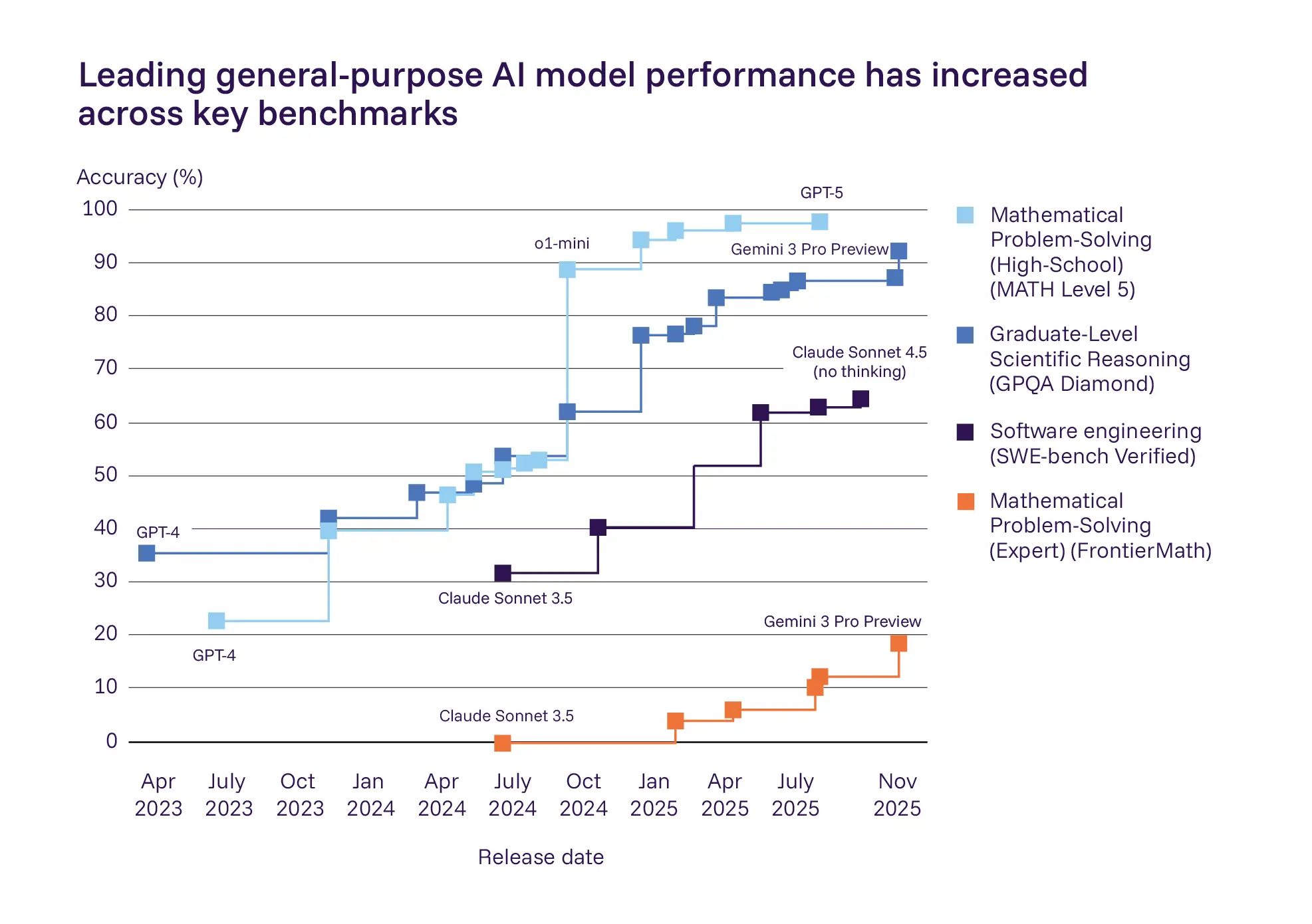
The major concern is that we may be closer to that AGI threshold than we realize. These systems have continued to improve their capabilities and architecture year after year. And once they cross that threshold, there may be no turning back.
AGI could eventually lead to ASI through recursive self-improvement, in which AI systems help develop the next generation of models, which then improve upon the generation after that. The rapid progress of today’s narrower AI systems suggests that we may be moving closer to conditions that could make this possible.
An example came with OpenAI recently claiming it had solved a Navier-Stokes Millennium Prize Problem, part of a sequence of fluid dynamics problems that have gone unsolved by mathematicians for more than a century. Their solution has not yet been verified by the Clay Mathematics Institute, which oversees the problem, but this feat does display how far the capability of this technology has come.
The concern is not limited to people outside the industry. Some of the people building these systems are also worried about where this trajectory could lead.
Jacob Coxon, a former Anthropic and OpenAI pretraining researcher, posted on X that the people building AI “earnestly believe it could kill us all by the end of the decade.”
I think that scenario represents the extreme end of the risk spectrum. But even if we never reach that point, there could still be grave consequences: weapons and cyberattacks, extreme income inequality and centralization of power if AI development continues at its current pace without meaningful regulation or oversight.
As AI becomes better at routine cognitive work, education may need to place greater emphasis on skills that remain difficult to automate, including judgment, collaboration, creativity and ethical reasoning. At the same time, it could become economically viable for companies to replace large portions of their workforce with AI, from entry-level positions to the C-suite, with models tasked primarily with maximizing shareholder value.
Anthropic CEO Dario Amodei made a similar argument in his Sept. 12 essay, calling on AI companies to “pace the frontier” and slow the rate at which the technology advances.
AGI is not here yet. But if current progress continues, it may not be far away. That gives us something we rarely have when confronting technological change: time. We still have an opportunity to decide what role AI should play in our economy, establish protections for workers and build guardrails before technology forces those decisions upon us.
Copy edited by Sydney Middleton