

A woman walked across the room with her hips leading the way.
Around her, participants followed, shifting their bodies. Some were moving confidently and others laughing as they figured out exactly what they were supposed to be doing. Every few moments, a laugh broke out from somewhere in the circle at the acting prompts. Someone exaggerated a movement. Others committed to it even harder, fully taking on the characters.
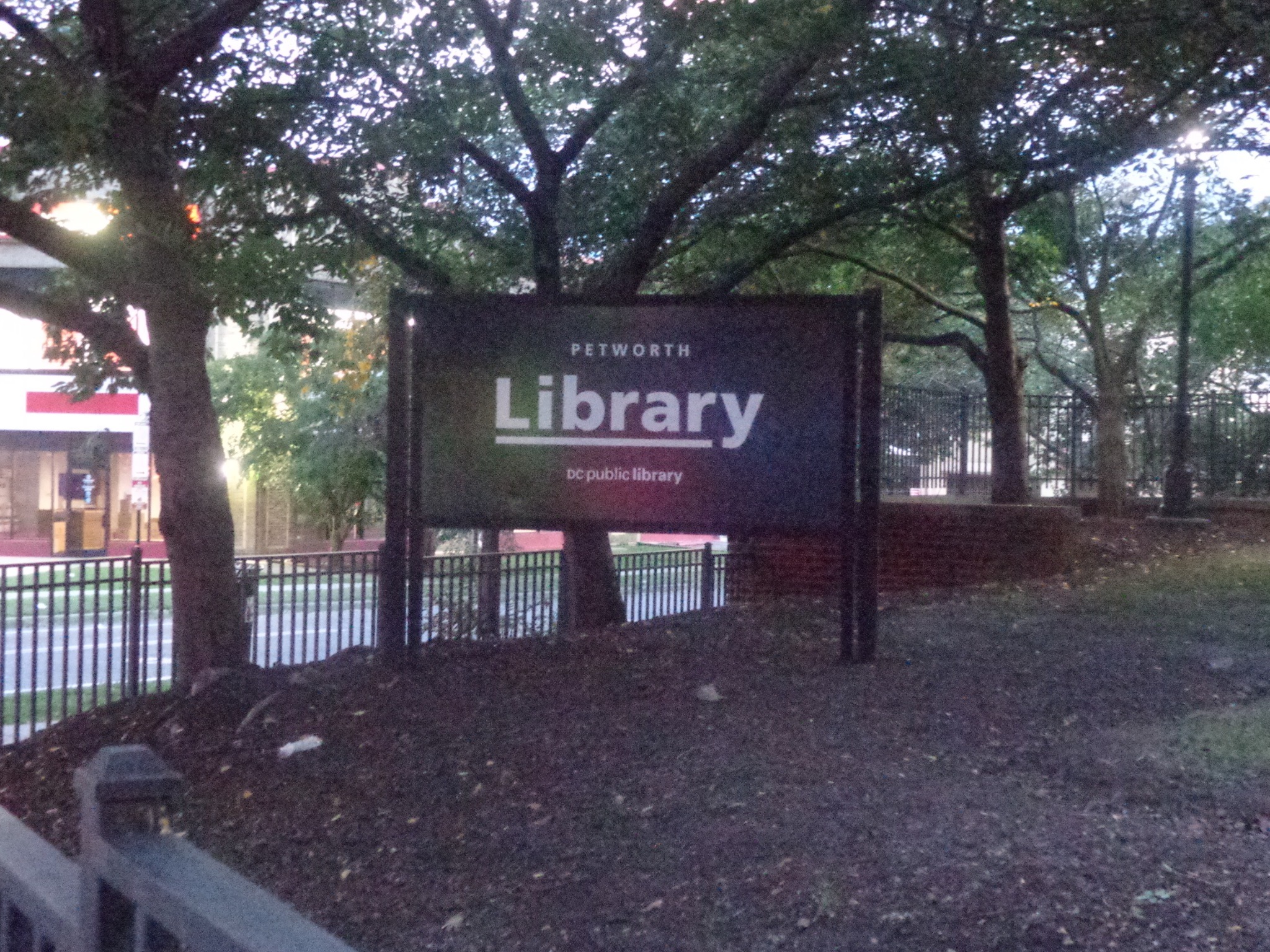
For 90 minutes, Washington Improv Theater’s Improv For All workshop filled the Petworth Neighborhood Library basement with people pretending to be characters doing prompts and reacting to each other dramatically with little time to plan. Each month they offer multiple free workshops across D.C.
Jessica Davis, a frequent goer to improv classes, was in the middle of the starting standing circle, when the instructor called on her for one of the first exercises.
“I thought, of course it’s me,” Davis said. “I’m an easy picking, you know?”
Over the past few months, Davis sought out free improv classes at public libraries, traveling between locations in Northern Virginia. Petworth was the farthest she had traveled for one. Despite her experience, Davis admitted some of the exercises were challenging, particularly when she had to process several instructions at once.
“Sometimes it’s hard for me to process instructions, or sometimes I’ll leave a piece out, because I am so eager,” Davis said.
At one point in the workshop, participants were asked to move around the room with different parts of their bodies. Davis found herself becoming more comfortable as the exercises continued, picking that as the moment she felt ready to fully participate.
“I think when I felt the most comfortable was when we did the walk around the room with our hips leading,” she said.
During another exercise, participants were asked to move around the room, while taking on different characters. Davis described slipping into the character of a stuck-up older woman who “can’t cope.” A few in the room of 20 laughed at the scenes and another covered their mouth. A few seconds later, everyone was doing it, taking turns.
Improv asks participants to respond without a script, build off of the scenario another person gives them and keep going, even when the result is awkward, unexpected or completely absurd. In the Petworth workshop, strangers were asked to participate in those scenarios together. Davis said that when she performs with people she does not know, she reaches a point where she stops thinking about the people watching her.
“Honestly, I just black out,” she said, laughing at that statement. “I’m like, no one’s watching it now. I’m just in my own little world, doing it.”
Davis reached that point, but Aida Seidou was participating in improv for the first time. She had never taken an improv class, and said the idea of performing in front of a room full of people was intimidating.
“I didn’t know what it would be like. [I thought it would be] one or two people in front of the whole class doing a whole scene,” Seidou said.
Instead of what she initially thought the workshop would be, she participated in group activities alongside everyone else, which consisted of pretending to make coffee in the morning with nothing but thin air, or waiting in line while partnering up with someone else to create their own prompts along the way.
“It didn’t feel like I was pressed to do something,” Seidou said.
That low-pressure environment was part of what made the workshop appealing to her in the first place. She had played a few improv games before, but had never committed to taking a class. The free workshop gave her a chance to try something unfamiliar without having to commit to it.
“I feel like there aren’t a lot of things where you can just try stuff out,” Seidou said. “It’s kind of nice to have something free that you can try.”
By the end of the workshop, Seidou had decided that she would do it again.
“Definitely. It was a lot of fun,” she said as she nodded outside the library, standing slightly to the side from the group, waiting to go get pizza with the rest of them.
Alan Dang had acting experience and worked as a videographer, but improv was new to him. He said he was looking for an outlet and a hobby when he found the workshop.

“Improv is definitely fun,” he said. “You could have a lot more creativity and it’s not as constrained as regular acting.”
He described the workshop as a way to exercise his creativity. Most started as strangers, which resulted in making plans to get pizza together.
Davis said that improv also gave her a way to draw from her own emotions. During one of the walking exercises, she channeled the stress she had been feeling in her own life into the characters she had portrayed.
“I think every improv experience is a way to shape what you’re bringing to the table,” Davis said.
Copy edited by Jori Johnson