

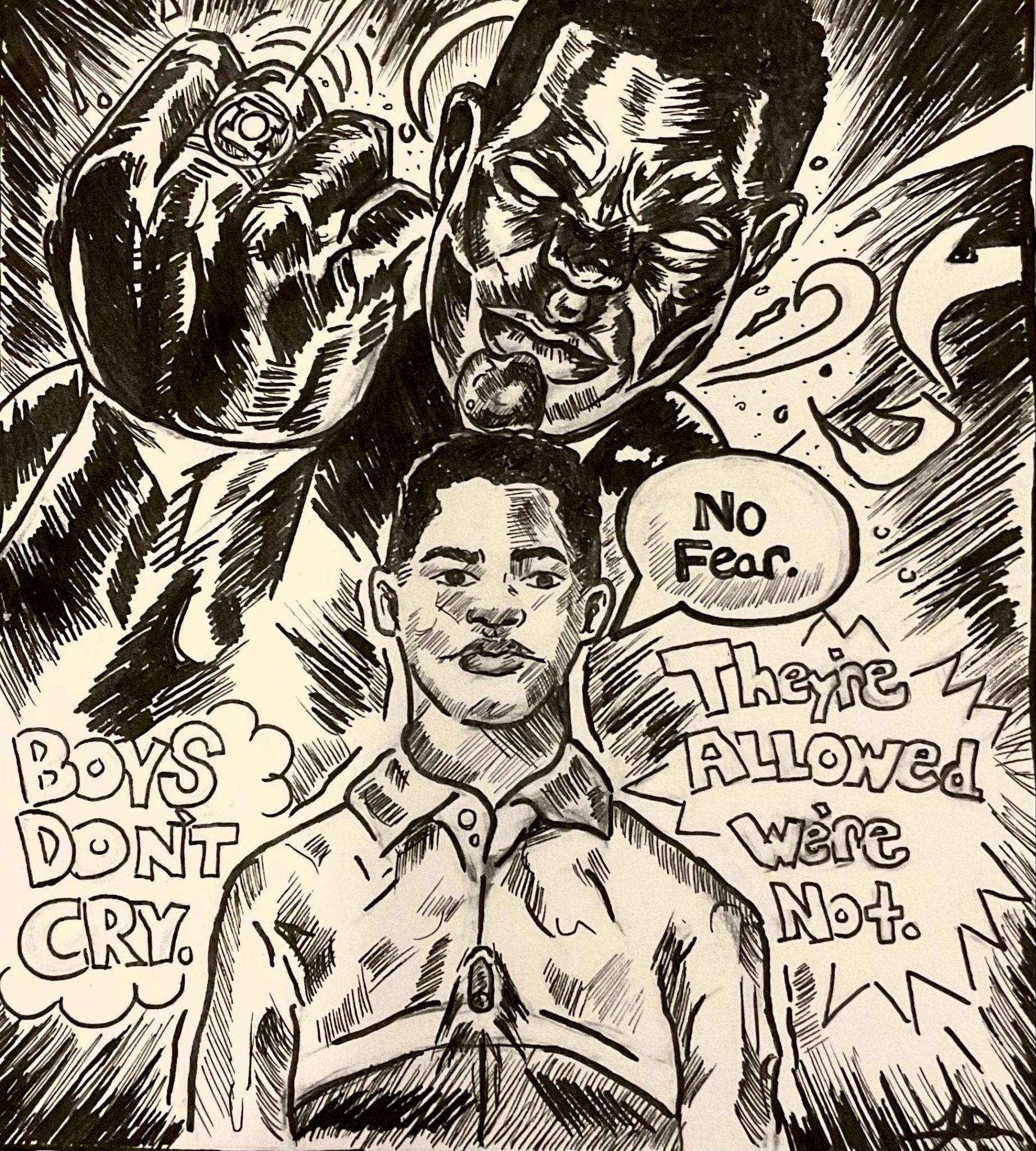
I was never spanked as a child. My parents don’t believe in it. At the time, I understood it was a parenting choice.
Watching HBO’s “Lanterns,” however, made me realize it was also something more: an early lesson that love, authority and discipline do not have to involve fear. That is why “Lanterns” has been difficult for me to enjoy.
The show is, on its surface, a superhero story about two Green Lanterns, the fictional space cops from DC Comics that protect Earth from extraterrestrial threats using a ring with the power of creation. But beneath the surface is something much more familiar: a culture that teaches boys and men that fear is weakness, humiliation builds character and obedience is more valuable than dignity. And I find that deeply uncomfortable.
The first episode of “Lanterns” begins with a scenario familiar to many of us who grew up Black: a young John Stewart Jr. (Cairo Cash Lee) is caught watching TV by his father, John Stewart Sr. (J. Alphonse Nicholson), past his bedtime and anxiously awaits his consequence. However, John Sr. does not give his son a typical punishment like chastising him, taking away a favorite toy or even spanking him. Instead, he takes his son outside, forces him to place an apple on his head and challenges him to stand still while he attempts to shoot it off.
This is not a normal punishment. To me, it depicts psychological abuse, plain and simple. The disturbing part isn’t simply that John Sr. threatens his son with a gun. It is that the show places this moment next to the current Green Lantern Hal Jordan’s (Kyle Chandler) philosophy of courage. “Are you afraid?” becomes more than a question; it becomes a test of masculinity. Fear isn’t something John Jr. is allowed to express. It is something he is expected to overcome, conceal and eventually weaponize against himself. And since the boy clearly looks up to Jordan, he internalizes this way of thinking.
What is intended to be a buddy cop dynamic between Hal Jordan and an adult John Stewart Jr. (Aaron Pierre) as the former trains the latter to become Earth’s next Green Lantern is soured by this knowledge of John’s childhood, making their dynamic feel much more “Training Day” than “X Files.”
Instead of a partnership built on trust and mutual respect, the foundation of Jordan and Stewart’s relationship is built on how well the trainee can endure whatever Jordan puts him through without complaining.
In another scene in the first episode, when Stewart mentions that he’s two months into training and Jordan has yet to teach him how to use the Green Lantern ring, Jordan aims their moving car off a cliff, tells Stewart to use the ring to save himself, and hops out. After the disturbing challenge, Stewart calls his father, enraged.
His advice: “Breathe in, button down, and bottle up. They’re allowed to have tantrums, we’re not.”
What sounds to Stewart like advice about emotional regulation reveals the trap of a particular kind of masculinity. Boys are taught that emotional restraint is strength, even when that restraint means swallowing humiliation, anger and pain.
This is where I realized just how much John Stewart Jr. and I differ. While his upbringing taught to withstand and even embrace abusive treatment in the name of acceptance, my parents taught me that authority isn’t automatically entitled to my obedience, especially at the expense of my dignity and safety.
During the transition from adolescence into young adulthood, many Americans experience hazing. Hazing impacts not just those who participate in collegiate Greek life but also sports teams, clubs, workplaces and the military.
Interestingly enough, both Green Lanterns come from military backgrounds. Hal Jordan’s father was an Air Force pilot who died in a plane crash when he was young, so Jordan became an Air Force Pilot. John Stewart Sr. was a Marine, so, naturally, John Stewart Jr. became a Marine.
According to a 2023 review from the Journal of Military, Veteran and Family Health, military hazing is unique because it focuses on “physical strength, authority, and power and reinforced by gender norms, stereotypes and social expectations that can lead to the exclusion or (forced) assimilation of those who are not perceived to match this masculine identity.”
“Lanterns” depicts that culture as it is passed from one generation of men to another. This is put on full display in the beginning of episode two, when Jordan tries to teach Stewart to fly using the Green Lantern ring, but Stewart’s mind creates a bird instead. Then, because Stewart dared to think differently instead of conforming, Jordan punishes him, sending him on a miniscule errand far away from the case they’re supposed to be working on together.
As passionate as I am about television, sci-fi and comic book media, it’s hard for me to enjoy “Lanterns” when I know there are so many young people today being told to “button down and bottle up,” who are being taught that their dignity and personhood mean less than arbitrary hyper-masculine measurements of strength and bravery.
We all know by now that we internalize what we see onscreen, especially as young people. I’m afraid that if future episodes don’t show John Stewart Jr. breaking away from his own hypermasculine conditioning, then the next generation won’t want to either. I sincerely believe there is a world where cruelty was never normalized as a form of upbringing, training or initiation, but unfortunately that world is not ours, and the dynamic between the Green Lanterns reflects that.
Copy edited by Daryl R. Thomas Jr.