

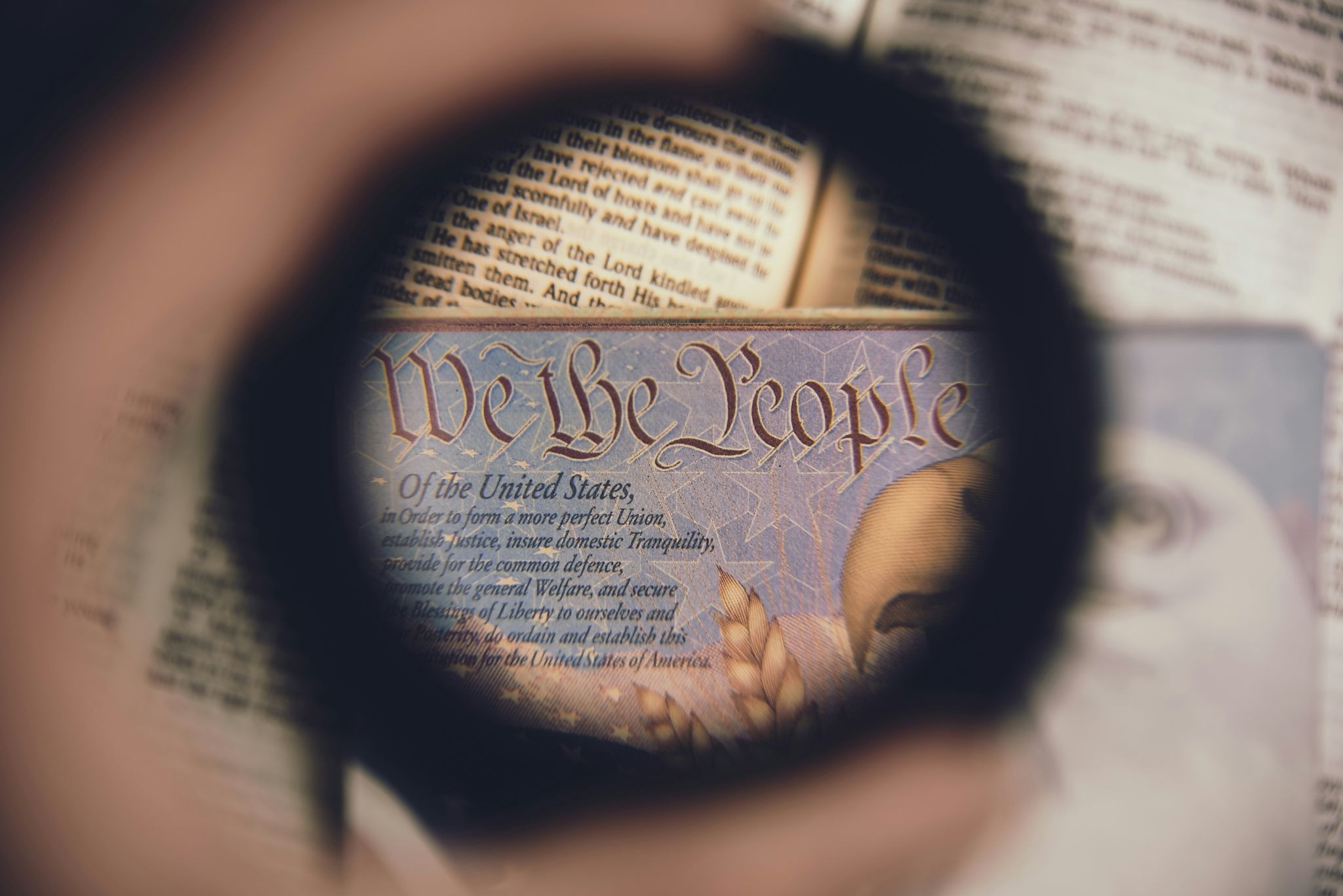
“We the People” are the first words emblazoned across the United States Constitution, a deliberate declaration that the nation’s governing charter derives its authority from the American people themselves, not from politicians, judges or self-proclaimed kings.
The Supreme Court, far from being a pillar of justice, has become a cesspool of corruption and the rule of law is little more than a façade. These so-called “justices” now wield their gavel like a sledgehammer, smashing decades of human rights progress while pretending to uphold the Constitution.
In the foundational 1803 Supreme Court case Marbury v. Madison, Chief Justice John Marshall famously wrote that it is the judiciary’s job to say what the law is. The case established the power of judicial review and gave the judiciary the ultimate authority to strike down laws if they are found to violate the Constitution.
Some people interpret this to mean that the Supreme Court has the final say on what the Constitution means. However, that is an oversimplification. Law is different from constitutional meaning. Courts resolve legal disputes by examining statutes, precedents and constitutional principles to decide specific cases.
Constitutional meaning, however, deals with broader questions about what the Constitution represents and how the U.S. government should function. Constitutional meaning belongs to everyone, and Black Americans throughout history have made immense strides to shape, challenge and redefine what the Constitution means in practice.
In past eras of U.S. politics, we the people, through our representatives in Congress, have shaped and settled constitutional meaning, including, at times, pushing back against Supreme Court decisions that exceeded the bounds of public and political consensus.
One notable example is the 1857 case Dred Scott v. Sandford, which ruled that Black Americans could not be U.S. citizens and that Congress lacked authority to prohibit slavery. Many politicians did not simply accept the Supreme Court’s interpretation of constitutional meaning at the time. Instead, they resisted and protested that Congress should oppose the decision, and constitutional amendments should be used to overturn it.
A decade later, at the Suffrage Convention of the Colored Citizens of New York, delegates denounced the decision as an attempt to preserve slavery, declaring that anyone who believed in the human rights principles of the Declaration of Independence should reject the Supreme Court’s ruling. Eventually, the outcome of the Civil War and the Reconstruction Era that followed effectively repudiated the Dred Scott decision.
The lesson here is not simply that the Supreme Court can be wrong, at least in the eyes of the American people, but also that the court’s constitutional interpretations are not beyond challenge. History reminds us that some of the Supreme Court’s most consequential rulings have not endured because the American people and Congress refused to let them. We should never take that for granted.
At the heart of these conflicts is a broader question of accountability. What happens when families, voters and communities lose faith in the judiciary’s ability to protect their freedoms and individual rights? That question has taken on renewed urgency following the Supreme Court’s most recent term. In a matter of weeks, the court expanded the authority of a president who often behaves as an aspiring autocrat, defying the law in the pursuit of personal authority and power.
Furthermore, the court significantly narrowed the Voting Rights Act, loosened campaign finance restrictions, allowed the Trump administration to proceed with plans to expel hundreds of thousands of migrants from the country and to turn away others at the U.S.-Mexico border.
Separately, the court ruled in two cases concerning gay and transgender rights. In one, it found that Colorado’s ban on conversion therapy, practices intended to change a minor’s gender identity or sexual orientation, was unconstitutional.
In another case, the court ruled that states may bar transgender female athletes from competing in girls’ and women’s school sports.
The trans-athlete and the immigration cases are essentially one in the same. They are both, at their core, a judgement on who can be allowed to exist in our society. That is precisely why nine unelected, life-appointed justices, answerable neither to voters nor the public, should not have the final word on issues that shape the lives of more than 340 million people.
Many tend to relate to our politics the same way we relate to everything else in the United States: as consumers who pick from a set of predetermined choices. But if we hope to recover and revitalize our democracy, we must start to think as citizens with duties, obligations and the sovereign power to make our world anew.
If the court continues to narrow the rights of the many while concentrating greater power and authority in the hands of the few, its decisions should be met with rigorous public scrutiny and democratic engagement. Through Congress, elections, civic participation, and, when necessary, constitutional amendment, the American people can reaffirm that the Constitution derives its authority not from nine justices, but from the people themselves, preserving the nation’s promise of a government that is truly of, by, and for the people.
Copy edited by Daryl R. Thomas Jr.