
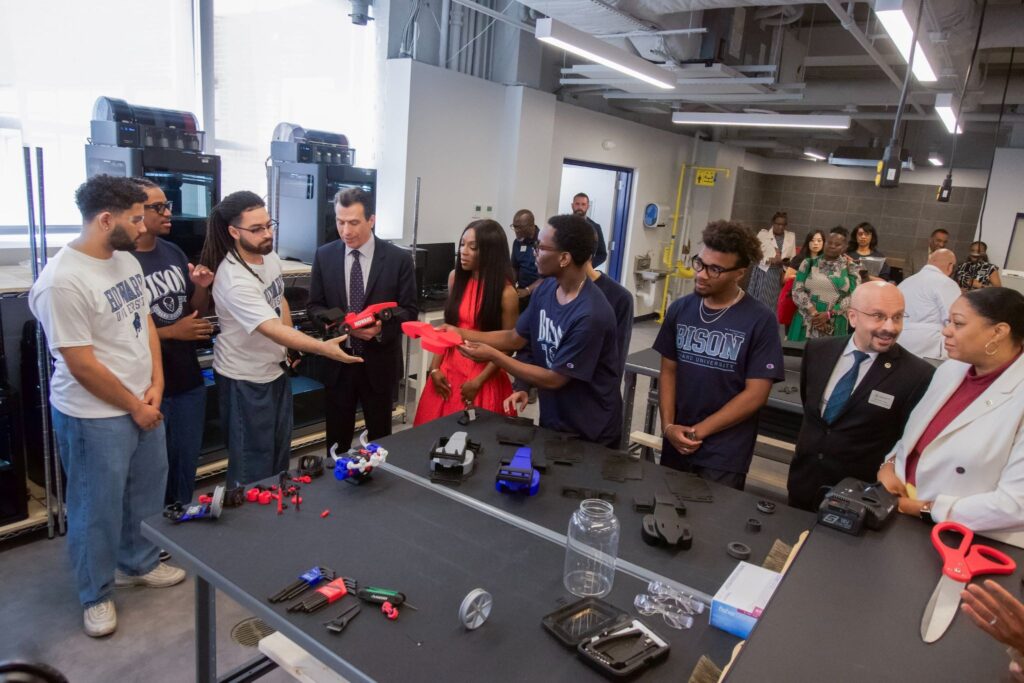
The Howard University College of Engineering and Architecture (CEA) opened a state-of-the-art makerspace, complete with artificial intelligence (AI) empowered design and digital fabrication on Thursday, April 16. The makerspace came into fruition due to large investments from Autodesk, a leading software product company in the architecture and engineering industry.
Among other technologies, the makerspace includes a laser cutter, 3D printer, water cutter and advanced prototyping equipment. Chief Marketing Officer at Autodesk and CEA Board of Visitors member Dara Tresder said that the ribbon-cutting event was one of her favorite events of the year thus far.
“The space was already buzzing,” Tresder said. “Being able to walk into the maker space – the first one on campus – and see the students already designing, building, collaborating in real time; it didn’t feel like a ceremony as much.”
The dream of a makerspace started in 2024 when Autodesk donated five million dollars to CEA to start the project, hoping to equip students emerging in the era of AI.
“Nearly half of students are saying they don’t feel like they’re learning the AI skills they need to get a job after graduation,” Tresder said.
Tresder said that while the company’s software is used in over 1,600 schools across the country, Howard was important because of its legacy and demographics.
“We look for partners where we can really make an impact,” she said. “There’s an incredible legacy here, strong leadership and a real momentum to equip students with new skills.”
While the makerspace is not yet fully open to students, CEA students like Yelena Cherubin-Lambert, a junior civil engineering major, are excited to use the resources.
“Other schools are kind of progressing above us, so I’m happy that we have this space where we can fabricate certain things,” Cherubin-Lambert said.
She added that such an investment gives her hope for the future of the school.
“Other companies are still willing to invest in us, especially due to everything happening,” Cherubin-Lambert said. “It’s very eye-opening to see that there are still people willing to invest in young Black excellence.”
Jevanni Napoleon is a junior civil engineering major from New Jersey currently serving as treasurer for the American Society for Civil Engineers. For her, access to a makerspace means potential for other possible resources, like on-site steel making used for steel bridge competitions.
“The makespace gives me hope that one day we’ll have more resources on site so we won’t have to outsource as much. It definitely feels like a door opening,” Napoleon said.
Kelsey Fennoy is a sophomore architecture major from Baltimore who got to access the space when it opened.
“I really think it’s just like an up-to-date classroom, and how these classrooms should be,” Fennoy said.
She found the area to be a relaxing place to study as opposed to the crowded architecture studios.
“It’s a new place to break out and wind down,” Fennoy said.
During the makerspace opening, Autodesk also announced a $1.95 million donation for the CEA to develop a new construction and engineering management program – a move Tresder says will be pivotal for the industry.
“Construction is a $2 trillion industry, and it is being transformed by AI. At the same time, there’s a major shortage of skilled talent,” Tresder said.
“I like to say that AI is raising the floor, but it is human ingenuity that will raise the ceiling,” Tresder said. “…which is exactly what this space is about.”
Copy edited by D’Nyah Jefferson – Philmore