

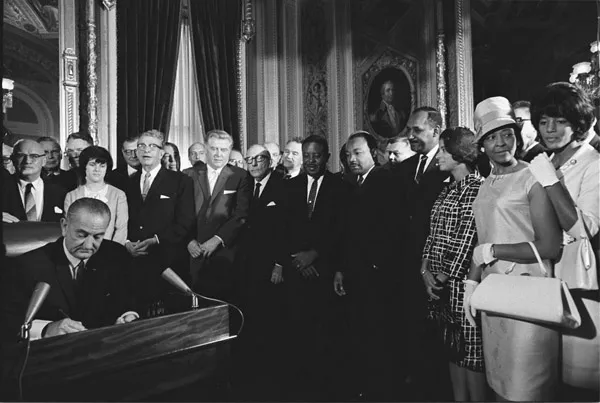
The conservative supermajority on the Supreme Court — working outside the realm of ethics, morality and the consent of society — eviscerated Section 2 of the Voting Rights Act of 1965, a cornerstone of modern civil rights legislation that helped dismantle Jim Crow. The 44-page ruling and concurrence, which will boost Republican politicians ahead of the midterm elections by making it harder for minority communities to challenge redistricting maps that dilute their political voice, represents the corpus and canon of white supremacy and we disavow this incorrigible decision that is fundamentally at odds with the NAACP’s mission and history itself.
The Voting Rights Act was passed in the immediate aftermath of the Civil War to explicitly address anti-Black racism that prevented Black people from obtaining equal protection of the law and having a voice in their representative government. Many states, especially ones like Louisiana, were continuing to infringe on Black people’s right to vote through unfair literacy tests and poll taxes.
The 14th and 15th Amendments, alongside Section 2 of the Voting Rights Act, were definitively not race-blind; as they were meant to right the wrongs of the horrific, centuries-long practice of human bondage. It is ironic that the relentless buying, selling, insuring and financing of enslaved people — and the products of their labor — built the nation itself, yet when their descendants began to gain even modest access to the rights and freedoms they’re supposed to be entitled to, those long accustomed to privilege reframed equality as oppression and filed suit.
Unfortunately, we do not live in a race-blind utopia where everyone has gained parity and the only difference in life outcomes is how hard you work. Nor do we, and should never, live in a society where white people get to tell Black people to “move on from slavery” — especially since there are Black people alive now whose grandparents were enslaved. One cannot, at once, rig the game for 246 years and then plead mortal error. But then again, the Supreme Court has chosen so.
And now, the disingenuous and oversimplified conservative argument against Section 2 of the Voting Rights Act is that being race-neutral and colorblind is the only correct non-discriminatory stance to take (despite the fact that the Constitution, in its original form, was far from colorblind and explicitly permitted the subordination of Black people). In effect, by taking race into consideration at all, you would be discriminating against white people, and that is who the Supreme Court sought to protect in the Louisiana decision — the people who enslaved our ancestors and sought to dilute the Black vote by any means necessary.
Janai Nelson, the president of the NAACP’s Legal Defense Fund, regarded this decision as the “worst case scenario.” Nelson added that she believed the majority was driven by political motivations, stating “What the court did was just as harmful and even more deceptive.” Indeed, it is true that the Supreme Court itself has become a political actor.
The court, with Chief Justice Roberts at the helm, now declares that racism in American politics is no more, stating in the majority’s opinion that, “vast social change has occurred throughout the country… which have made great strides in ending entrenched racial discrimination” (a reality made possible in large part by the very protections established under the Voting Rights Act). To that end, the court has enabled partisan gerrymandering, limited lawsuits against racially discriminatory voting laws and now upended the core protection against racially discriminatory redistricting in states across the country.
Voting rights activist Stacey Abrams, who received the NAACP’s first-ever Social Justice Impact award, writes in her op-ed: “This is how authoritarianism is imposed… we now find ourselves returning to the before-times. But instead of Alabama state police on the Edmund Pettus Bridge, we have state legislators with poison pens, drafting themselves into permanent power.”
Almost immediately after the court’s decision, states began moving to reshape the political landscape. In Florida, officials redrew federal legislative districts in ways that could hand Republican politicians as many as four additional seats in Congress. In Texas, lawmakers advanced new maps that could yield up to five more seats, while Mississippi has begun redrawing judicial districts. The Congressional Black Caucus may lose as much as 30 percent of its membership and the decision is expected to drive significant changes in California, particularly in how Latino and Asian American communities are represented in regions where they make up a substantial share of the electorate.
The decision will continue adding fuel to the fire of redrawn political districts and retaliatory actions, a mere four years before the next census, which will remind us of what we know to be true: the demographics of the United States are evolving. This ruling is an attempt to slow the pace of change, if not halt it altogether. But it will not succeed. Our national organization has called every chapter to order and we invite all Howard University students to join our ranks to defend voting rights, demand legislative reform and organize our communities for sustained civic action.
Lobby and demand your representatives to revise and pass the John R. Lewis Voting Rights Advancement Act, advance the Freedom to Vote Act and lay the groundwork for a constitutional amendment guaranteeing the right to vote. We ask each person to verify their voter registration and that of at least five others, volunteer in coordinated getting-out-the-vote field efforts, attend your state’s redistricting hearings and engage in phone-banking initiatives.
In the weeks and months ahead, we are tasked with monitoring your state’s redistricting sessions, building evidentiary records where race-based discrimination persists and preparing for targeted litigation. We must advocate for state-level protections against partisan gerrymandering, defend existing voting rights laws and pressure lawmakers at every level to uphold the promise of democracy.
For without representation, what is citizenship?
Respectfully,
The NAACP Howard Chapter
The Oldest and Largest Civil Rights Organization
2026-2027 Howard NAACP Executive Officers
Bijou-Elyse Wallace
President
Edric Bussie
1st Vice President

Gabriel Beidleman
2nd Vice President
Asia Robinson
Secretary
Darryel Brown
Treasurer
Statement approved by Carmel Henry, NAACP D.C. Branch President and Howard Chapter Advisor