

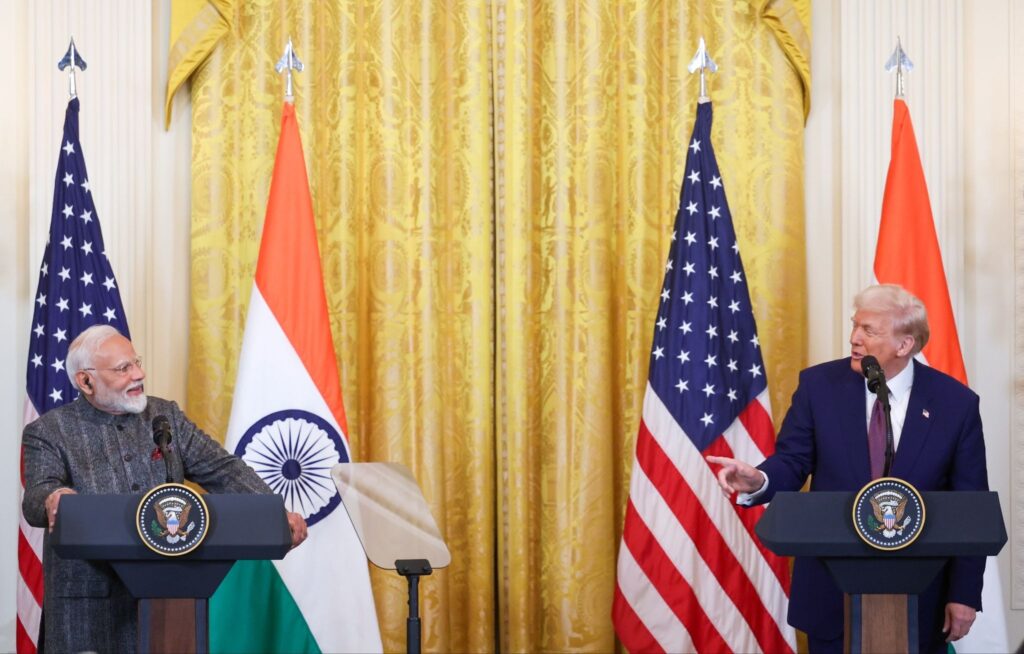
For much of the past year, the United States and India were locked in a tariff dispute that raised duties on Indian goods to 50 percent and strained one of Washington’s most important trade relationships. Last week, negotiators from both countries sat down in Washington for the first time in months to try to close a deal that would cut those tariffs and reshape how the two economies do business with each other.
The talks, which began April 20, marked the first formal in-person engagement since a framework agreement in February that slashed U.S. tariffs on Indian goods from 50 percent to 18 percent and set the stage for a broader bilateral trade deal.
The Indian team was led by Additional Secretary in the Department of Commerce Darpan Jain and included officials from customs and the Ministry of External Affairs, as noted by Asian News International (ANI). On the American side, Brendan Lynch, the Assistant U.S. Trade Representative for South and Central Asia, was present in the negotiations.
A senior U.S. official told ANI that the talks are proving productive.
“The Trump administration and India continue to have positive and productive discussions towards a finalised trade deal,” the official said.
Commerce and Industry Minister Piyush Goyal confirmed on April 20 that the first phase was largely settled.
“We have almost finalized the free trade agreement, the first tranche of the bilateral trade agreement with them,” Goyal said. “We are trying to work out what would be the mechanism by which India can get preferential market access in the U.S. market compared to our competitors.”
Goyal described the bilateral relationship as extending beyond commerce. He emphasized that India-U.S. relations are strong and multi-dimensional, extending well beyond trade to include significant collaboration in technology, critical minerals and defense.
“It’s a partnership of two countries which will define the future,” he said.
This is not the first time the two countries have had trade friction. The U.S. imposed Section 232 tariffs on steel and aluminum in 2018. In 2019, the Trump administration revoked India’s eligibility under the Generalized System of Preferences, which allowed certain Indian exports to enter the U.S. duty-free.
India had maintained tariffs averaging 37 percent on agricultural goods and exceeding 100 percent on certain automobiles, according to a White House fact sheet.
On April 2, 2025, President Donald Trump declared a national emergency and imposed a 25 percent reciprocal tariff on Indian goods. By Aug. 2025, the U.S. added another 25 percent punitive duty. A punitive duty is an additional tariff imposed to penalize a country for specific actions or policies, often to pressure a change in behavior.
The U.S., in this case, cited India’s continued purchase of Russian crude oil during the Ukraine conflict. The combined 50 percent rate applied to Indian exports entering the American market.
In February 2025, Trump and Prime Minister Narendra Modi launched formal bilateral trade agreement negotiations. The two leaders reached a framework on Feb. 2 during a phone call.
Trump agreed to remove the punitive 25 percent tariff and lower the reciprocal rate to 18 percent. India signaled willingness to reduce or eliminate tariffs on U.S. industrial goods and agricultural products, and committed to purchasing $500 billion in American energy, aircraft, technology and other goods over five years.
On Feb. 20, the U.S. Supreme Court struck down the reciprocal tariffs imposed under the International Emergency Economic Powers Act. The administration then imposed a new 10 percent baseline tariff for all nations under Section 122, requiring both sides to recalibrate the terms of the deal.
A planned meeting between chief negotiators in February was deferred. Last week’s round in Washington marked the first formal engagement since.
With tariffs on Indian goods set at 18 percent, India now faces lower duties than Vietnam and Bangladesh, both at 20 percent, and lower than China, which faces rates between 30 percent and 35 percent.
The United Nations Economic and Social Commission for Asia and the Pacific noted that the agreement could reshape trade patterns across South Asia. Neighboring countries could export raw materials and intermediate goods to India for further processing before final products are shipped to the U.S.
“Such integration would strengthen intra-SAARC trade linkages, improve regional supply-chain resilience and allow small and medium enterprises in these countries to benefit indirectly from India’s improved market access,” UNESCAP said.
For the United States, the deal opens access to a consumer market of more than 1.4 billion people. India’s purchase commitment of $500 billion over five years includes energy products, aircraft and aircraft parts, precious metals, technology goods and coking coal, according to the joint statement.

India is also reportedly considering Boeing aircraft orders valued at up to $80 billion.
The White House indicated that India committed to halting purchases of Russian crude oil and shifting procurement to the U.S. India’s crude oil import dependence rose to 88.2 percent in the 2024-25 fiscal year, up from 85.5 percent two years prior.
India’s Ministry of External Affairs has not confirmed whether a formal commitment to halt Russian oil purchases was made.
U.S. Trade Representative Jamieson Greer said in January that India had made “a lot of progress” in talks but noted that energy imports and agricultural market access remained under discussion.
Russian President Vladimir Putin visited India earlier this year. India has maintained diplomatic and energy ties with Russia while expanding defense and technology partnerships with the United States.
The status of India’s dairy and agriculture sectors is a central point in the negotiations. Indian officials have drawn firm boundaries around these industries, which support the livelihoods of hundreds of millions of farmers.
Finance Minister Nirmala Sitharaman told the Financial Express that the sectors remain protected.
“Agriculture and dairy have been among very big red lines, where a high degree of caution has been exercised,” Sitharaman said.
Goyal wrote on X after the February framework was announced that dairy, fruits, vegetables, spices and other grains have been protected under the agreement. He said the protections would safeguard the interests of domestic farmers and strengthen local agriculture through “preferential access” to the American market.
The date for the next round of negotiations is to be announced. The tariff rate on Indian goods remains at 18 percent under the February framework, and the terms of the final agreement, including commitments on energy procurement, agricultural market access and the timeline for implementation, are still being negotiated.
The outcome will shape the terms of trade between the world’s largest economy and the world’s largest democracy.
Copy edited by Kennedi Bryant