

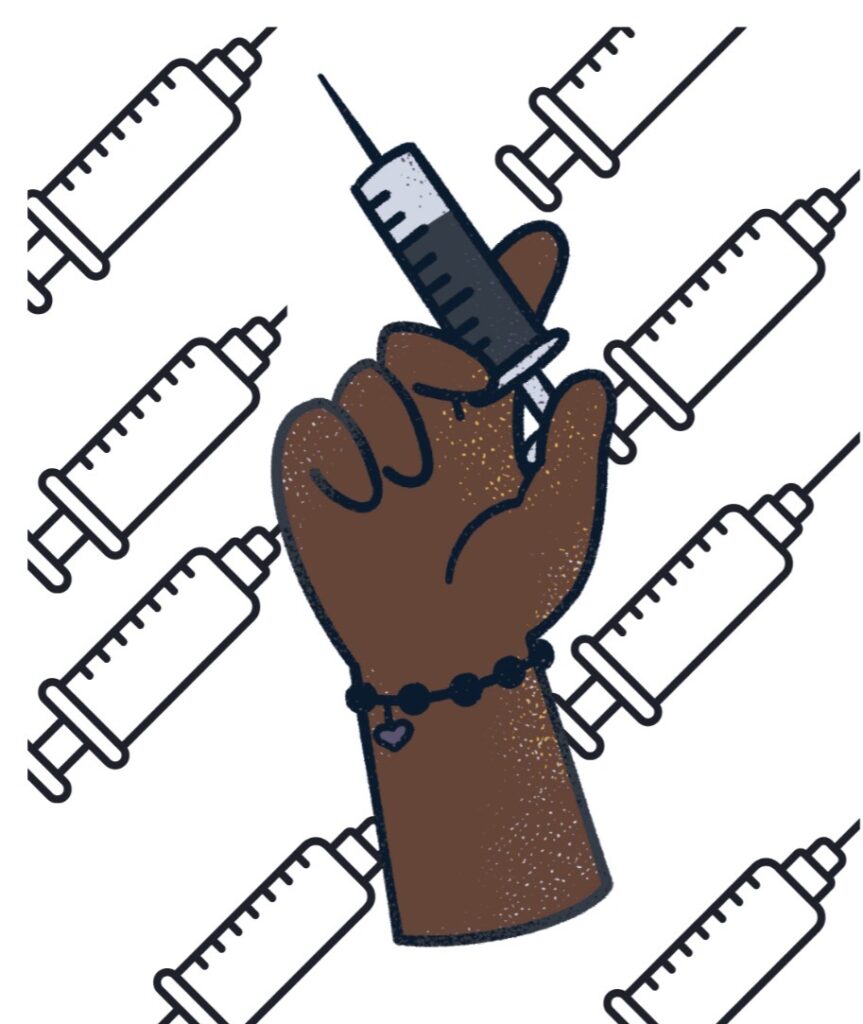
Ozempic, GLP1s and “weight-loss” drugs have become buzzwords across the internet and social media. Searches containing the hashtag “Ozempic” have garnered 70 million views on TikTok, and Google queries with “weight loss” and “GLP1” reached their peak in May 2024 and March 2025, respectively. But within the world of this so-called wonder drug, there lie serious questions that require answering. Mainly, what are they, where did this sudden, lucrative craze come from and what does it say about the rigid, white and oppressive beauty standards in American society?
Ozempic is classified as a GLP-1, which stands for glucagon-like peptide, a class of medications used predominantly for the treatment of type-2 diabetes and obesity. Although Ozempic was originally approved by the FDA in 2017 as a diabetes medication, users quickly discovered and began reporting on its positive effects for rapid weight loss. Thus, its manufacturing company, Novo Nordisk, created a separate drug, Wegovy, containing the active ingredient to trigger weight loss, semaglutide, in 2021
and it became an approved treatment for obesity-caused heart disease in 2024.
According to a study done by Indiana University School of Medicine, within the four years of collected data (from 2017-2021), the number of Americans using Ozempic increased 40 times, with roughly 9 million citizens, or 2-3 percent of the population, now regularly using some form. Although this number is large and somewhat frightening, considering science has yet to uncover the long-term side effects of persistent usage, it’s not altogether shocking considering the obsession many Americans have with weight and how deeply it’s tied to the country’s beauty standards.
In American culture, the ideal body type is a hotly debated contest, one that’s forever in flux and fueled by a small percentage of high earners hounding and capitalizing on society’s insecurities. Looking at an article from CNN examining the past 100 years of white beauty standards, there’s been a constant back-and-forth between the sought-after sleek, thin flappers of the 1920s, to the fuller, curvier women of the 40s and 50s. The 1960s, however, marked a somewhat dramatic pivot; thin became the forever-constant norm and golden standard, in part due to the rise of supermodels as a profession, and the in-your-face marketing that accompanied.
It also marked a dramatic uptick in reports of disordered eating. From there, the beauty standards we’re familiar with today began to take shape; the 80s, with its intense emphasis on being sleek, slender and “in shape;” and the 90s and 2000s, with its desire to have everyone be “heroin chic.”
The first direct opposition to this came in 1969 with the creation of the National Association to Aid Fat Americans, founded by Bill Fabrey. Four years later in 1973, a group of California feminists with similar grievances formed a partnering organization called Fat Liberation, writing a full manifesto which demanded “equal rights for fat people in all areas of life.”
Although these early groups didn’t use the term “body positivity,” their underlying message was quite similar to the modern movement: all bodies are good bodies, and the increasingly popular diet industries were guilty of reducing and marginalizing fat, Black or queer people. This movement was radical in many ways, yet with time, it fell victim to the same lack of intersectionality as many liberation movements before it, and began shutting out the concerns of POC to “advance” the movement as a whole. As the online body positivity movement began to expand and become more mainstream, its very founders became reduced and marginalized in the same fashion as before.
Instagram, which garnered over 27.6 million posts with the hashtags #BodyPositive or #BodyPositivity combined as of 2022, was a large factor in this, as a vast number of the individuals garnering attention from companies, or gaining the most traction were “white, slender, able-bodied cis-women.” The commodification of Black phenotypical features by white women in this era added to the performative nature of this “inclusion” era. Seeing curves, hips, a bust and butt on ethnically ambiguous women, such as the Kardashian family, was the biggest money maker for social media platforms. Around the same time, the glamorization of the BBL, or Brazilian Butt Lift, a procedure whose frequency grew over double across a four year period, was mostly spearheaded by LA socialites and influencers, and targeted towards younger girls.
Within the past five years, societal standards have transitioned away from the illusion of inclusion and radical body positivity and begun aligning more closely to the heroin-chic physique of the 1990s and 2000s. Celebrities are reversing the plastic surgery they spent hundreds of thousands on to attain and maintain, and they’re convincing the general population to do the same. So what, if anything, does this mean for the Black community, specifically Black women?
Well, it means that Black women’s bodies have again shifted from the hot commodity white women were desperate to emulate and objectify, to the source of their villainization. The ozempic age marks the death of performative inclusivity, with celebrities and social media at large outwardly displaying their contempt for Black, fat or differently presenting bodies once again. It also reflects a larger resurgence of a new, more overt and domineering era of conservatism in America. Big money is being spent on aesthetics and appeal via advertisement, with companies like Novo Nordisk spending nearly $500 million on Ozempic and Wegovey ads within the first 9 months of 2025. It should be noted this is a 44 percent spending increase comparatively to last year. When considering this, combined with the historical interconnectedness of white and thin supremacy, it’s clear the societal beauty standard has reverted into staunch anti-Blackness.
Although this asks for a new generation of Black women being raised under conditions of self-hatred, it does not necessitate it. Meaning, we may still choose the path of “radical” self-love and acceptance. Of course, this is easier said than done, however the first step is to see-through the $500 million dollar veneer; reject the aesthetic being presented to you as the only one. Realize your self-importance outside of what white America dictates it to be. Take up space in a world determined to shrink you.
Copy edited by Daryl R. Thomas Jr.