

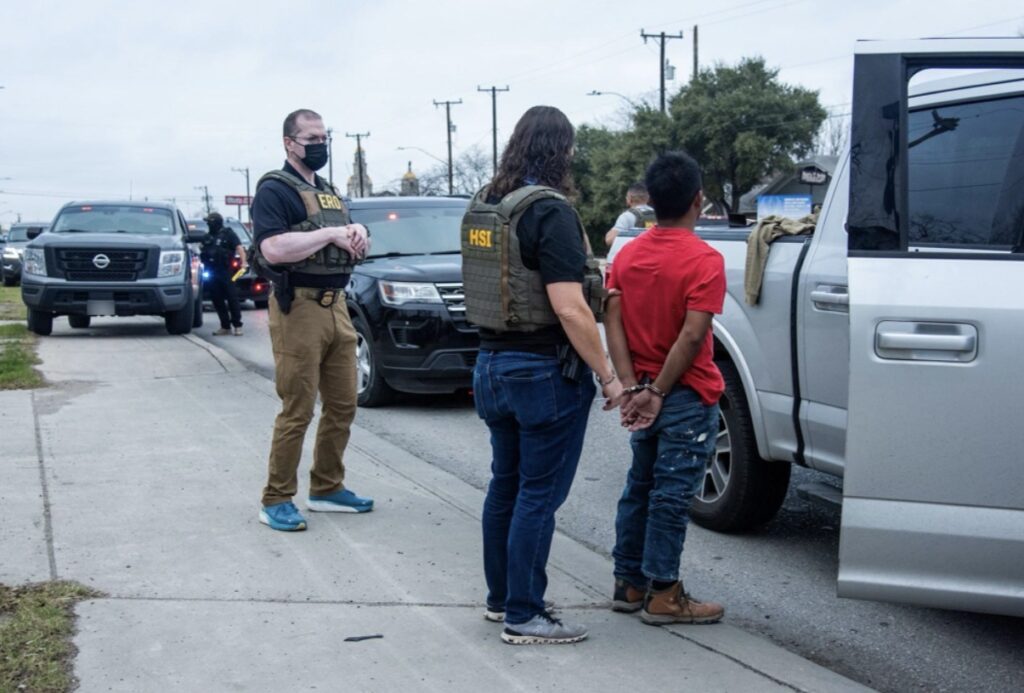
U.S. Immigration and Customs Enforcement (ICE) has reportedly detained more than 6,200 children since January 2025, contributing to a total detained population of over 60,000. As immigration detention expands, it becomes necessary to examine what is truly happening to the children currently in custody.
Between 2018 and 2019, eight children died in U.S. immigration custody. Years later, in 2025, the total detained population increased by 70 percent compared to levels during the early Biden administration, according to NPR. However, even these numbers are incomplete, as they reflect only what is formally documented while obscuring the full extent of harm experienced by those in detainment whose experiences often go unreported within detention systems.
Qazi, an American-Bengali creative living in Oklahoma City, reflected on the targeted detention of his cousin and aunt. As Muslims, they endured not only physical abuse, but psychological harm as well, including being forced into situations where they had to choose between starvation and consuming pork – a food explicitly prohibited in Islam, making this coercion a violation of both bodily autonomy and religious practice.
“[My cousin] went in as a kid with his whole life ahead of him, and came out a completely different person … He came back looking like a stick, he was malnourished … mentally and physically changed,” said Qazi, who requested to only be referred to by his first name.
According to the legal statements put forth by ICE Detainee Death Reporting, ICE is required to report in-custody deaths within 30 days and provide full reports within 60 to 90 days, according to the 2018 Department of Homeland Security Appropriations Bill. However, in practice, reporting is often delayed or inconsistent. Investigations by advocacy groups such as the American Civil Liberties Union and the Detention Watch Network have found that official reports can omit key details, including causes of death or failures in health care.
Nicole Baummann, a child welfare specialist in Oklahoma County with experience in advocacy work for the Council of American Islamic Relations, emphasized how this lack of information makes meaningful intervention nearly impossible.
“It’s hard to advocate for something when there is no structure,” she said. “[Immigrants] don’t even know what legitimate paperwork they need to have because the government doesn’t even know. There’s been situations where lawyers didn’t even know what papers [immigrants] needed at one point.”
These same advocates have also raised concerns with “deathbed releases,” where individuals in custody are freed just before their death. If they die outside of ICE detention, this will exclude them from official in-custody death tolls, according to the American Immigration Council.
Baummann notes that these issues extend beyond immigration enforcement alone. Instead, it is a multifaceted problem: communities continue to be targeted based on appearance, not only by ICE, but through similar patterns in child welfare policies, which, although designed to protect indigenous children and families, are rarely enforced.
According to PBS, children and parents alike have reported unsafe and unsanitary conditions in ICE detention. From worm and mold-contaminated food to inadequate medical care, senior lawyers with the National Center for Youth Law have noted that there are “profound problems with basic needs.”
In addition to confinement and a lack of education, instances of sexual violence against young women and teenage girls have occured, according to PBS. Qazi said that these conditions are sustained by policy as well as public perception.
“People are raised to believe immigrants are bad until they meet one. Then it becomes, ‘Oh, he’s a good person,’” he said. “Until then, people are just scared of what they’re ignorant of.”
In a letter written from the Dilley Immigration Processing Center, nine-year-old Susej Fernandez described her time in detention after arriving in the U.S. with her mother.
“I have been 50 days in Dilley Immigration Processing Center. Seeing how people like me, immigrants, are being treated, changes my perspective about the U.S.” she wrote.
Reports from PBS describe children exhibiting signs of severe distress: hitting themselves, socially withdrawing or asking whether they are “bad people.”
Other anecdotes include those covered by U.S. Senator Jon Ossoff in a 2025 congressional investigation, wherein a U.S. citizen child reportedly began vomiting blood while in custody, to which a guard responded, “Just give the girl a cracker.”
Experts caution against treating the psychological impact of immigration detention as a singular, uniform experience. On the contrary, they point to a more complex framework informed by stigma, perception and lived experience.
Professor Ezer Kang, a clinical psychologist at Howard University, explained that children in and around immigration enforcement are affected through multiple forms of stigma.
Repeated labelings that signal exclusion and social marginalization, especially when used consistently in public discourse, can erode an individual’s and community’s sense of belonging and self.
“If you or your family members are frequently referred to as aliens, undocumented, illegal,or any other derogatory terms that might directly or indirectly communicate that you do not belong … we will begin to internalize it,” Kang said.
Kang also describes anticipated stigma: the expectation of being mistreated, even when no immediate harm is present. Children exposed to ICE may be “constantly vigilant and fearful that if they go to school and come back, their parents aren’t gonna be there, so they don’t want to go to school anymore.”

A third form, enacted stigma, occurs when those fears materialize through direct experiences such as detention, separation or aggressive enforcement practices.
This fear, brought forth by societal stigmatization, is not only seen in children – such as Qazi’s then thirteen-year-old cousin, who had to live with extended family after his immediate family’s detainment – but also the adults who have to take care of them. After his aunt’s detainment, Qazi noted that she still can’t get a job due to a lack of formal documentation. She had to work under the table at a coffee shop for over a decade to support her children.
Importantly, Kang emphasizes that these effects largely vary – a child who witnesses or experiences a violent arrest may experience trauma differently than one who encounters a more leveled interaction. Similarly, children who are not detained themselves may still experience significant psychological distress.
More than 6 million children in the U.S. live with at least one undocumented family member, which exposes many to the constant threat of immigration enforcement even without direct contact. In this way, the impacts of American immigration enforcement extend beyond detention centers and instead shape the lives of children of color across American communities.
Children in ICE custody are often detained alongside or taken from their parents, meaning their experiences are often closely tied to the treatment of adults, particularly mothers.
According to the Latin Times, reports from late 2025 indicate that women make up roughly 40 percent of the ICE detention population, including pregnant, postpartum and nursing individuals.
Between January 2025 and February 2026, around 500 pregnant or postpartum individuals were processed through ICE detention. Organizations such as Physicians for Human Rights argue that the abuse and mistreatment women face has a direct consequence on the children in their care.
As it stands, there is still no comprehensive, real-time public accounting of harm or death among all people, let alone children, in ICE custody. Without consistent and reliable data, understanding the full scope of what is happening inside these centers becomes nearly impossible, making accountability even more difficult to demand.
Qazi framed this issue as a characterizing factor of the system, rather than an incidental case: “It’s about deconstructing the system at this point. It’s not built for us – it was never built for us.”
Copy edited by Kennedi Bryant