

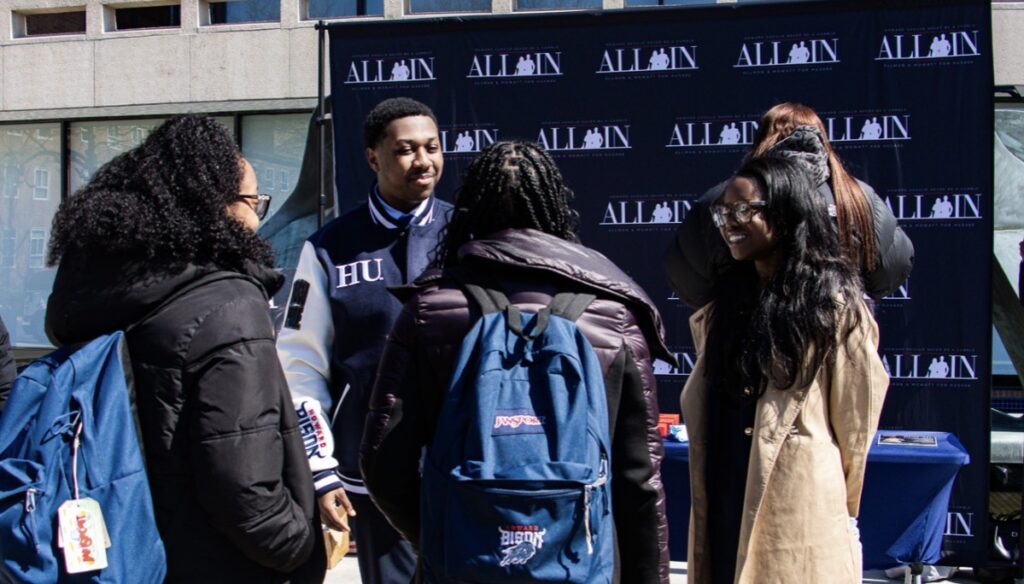
National trust in the government has dropped to a record low, with the majority of young adults ages 18-34 voicing discontent with incompetence and corruption. Among a generation increasingly disillusioned with politics, the role of the incoming student government at Howard is not just to lead but to convince a partially cynical, weary student body that they can and should trust political systems.
Elections were held in early April, and students elected positions ranging from Howard University Student Association (HUSA) president to senators to Mister and Miss Howard, each of which carries a responsibility beyond a title or sash. In the weeks leading up to the election, many candidates found themselves campaigning in the shadow of a broader political climate they could not ignore.
The 66th Howard University Student Association president-elect, Jeremy Allman, a junior honors political science major and history minor, views his role as “the eyes and ears” of Howard’s campus.
“We want to make sure students are in the room for real decisions that actually make real change,” Allman said. “If students don’t feel the impact, they’re not going to want to get involved.”
Allman argued that the current political climate, especially the Trump administration’s polarizing presence on platforms like X and Truth Social, has created a hostile environment that makes people feel excluded and unrepresented.
A youth poll from the Harvard Institute of Politics supports Allman’s assertion, finding that half of young Americans report that they “don’t have a say” in government. The survey reveals that as nearly half the generation struggles with inflation and housing costs, many see the political system as an unresponsive tool for elites only.
To counter this, Allman consciously avoids adopting tactics of contemporary politics, drawing instead from the 1969 Stonewall Riots and the advocacy of Marsha P. Johnson. The Stonewall Riots represented a turning point in the fight for LGBTQIA+ rights, and through her leadership, Marsha P. Johnson, a transgender Black woman, helped galvanize the fight for gay rights.
“I’m big on the quote ‘speak even when your voice shakes,’” Allman said.“The P in Marsha P. Johnson stands for ‘pay no mind,’ which motivates how I lead; if no one says it, it won’t get done.”
Newly elected College of Arts and Sciences senator and freshman political science major Michael James Jr. agrees with Allman; he said when people become fed up with the lack of transparency and accountability in national politics, the student government must work twice as hard to bridge that gap.
He advocates for radical inclusion, finding students that avoid political involvement and using a “boots on the ground” approach to restore trust in a discouraged population.
“On a college campus, there’s a beginner’s trust for when people go out in the world and vote,” James Jr. said. “If they can’t trust the government here, they can’t trust their government out there. We’re showing students what real leaders are and what the government should look like.”
A record high of 80 percent of Americans feel that the country is vastly divided on its most important values. During campaign season, James Jr. felt national division creeping onto campus, with different views of what Howard’s government should and shouldn’t do.
Instead of stoking polarization, James Jr. models his style of governing around compromise, reframing disagreements with fellow senators as a way to serve students.
“I govern off of compromise,”James Jr. said. “We can disagree and still come together to do our jobs and make a decision for the best of who we represent. We should still come together after we leave the Senate and be able to talk.”
While HUSA president and senators handle policy and the machinery of legislation, the 88th Miss Howard-elect, Ssanyu Lukoma, views her role as the bridge between the administration and the student body’s personal realities. For Lukoma, a junior broadcast journalism major and political science minor, the title is less about “smiling and waving” and more about acting as an ambassador and advocate to the school.
“When you’re selected and elected to be the most visible student leader on campus, it means that you have a responsibility to intentionally connect,” Lukoma said. “It’s an opportunity to serve in the best way that I know how.”
Lukoma acknowledges that Howard students are at a unique crossroads of being Black, Generation Z and living in the nation’s capital at a time where the government is failing to “uphold constitutional standards.” Despite this, Lukoma notes that this environment has empowered Howard students to be more vocal and make a social difference.
In a climate where polarization on campus often dominates voting patterns and culture, Lukoma said she strives to unify students in an already divisive culture.
While Lukoma relates to a level of fatigue and exhaustion, she offers a blunt perspective on those that opt out of politics on and off campus; to her, silence has a real cost: the loss of agency.
“If you’re complaining about the issue and you’re not contributing to any part of the solution when you have full access to it, there’s only so much I can do,” said Lukoma. “Your vote does matter. If you want to see change on campus, you not only need to vote but also advocate for what you believe in.”
Copy edited by Kennedi Bryant