

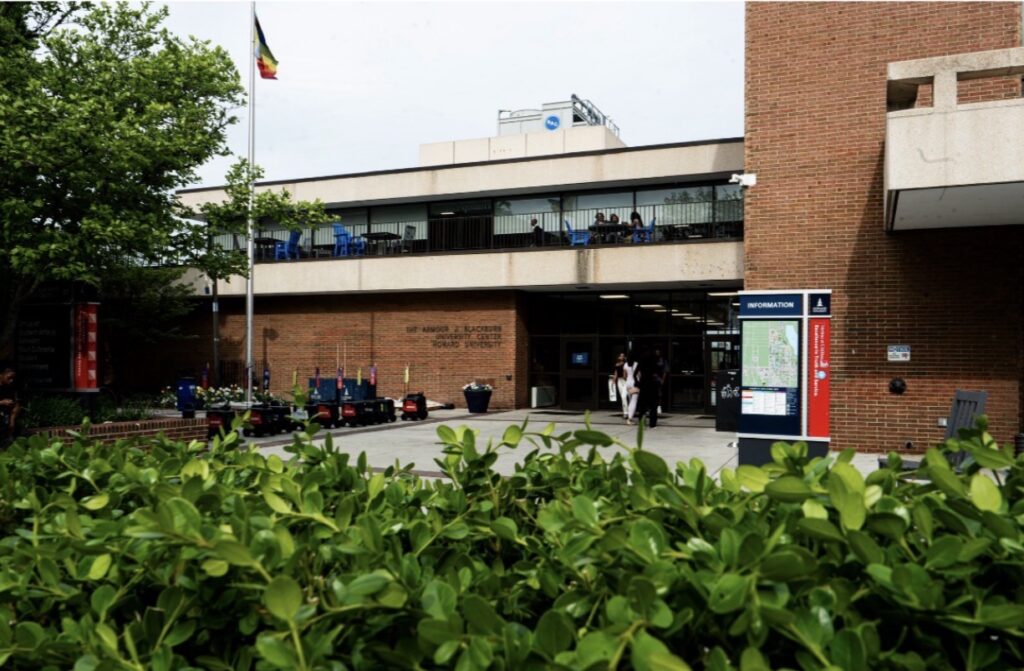
Organization-hosted activities are a key part of student life at Howard University, but recently students have found it difficult for their organizations to host events due to barriers in reserving one of Howard’s biggest buildings.
Yoselyn Owolabi, a junior political science and criminology double major, serves as the events chair of B.E.S.T. You Programming, a mentorship organization on Howard’s campus. She experienced these scheduling issues firsthand.
“There was a time where one of our event weeks had to be rescheduled twice,” she said.
Scheduling space in the Armour J. Blackburn University Center can be a lengthy process. All official Howard University clubs and organizations operate event scheduling procedures using an online platform called Engage. In order to reserve a room, a member of the organization’s executive board — often the events coordinator — must submit an event request in Engage two weeks prior.
“Since getting a room is contingent on an Engage approval, it really depends on when your advisor approves it” said Owolabi.
Due to delayed approvals at various stages of this process, rooms fill up very quickly in Blackburn. This has caused double bookings, meaning organizations have had to either reschedule on the day of the event or move their event online.
Owolabi mentioned that this particular week of events ended up having to be rescheduled a month later from the originally planned date. In other cases of double booking, some of the events for the B.E.S.T. You Programming organization had to move online.
“There have been about two to three events that we had to move virtually because the room ended up being double-booked or we didn’t get a room in time.”
Additionally, Owolabi mentioned that some organizations will schedule events in the same room and during the same time as a class that is taking place there. Class periods that meet later in the day often conflict with times that organizations commonly host events.
Owolabi believes that the ideal solution would be to have one system with all buildings and rooms available for reservation in one place.
“I think that if there was a centralized system that all the colleges and buildings could adopt together, we could pick something anywhere and it would all be in one system,” she said.
While a majority of the event scheduling and room booking process is done online, there is an Office of Central Scheduling located inside Blackburn. Some students have gone in person to get scheduling issues sorted out.
“Instead of waiting for an email back, I’d rather just go to the office and get it done in real time,” said Owolabi.
Although this seems like it would be more effective, according to Owolabi, many students often enter the scheduling office to find lines of students who had the same idea.
Jerrain Holmes, a junior finance major from Detroit, Michigan, serves as the associate director of the Special Projects and Programming Department of the Howard University Student Association. He wishes that more organizations knew about the other building options for hosting events and believes the Blackburn scheduling office could help redirect students in the event of a double booking.
“Let students know that there are other opportunities (for room scheduling) other than Blackburn and Douglass [Hall],” said Holmes.
According to communication sent out during meetings with executive board members of organizations, student organizations are required to host a minimum of three events per semester to remain active. General body meetings and service programming do not count toward the minimum number of events.
“It makes it harder to even reach that cap if we can’t even secure the rooms,” said Holmes.
Student organizations that tried booking a room as early as March 17 were notified via email that there would be no more space available in Blackburn for room reservations for the rest of the semester, with the final day of all approved programming being April 24.
Holmes and Owolabi suggested reform to the existing system for scheduling rooms. Both students recognize that this is not solely the fault of the Office of Central Scheduling at Blackburn and is the result of many complicated factors.
Much of the scheduling process is first come first serve and requires student organization leaders to be proactive and quick with the cultivation and submission of their programming. Holmes learned from talking with other student leaders that some organizations get all of their events scheduled as early as the beginning of each semester.

“Everything is not always centered around Blackburn scheduling,” he said. “I feel like Blackburn scheduling could provide those other examples (of alternate spaces to book) for student organizations to be seen.”
The Office of University Scheduling, Executive Director of Campus Life, and Assistant Director of Student Involvement were all reached out to for comment but did not respond in time for publication.
Copy edited by Daryl R. Thomas Jr.