

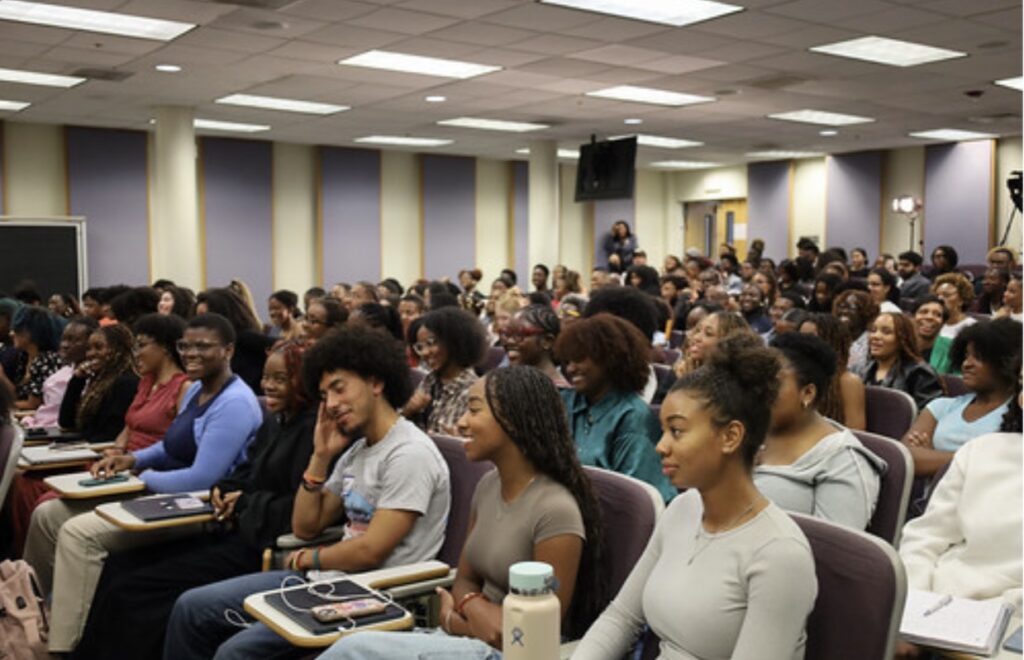
A recent study published in JAMA Network Open found that Black adults who attended historically Black colleges and universities (HBCUs) performed better on cognitive tests later in life than those who attended predominantly white institutions.
The findings are shifting how researchers think about the role of college beyond academics, emphasizing how campus environments may influence long-term health.
Dr. Iesha Fields, Ph.D., a biology professor, program coordinator and triple alum of Howard, said the findings align with both her professional and lived experience.
“[HBCUs] create an environment where students see themselves reflected in the leadership and curriculum, which provides a powerful sense of belonging that is often missing at other institutions,” Fields said.
The study analyzed nearly 2,000 Black adults who attended college between 1940 and 1980. Researchers measured memory, language and overall cognitive function decades later, finding consistent advantages among HBCU attendees.
Those outcomes may be linked to culturally affirming environments that reduce exposure to racial stress, a factor long associated with higher mortality and chronic health risks.
Fields described the sense of belonging at HBCUs not only as social support, but as a condition that allows students to fully academically engage without the burden of constant self-monitoring.
“Psychologically, Howard provides what I like to call mental breathing room. When you feel safe and seen, your brain isn’t busy managing anxiety; it’s free to do the heavy lifting of learning and critical thinking.”
In that environment, academic performance and mental well-being are not competing priorities but reinforcing ones, allowing students to develop without separating intellectual growth from personal stability.
“For four years, students are shielded from a variable that is often a constant stressor both before and after college. By providing a safe space for expression and a deep connection to cultural identity,” Fields said.
Chronic stress, she noted, is not abstract. It has measurable effects on the body, particularly when individuals are placed in environments that demand constant adaptation or vigilance. Over time, that sustained pressure can affect memory, focus and cognitive endurance.
“At a PWI, Black students are often required to code-switch and navigate systemic biases, which likely triggers stress.” Fields explains, “Surrounding students with mentors who share their lived experiences and a curriculum that centers their contributions to science and society helps foster a secure sense of self.”
The contrast between those environments offers a clearer understanding of how stress is not only experienced, but absorbed over time, shaping how individuals learn, retain information and respond to pressure well into adulthood.
Psychology professor Dr. Monique Major, Ph.D. said Howard’s campus offers structured support that helps students manage stress and maintain well-being.
“Howard’s Division of Student Activities offers counseling services to students individually or in groups,” Major said. “They also offer workshops throughout the academic year to help students manage stress, maintain their well-being and navigate unexpected life challenges.”
Major reinforced that academic programs and mental health resources work together, equipping students to navigate both coursework and life challenges.
“Studets form peer networks with like-minded individuals who share backgrounds and goals. These friend groups become fertile ground for intellectual sharpness, excellence, and creativity rooted in acceptance,” she said.
The connections students form on campus create a lasting foundation. Peer networks highlight both personal and academic growth, offering guidance and support that alumni carry into their careers, communities and everyday lives.
Danielle Jefferson, a sophomore health science major from New York City whose high school was a predominantly white institution (PWI), said that her experience at an HBCU has strengthened her confidence and perspective.
“I feel like I can be myself more, and flourish in a way that I was not able to at my previous PWIs,” Jefferson said.
She described her earlier academic environments as spaces where expectations often felt external, determined by standards that did not reflect her identity.

“At PWIs, it can feel like a bubble, with less exposure to what I would consider the norm or how most people in the world actually are,” Jefferson said. “There was always pressure to conform, and to excel in a way that felt tied to societal norms and, at times, elitism.”
Jefferson explains that at Howard the pressure to succeed becomes a personal challenge rather than a measure against others. The perception pivots from external expectations to discovering and refining her own potential.
“Howard has pushed me to value the strength of the connections I’m building, not just knowing influential people,” Jefferson emphasized. “There’s a balance, and it’s taught me to seek that and value it much more.”
This advancement beyond academics influences how she perceives her identity and situates herself within the African diaspora and the wider world.
“I have more of an appreciation for the African diaspora since attending an HBCU,” she said. “It has been a cultural immersion that influenced my identity in a way I couldn’t replicate anywhere else.”
Jefferson’s experiences illustrate how HBCUs reshape the pressures of societal expectations and systemic bias into opportunities for growth, allowing students to excel on their own terms while strengthening their belonging and establishing positive long-term outcomes.
“There is still pressure [attending an HBCU], but it emphasizes becoming your best self.” Jefferson continues, “It almost forces you to become the best version of yourself in every aspect of life, whether that’s your mental health, wellness, community engagement or academics.
Copy edited by Daryl R. Thomas Jr.