

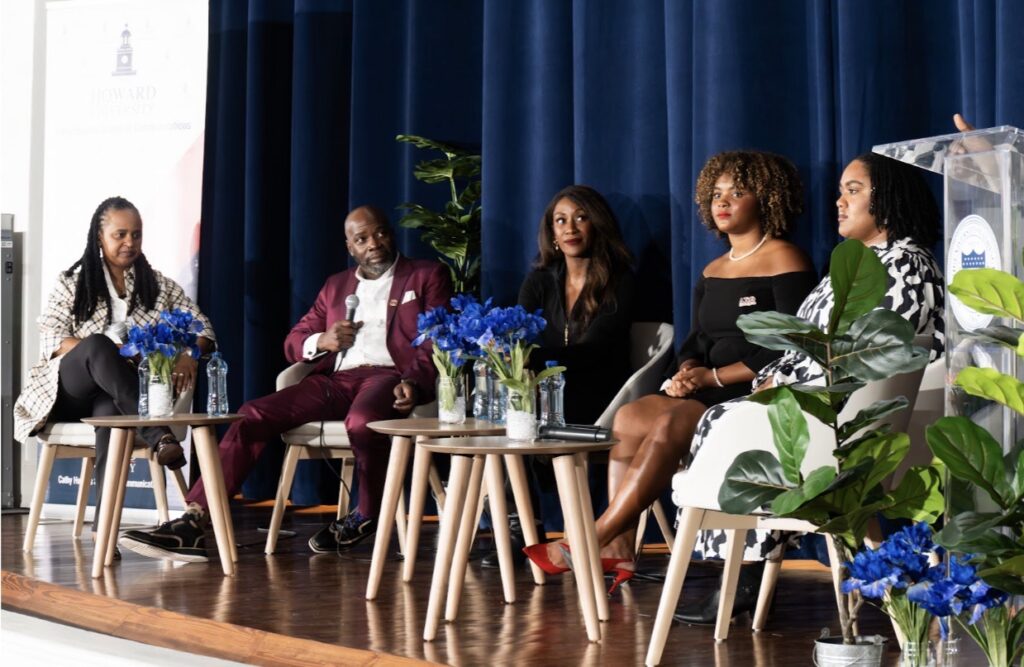
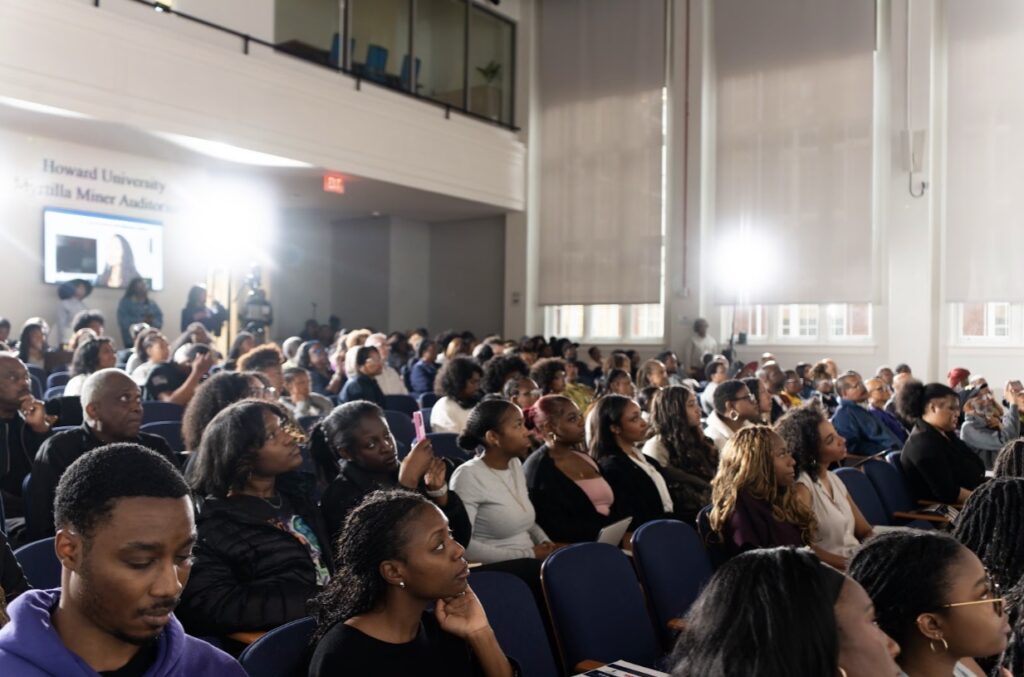
Laughter, community and leadership filled Miner Hall auditorium on April 2 as the Cathy Hughes School of Communications hosted a “Reporting While Black” panel featuring six Black journalists, marking their second event of the semester.
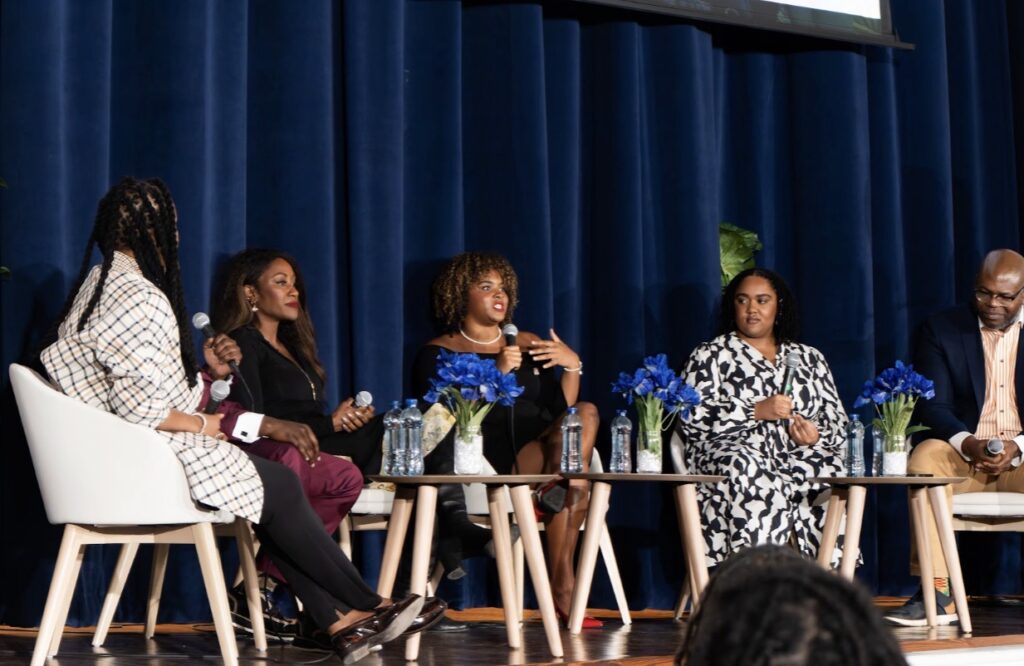
The panelists included Karen Attiah, Michael Harriot, Jason Johnson, PhD and Stacey Patton, PhD, who took the place of Joy-Ann Reid as she responded to breaking news. It also featured two Howard University student journalists, Myla Roundy and Zoe Cummings.
Communications students were present in the room with camera and sound equipment alongside members of Howard University Television (WHUT), which streamed the event.
Johnson served as the moderator for the panel, asking each panelist questions. Johnson has provided commentary for outlets on four continents and recently launched a Substack. He started his self-titled YouTube channel six months ago, and has amassed over one million views and over 40 thousand subscribers.
“The presence of our student journalists on this stage matters just as much because they are not the future of journalism; they are journalism. They are right now,” Patton said in her opening remarks.
Patton is an award-winning journalist, historian, author and child advocate. She built an independent journalism platform on Substack with over 46,000 subscribers and has a new book titled, “Strung Up: How White America Learned to Lynch Black Children” set to release on Oct. 6. Patton teaches journalism at Howard and formerly taught journalism at Morgan State University where she currently serves as a research associate. She said she uses the proceeds from her Substack to support her HBCU journalism students, hoping to never have to tell her students, “no.”
Part of Patton’s teaching philosophy includes introducing students to entrepreneurial journalism, which she defines as using new media platforms to control messaging while also engaging audiences on social media. She believes it includes thinking outside of the corporate space, beyond traditional storytelling.
“Last summer, I got on Substack and for the first time in my life as a writer and journalist, I felt absolutely free,” Patton said, “No editor telling me to soften my language, no institution asking me to die with the truth. I build my own audience; I generate my own revenue.”
Cummings, a graduating journalism major, has reported on culture, business and politics. She is an incoming intern with the Washington Post for the summer of 2026, a Forbes HBCU scholar, as well as a two-time editor-in-chief of Howard’s Cover2Cover magazine. Cummings described entrepreneurial journalism as a realm where one should confidently express authenticity across various platforms.
“Though you can’t always do that successfully at legacy media corporations, you can always do it in the safety of your own site or publishing,” Cummings said. “It’s not enough to just be in the room anymore. You have to be willing to get into the room and say something of substance.”
Cummings reflected on her experience at her first summer internship upon finishing her sophomore year of college, recalling a pivotal Zoom meeting with a grassroots women’s organization that raised over a million dollars for Kamala Harris’s campaign. She felt that this was a story to tell, yet her colleagues at a news outlet thought differently.
“I remember sitting in that meeting and heard a room of people that did not look like me talk about how impossible it was gonna be for her to win that race,” Cummings said.
While her peers dismissed the possibility of Harris winning, instead focusing on potential failures, Cummings felt compelled to tell a different story. After discussing her ideas with her assignment desk editor, she was able to get an article out and make an impact.
“I spent the entire day researching and writing the article, and when we finally got it up, it was the highest viewed article on our site for the week,” Cummings said.
Attiah is an award-winning journalist, editor and Columbia University and Northwestern University graduate. She was formerly a columnist and the founding global opinion editor at the Washington Post and currently leads a Renaissance Study series she started in 2025, focused on banned subjects in today’s political climate.
Attiah had a similar story in making an impact through adversity. After spending three years designing her race and media course at Columbia University, the university decided not to renew it after just one term. Refusing to quit, she took to social media to ask if anyone was interested in taking the course. She was able to get traction beyond her expectations, turning cancellation into community.
“It turned out 2,000 people responded, selling out 500 spots in 48 hours, and I decided to teach them around last summer, and I decided to do it again in the fall,” Attiah said.
Attiah was also recently terminated from her opinion position at the Washington Post posting on social media following Charlie Kirk’s assassination.
“I was talking about how America is a country that coddles white male violence that absolves them of their actions,” Attiah said. “Within not even 12 hours, I get an email notice of termination…that I was accused of misconduct and that I put my colleagues in physical danger.”
Following the termination, Attiah shared her story on Substack, catching the attention of Barack Obama and leading her to 52,000 subscribers on the platform. She said she is in the process of taking further action.
“I was fired for not only doing my job, but for telling the truth…it’s a lesson that you can do everything right and still be wrong,” Attiah said.“But now I don’t see it that way. I look at it as, like, I did everything right and now I’m free.”
Harriot is an award-winning journalist, author of New York Times bestseller “Black AF History, The Un-Whitewashed Story of America,” and the founder of contrabandcamp.com, a journal collective covering the intersection of race, culture and politics.

Harriot believes that platforms such as The Washington Post benefit from Black people and their stories and contributions. Harriot is currently working on an article that questions whether or not AI makes America more racist.
“If you feed racism into an algorithm…what if it makes us more racist? A lot of us depend on it as a venue or access to capital,” Harriot said.
When said it is journalists’ responsibility to hold up a mirror to politics.
“Our responsibility is to not be beholden to the false notion of objectivity because it’s a white notion and speak clearly and to the point,” Harriot said.
Roundy is a third-year journalism major who currently serves as the investigative section editor for The Hilltop. When it comes to the future of journalism, Roundy believes it will center on intention. She has experience covering stories on politics and education sustainability, and has interned at multiple news outlets. Roundy currently runs her own Substack titled “Myla’s Muse,” which she has had for two years.
“A word to describe the future of journalism would be intentional…when you have people that are intentional about the work they produce, that’s when you get the best stories,” Roundy said.
Roundy also believes in the community aspect that journalism offers. While scrolling on Substack, Roundy gets story ideas and witnesses writers pouring into each other. Roundy approaches her writing with intentionality as well.
“Every story that I published, there’s always a Black voice in that piece… It’s something that I’m very intentional about…that’s something that matters,” Roundy said.
Patton said that the future of journalism will not rely on a big corporate outlet in big town Manhattan.
“It’s not going to be reporters sitting at a news desk saying ‘Back to you, Bob,’ and instead, will be a lot more like Don Lemon on New Year’s Eve getting lit holding his microphone upside down as he picks it back up and still reports the news,” she said.
“It’s audience-owned, it’s immersive, it’s authentic, multilingual, diverse, global. It’s queer, fluid. It’s not going to be CNN at all,” Patton added.
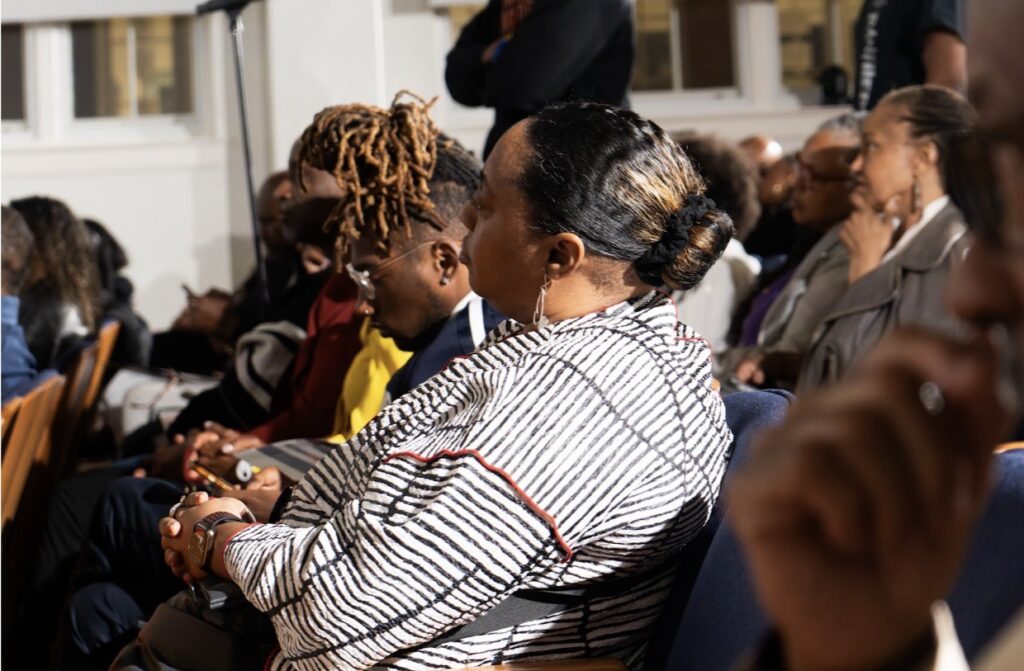
Jeneane Jones was a panel attendee and has 40 years of experience in media. She recalled her experience in journalism compared to the current state of journalism.
“We did not have the ability to fight with nuance. We had to fight to stay in our position,” Jones said.
Jones appreciated the panelists’ attitude towards fighting for what they believe in, and agrees that student journalists are not the future, but the now.
“When I see this kind of platform that took place today, the individuals who are presenting, representing, I could see them leaping over our shoulders,” Jones said.
dominic k. mckenzie, the lead emcee and an assistant professor in the School of Communications, brought the panel to a close with a message for the audience.
“You do not have to wait to be chosen. You do not have to shrink yourself to be published…you can build, you can own, you can tell the truth…so now it’s your turn,” mckenzie said.
Copy edited by D’Nyah Jefferson – Philmore