

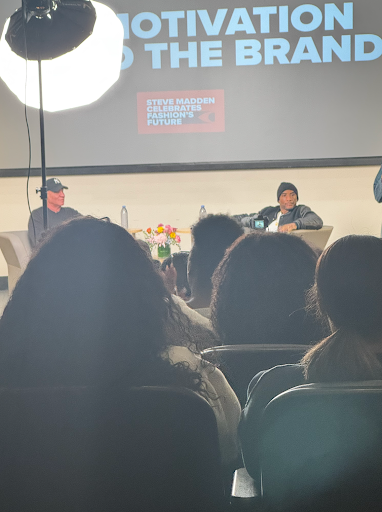
In a room packed with the next generation of Black entrepreneurs and creatives, two unlikely allies sat down in the School of Business’ Auditorium to discuss the messy, non-linear path to global success. On one side of the stage was Steve Madden, the footwear mogul who built a billion-dollar empire from the trunk of his car; on the other, Charlamagne tha God, the media mogul and Radio Hall of Famer known for his brand of truth.
Madden opened the discussion by addressing his childhood and his struggle with Attention Deficit Disorder (ADD). He described his mind as a “cable box” where the channels are constantly changing, making it difficult to function in traditional settings. However, he argued that this “learning difference” became his primary business advantage.
“It is a gift and a curse at the same time,” Madden said. “It’s a gift because you’re able to do a lot of stuff, but it can take you down, too.”
Charlamagne, the host of the event, shifted the conversation to social and emotional health, noting that these skills are rarely taught in college but are essential for survival. Madden agreed, noting that while his mind moves at high speeds, he now relies on prayer, meditation and exercise to stay grounded.
“It still takes me an hour to get out of my own head in the morning,” Madden admitted, emphasizing that even at his level of success, he even needs to tell his brain to “slow down.”
One of the most practical takeaways for the entrepreneurs in the room was Madden’s emphasis on mentorship and learning a craft from the bottom up. Madden didn’t start as a big-time designer; he started by sweeping the basement of a shoe store.
He modeled his career after the store’s owner, a 30-year-old businessman who proved that “you could be cool and still be a successful businessman.”
Madden stressed that having a mentor is a “lost art” and that students should look for someone they genuinely respect to begin their journey. He spent years in the wholesale business learning every facet of the industry from design to finance before ever launching his own line.
The conversation then turned to Madden’s 41-month prison sentence for financial impropriety, a period he attributes to a lack of gratitude and a toxic habit of comparison.
“I was too greedy,” Madden said. “I wanted money because I saw other people with it. I felt somehow ‘less than’ if you had more money than me”
Madden described the “heartbreak” of prison life: the terrible food, the lack of medical care, and the sad feeling when visitors would leave while he had to return to a cell. He credited his bounce back to a singular focus: the shoes.
When he was released, he didn’t try to reinvent his image through public relations; he rebuilt his trust with the industry by simply making better products.
“It’s about the craft,” he told the students.”Make shoes the ‘girlies’ want to buy. That’s it.”
Madden’s early success came from identifying what was not already out there on the market. In the 90s, the shoe industry had forgotten about teenagers. Madden began making “little shoes that the girlies liked,” such as backless clogs that looked like boots when worn with jeans, and “Mary Janes” with dance-inspired straps.
When asked about current trends, Madden was honest about the difficulty of pivoting. While he is known for heels, he had to force himself to move into sneakers because they became a part of mainstream American culture.
When a student in the crowd asked about the specific transition from being a “talented” creative to becoming a “strategic” business owner, Madden’s response was surprisingly blunt. He argued that one of the most difficult things for a young person to unlearn is the need to overshare.
“I had to learn to keep my mouth shut,” Madden told the student.
He explained that a significant part of strategic power is internalizing your vision rather than broadcasting it to everyone.
“You don’t need to let everyone know what you’re thinking all the time. Nobody can look into your brain, and that is a big gift,” he said.
The conversation on strategy naturally flowed into the concept of consumer risk, prompted by a question from another student. She asked how a brand can encourage consumers to break barriers and take risks with their personal style.
Madden admitted that today’s digital landscape has created a paradox: while technology like TikTok offers massive reach, it has made the current generation less likely to take actual fashion risks. He described modern consumers as a “herd of cattle” who are often too scared of

social media backlash to embrace a trend before it’s already been validated by the algorithm. His advice for creators was to stay open to new information but to prioritize their gut instinct over what is currently trending on a feed.
“I want to be a first-rate version of me, not a second-rate version of someone else,” Charlamagne told the room.
He critiqued the modern obsession with following someone else’s dream just because it looks profitable online. He argued that if you “find the unique gift God gave you, the world will eventually open up.”
This shift in perspective served as the defining lesson of the afternoon: success isn’t about chasing the crowd; it’s about having the patience to let the crowd eventually find you.
The event ended with a reality check on wealth. Madden admitted that he likes money because it allows him to help his family and friends, but he warned that “money cannot buy happiness.” He defined his current happiness at about “80 percent of the time,” reflecting on an earlier point that he’s not “perfect,” and still struggles to get going sometimes.
For the students, the message was clear: there are no shortcuts. Whether you are dealing with a learning disability, a major professional setback, or the pressure of social media, the only way to build a global brand is to learn your craft, respect the process and as Madden puts it, “keep putting one foot in front of the other.”
Copy Edited by Kennedi Bryant