

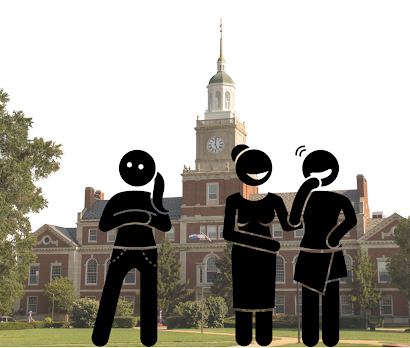
Last semester, a junior biology major hit it off with her organic chemistry class’s study group. The same five people met every week to split practice problems. They laughed, cried over grades and sent memes in the group chat. Two weeks ago, she saw one of the members. She smiled and started to wave. He looked directly past her and kept walking.
“I kept replaying it,” said the student, who requested to remain anonymous due to the sensitive nature of campus social dynamics. “We spent so much time together. How could he just ignore me like that?”
Some students recognize this social pattern and label it as the “Howard Treatment”: Deliberately pretending not to see someone you’ve met before — a classmate, a suitemate, someone you partied with — often because acknowledging them feels awkward, stressful or beneath you.
Senior communications major Noah Salaam said he knows it well.
“I’m typically the person who waves and won’t get a wave back,” he said. “That’s usually me.”
This is a fairly common occurrence on Howard’s campus. It probably happened this week, if not today. The Howard Treatment is a complex system of risk-award analysis that occurs in milliseconds. It usually goes something like this:
Walking across The Yard, someone familiar appears. Suddenly, the solar panels on top of Locke Hall become fascinating, or you train your eyes on your phone’s weather app as you run the calculation: How well do we know each other? What’s the appropriate level of greeting? Nod? Wave? Side hug? What if they don’t remember? What if they’re busy?
By the time the mental calculations are complete, the moment has passed.
When basic acknowledgment requires this much labor, pretending as if you never saw them is the easier option. But at Howard University, where community is lauded, this should not be acceptable. But is this specific to Howard, or a generation wide phenomenon?
Beyond Howard
Howard did not invent social awkwardness, nor did Generation Z. However, this generation perfected how to avoid it — desperate to avoid a “cringe” or “awkward” moment. And in a social media age where everything is retouched and interactions can be controlled, there is a generation of students who can spew eloquent think pieces on TikTok but freeze up at a spontaneous hallway conversation.
But the Howard Treatment is not specific to well, Howard.
Ana Mateo-Jerez, a student at Columbia University, recognized this pattern immediately. “I’ve definitely experienced that,” she said. “I’m also not going to lie, I think I’ve been that person before.”
When asked why this happens, her answer was blunt.
“Sometimes it’s just easier to not say hi to someone. It’s like an effort to have to talk to people or even wave.” Then she paused. “I also realized the opposite, that sometimes it’s harder to pretend you don’t know someone. I don’t know, it’s weird.”
Even students at other institutions recognize the absurdity while participating in it. However, Howard’s culture of excellence may be intensifying what appears to be a generational trend. Howard prides itself on cultivating high achievers and future leaders. But excellence can have a cost, a feeling that every moment is a performance. Every interaction is an opportunity to advance or risk a reputation. So it’s easier to choose to just opt out and conserve social energy for moments that “matter.”
Transactional Relationships
Then, there’s a transactional dynamic that makes the Howard Treatment particularly painful. Someone could be warm and friendly on the campaign trail for a council or senate seat, or when they ask to work together on a group project. The friendliness feels genuine and you excitedly think, “This could be the start of a real friendship.” But then the election ends, the project gets submitted and then suddenly, that same person walks past without acknowledgment.
A Howard senior who also requested anonymity described an experience with someone she’s known since freshman week and originally perceived as a friend, but unfortunately, they’re only in touch when they are running for a new student leadership position.
“When this person was running for something, they literally flagged me down to say hi and ask how I was doing,” she said. “They were so friendly, but the moment they got what they wanted, they went back to ignoring me. Well, until next year. Honestly, it’s exhausting.”
The next time that person is spotted across The Yard, there’s no anticipation of a wave. Just the sting of realizing that the relationship was always conditional. Over time, this breeds a suspicion that questions whether every friendly interaction on campus operates on this same logic. Is everyone performing connection? It’s not universally true — but reaching this conclusion is a fair response to repeated experiences.

The Matrix
Experiencing a lack of acknowledgement repeatedly can result in students defaulting to a defensive position. Why acknowledge anyone if there’s a chance they were only friendly when it served them or have they already forgotten you?
In this way, the Howard Treatment becomes protective — a way to avoid feeling foolish. But this stance gives way to a recursive problem: the weird social matrix where seeing someone you know triggers the memory of a previous failed acknowledgment. Last time, a wave went unreturned. So this time, preemptively withhold the wave to avoid getting ignored twice. But what if the other person was actually planning to acknowledge you, and now they think you’re the rude one?
Neither person is privy to the history informing the other’s behavior. The Howard Treatment becomes self-perpetuating, where each non-interaction justifies the next.
Nuance
It’s important to say that not every instance of nonacknowledgement constitutes the Howard Treatment. Sometimes people genuinely don’t see familiar faces. They may be distracted by an exam or mental health struggles that make even the smallest interaction impossible. Sometimes social anxiety, which is reported by over 60 percent of Generation Z, can make the idea of small talk unbearable. A Howard student expressed “turning his head” if he sees someone he’s not close with, because those interactions make him anxious.
The difference is intentionality. The treatment involves active avoidance. However, the challenge is that intentional avoidance and a genuine oversight can look identical from the outside. Even the most well-meaning students can inadvertently participate in this cycle, or feel hurt if someone didn’t notice them.
The Solution
If everyone experiences the Howard Treatment but everyone also contributes to it, the question becomes: what kind of community does Howard want to be?
There’s no perfect solution. HUSA can’t mandate friendlessness; there’s no policy Howard can issue to address Howard Treatment. So the solution lies in individual effort. Trying to be kinder and more genuine, while also extending grace. Maybe the person who walked past you had a horrible day. Maybe they genuinely didn’t see you.
But on the flip side, sometimes that person actually did see you. Sometimes the avoidance is deliberate, and both realities can be true simultaneously, which makes this complicated.
The Howard Treatment thrives when students feel they must curate themselves, but it diminishes when people remember that basic human acknowledgment doesn’t have to be a performance. A nod costs nothing. Saying “hey” isn’t a declaration of love.
Howard’s mission centers on excellence and that mission matters, but the pursuit of excellence shouldn’t require sacrificing the ability to see and be seen by others sharing that same pursuit.
Real leadership requires genuine connection.
Copy edited by Daryl R. Thomas Jr.