

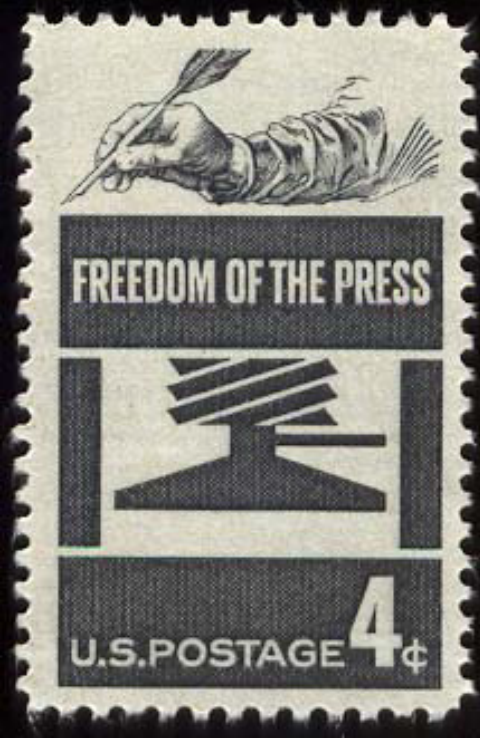
Amendment. (Photo courtesy of Wikimedia Commons)
Black students who heard about the arrests of journalists Don Lemon and Georgia Fort by the hands of the Trump administration saw an escalation to the censorship of the press, demonstrating a threat to First Amendment freedoms and protections.
On Jan.18, protesters entered a church in St. Paul, Minn., and interrupted a church service full of chants related to Immigration and Customs Enforcement (ICE). A chaotic scene unfolded inside the church as protesters and members of the Southern Baptist Church convention shouted at each other over injustices committed by ICE officers.
Lemon, a former CNN host, and Fort, a local journalist, entered the church to cover the demonstration against the Trump administration’s immigration crackdown in the Twin Cities.
According to an unsealed federal indictment, the United States Department of Justice accused Lemon and Fort of conspiring to deprive others of their constitutional rights — a felony punishable up to 10 years in prison, a fine or both for allegedly obstructing the free exercise of religion in a place of worship.
Lemon pleaded not guilty to federal civil rights charges. His attorney did not return calls seeking comments about Lemon’s legal process, but arrangements in federal court typically include the entering of pleas and scheduling for future proceedings.
“We don’t prosecute journalists for doing their job. That happens in Russia, China, Iran and other authoritarian regimes. And yet the government sold this unconstitutional mess to the grant jury,” the motion states.
While both parties, the church and the press, have their rights to freedom of expression, only the press was held liable in contrast to the ICE protesters’ actions or contributing factors that may have escalated the situation.
Being at the scene of a breaking news development to report is considered the job of a journalist. It is actively protected by the First Amendment, which expressly protects “freedom of the press.”
The president of Washington Association of Black Journalists (WABJ), Phil Lewis, underscored the importance of freedom to independent journalism and aspiring young journalists and what he believed this moment signifies for the future of aspiring press freedom and independent reporting.
“There’s a lot of doom and gloom about the journalism industry, a lot of which is valid,” Lewis said. “I’m hopeful people will understand why a free independent media is so important.”
Lewis spoke to the perspective of young journalists, especially from Black perspectives and how to interpret the unfolding and changing bureaucracy of access to freedom of speech under this administration and beyond.
“Young journalists understand how crucial it is to hold those in power to account, and the arrests of Don Lemon and Georgia Fort only underscore that point,” said Lewis. “There are more ways now than ever to tell stories and get people to listen.”
Lewis explained how Black journalists, in particular, have always been under attack, so this moment isn’t unfamiliar. In May 1892, a white mob destroyed the Memphis office of “Free Speech and Headlight,” the newspaper co-owned by journalist Ida B. Wells after she published an editorial exposing the truth behind lynching. Despite this history, Lewis remains inspired by the new generation of journalists who are taking up the mantle and contributing to the work of past journalists.
“I have spent my entire career covering the news. I will not stop now.” Lemon commented after his arrest. “There is no more important time than right now, this moment for a free and independent media shines a light on the truth and holds those in power accountable.”
Fort noted on Feb. 2 that she has received support from her community and legal team since her arrest, with individuals donating to her website and legal fund to support the ability to continue telling stories.
“There’s been a strategic attack on the free press for quite some time,” Fort told MS Now’s Rachel Maddow. She added that it is intensifying and her arrest and Don Lemon’s arrest are a new level of threat to taking someone’s freedom away.
Attorneys for Lemon and Fort filed a joint motion seeking the disclosure of grant jury proceedings, calling the case an “unconstitutional mess” unworthy of the American justice system.
In a statement published from their website, the National Association of Black Journalists (NABJ) wrote how the arrests of Lemon and Fort are part of “the government’s escalating effort and actions to criminalize and threaten press freedom under the guise of law enforcement.”
NABJ released a blog post on Jan. 30th, writing “a government that responds to scrutiny by targeting the messenger is not protecting the public, it is attempting to intimidate it.”
The Howard University Association of Black Journalists (HUABJ), a collegiate chapter of NABJ, aims to cultivate, teach and prepare current student journalists at Howard. It hosts events for their members and provides them with resources and opportunities to be successful in the field of journalism.
Rasiah Worthy is a senior journalism major with a sports administration minor from Detroit, Michigan. She also serves as this year’s president of HUABJ.

While HUABJ does not have any plans to release their own official statement pertaining to the arrests, they reposted the statement that was released by the WABJ chapter on its Instagram account.
Worthy said she understands the apprehension Howard University students may be facing related to their futures in journalism after the arrests occurred.
“We all know the ethics of journalism and we honor the freedom of the press, so in a perfect world nothing is supposed to happen to us,” she said.
Worthy added that she believed it would be beneficial to include courses in the journalism degree scheme that address safe reporting and how to stay safe as a student journalist.
“I think they need to incorporate that [journalism safety] into the curriculum more because there are people who want to cover immigration and politics in general. It’s just scary,” she said.
Worthy believes that students should lean on their professors, as well as each other, for support during this time. She also stresses the importance of becoming a member of your local NABJ chapter.
“Lean on the organizations like NABJ and WABJ because we have the resources,” she said. “We just need to know that’s what you want first.”
According to their website, HUABJ believes that students should bind together and continue to increase Black employment in the journalism space. As an official student chapter of NABJ, the organization hopes to encourage and educate current student journalists at Howard University.
Maureen Abraham, a sophomore broadcast journalism major and political science minor from Fort Lauderdale, Florida, is a member of HUABJ. Abraham joined HUABJ to find a common space to talk with her peers and grow in her journalistic skills.
As a member of HUABJ, she has attended speaker sessions and utilized resources that the organization has provided. She has also been able to form a community with fellow journalism majors at Howard.
For Abraham, the arrests of Don Lemon and Georgia Fort left a substantial impact. As a journalism major, she found herself discussing the subject in most of her everyday classes. Some of the content in these conversations left her reconsidering her future with journalism.
“It makes me question what my limitations will be,” she said. “I know I have a service to report the truth but at what cost?”
Copy edited by D’Nyah Jefferson – Philmore