

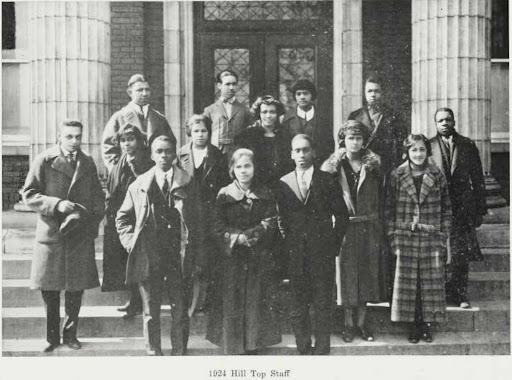
People have long associated famous author Zora Neale Hurston with The Hilltop, naming her one of our founders, alongside Louis Eugene King. But, what if I told you that she did not actually co-found the newspaper?
The Hilltop’s inaugural Jan. 22, 1924 edition does not list Hurston on its masthead. In her autobiography, she makes no mention of founding the paper — only that she named the paper during the year and a half she attended Howard University.
“I joined the Zeta Phi Beta Sorority, took part in all the literary activities on the campus, and made The Stylus, the small literary society on the hill. I named the student paper The Hill Top,” Hurston wrote.
This was recently pointed out to me by Robert Vickers, a class of 1990 Howard graduate and former national and local editor for The Hilltop. For the celebration of The Hilltop’s centennial year in 2024, Vickers did extensive research on the history of the Hilltop and saw no bylines from Hurston in the archives, with her name only appearing in articles after she graduated from Howard.
“It’s a technical distinction, but journalists are in the business of accuracy,” Vickers wrote to me in an email.
I couldn’t have put it better myself. Our job, put simply, is to seek the truth. It is a common expression in the industry that “journalism is the first draft of history.” However, even history was distorted throughout the years to fit certain narratives.
250 years ago, the so-called ‘founding fathers’ signed the Declaration of Independence, and with it came the concept of the ‘American Dream,’ which promised freedom, equality and justice for all. This came with caveats; these promises were only for white male landowners. And while for many years history books romanticized the early years of the country, the truth was different.
I implore you to consider another important quarter millennium: the 246 years of slavery in the United States, from 1619, 157 years before the birth of the nation, to the end of the Civil War and the ratification of the 13th Amendment in 1865. Even then, the plight of Black individuals continued throughout Reconstruction, the Jim Crow Era and the Civil Rights movement all the way through the 1970s. One could argue it continues today, as advocacy for Black rights manifests through the Black Lives Matter movement.
The current political administration brought diversity, equity and inclusion rollbacks, occupation of cities by National Guard and Immigration and Customs Enforcement (ICE) officers, who have overstepped their roles and used force to detain people.
It makes one wonder; what good are the founding values of our country if they are only meant for a select few? This is about more than political differences. It is about determining our value systems to know what we do and don’t find acceptable. And that starts with individuals.
Most Americans will tell you our country needs to change in some way. Historians like Peter Stearns of George Mason University argue that an understanding of history is crucial to evaluating the present state of a society and enacting any sort of change.
“Only through studying history can we grasp how things change; only through history can we begin to comprehend the factors that cause change; and only through history can we understand what elements of an institution or a society persist despite change,” writes Stearn in his 1998 essay, “Why Study History?”
In recent years, it has become tradition for Hilltop staff members to say “For Zora,” as a reminder of where the newspaper started. Several stories from publications like NPR to Howard’s The Dig call Hurston a co-founder.
Many might find it shocking that someone who has defined our work and guiding principles for so long did not have the tangible influence we once thought she did. We could choose to let it shake us, causing an identity crisis and calling for a reconstruction of everything The Hilltop once stood for. Or, we can continue with our founders’ mission to serve as the student voice of Howard University and continue to unify the Howard spirit, serve as a medium for student opinions and work constantly toward the welfare of the school.
After two and a half centuries, our country faces a similar crossroad to The Hilltop. Earlier this school year, at Howard’s 158th Convocation, Oratrix Sherrilyn Ifill called Howard students the “mothers and fathers of a new America.”
“We can choose to grieve the world that we have known or we can get to work on the new world that will come quickly in its wake,” Ifill said. “As surely as we can all feel that something is coming to an end, it is as sure as it is true that something new is preparing to be birthed in this country.”
We are being forced to reckon with where we have gone right and where we have gone wrong throughout history. We must choose how to move forward. To do so, it is imperative we remain critical of the information we receive. Yes, journalism is the first draft of history and journalism is about truth, but we are living in an age where the truth isn’t always valued by people in power.
In October of 2025, the United States Department of Defense under Defense Secretary Pete Hegseth imposed new rules for journalists who covered the military, requiring them to sign an agreement restricting their access to the Pentagon. Major outlets like the Associated Press, The New York Times and Fox News refused to sign, resulting in revoked access and government control over information.
More recently, independent journalists Don Lemon and Georgia Fort gained national attention for being arrested after covering an anti-ICE protest in Minnesota. These are just a few examples of the threats to the First Amendment facing the country today.
At the center of these events are the idea of truth, specifically who controls narratives and how much of the truth is shared.
Learning about the true role Hurston played in the origins of The Hilltop is a powerful reminder of the importance of remaining critical about what we believe, and open-minded about the information we receive. We must never stop pursuing an understanding of the truth of our history. That is the only way we have a chance at protecting our future.

Copy edited by Daryl R. Thomas Jr. and Kennedi Bryant