

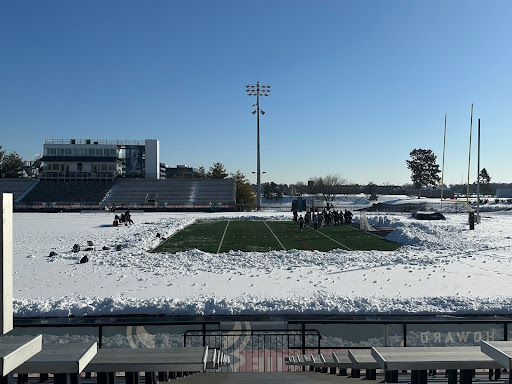
A major winter storm that placed the Washington, D.C. region under a state of emergency last weekend brought less snow than initially projected but produced an unusually heavy mix of sleet and ice, prompting widespread closures. District officials acknowledged the difficulty of clearing hardened conditions, and Howard University announced a near-weeklong campus shutdown over safety concerns.
The National Weather Service reported 7.5 inches of snow in parts of Washington, D.C., followed by an estimated two to four inches of sleet, a combination that officials said slowed cleanup efforts across the region despite progress on road and sidewalk clearance.
Behind the decision to extend the closure for much of the week was a multifaceted assessment by Howard’s emergency management team, which said administrative leaders weighed not only the weather forecast, but also regional transportation conditions and mobility risks.
“We look at a number of different things,” said Rashad Young, senior vice president and chief administrative officer of emergency management.
Young stated the university monitored snow accumulation, ice, road temperatures and transit operations across the region, including D.C., Maryland and Virginia.
“It’s one thing if D.C. can plow all of its streets,” he said, “but if neighborhoods and communities in Maryland and Virginia can’t plow or don’t plow, that then raises a challenge for us in terms of employees being able to get to campus to support operations.”
Forecast uncertainty also delayed a final decision until conditions became clear.
“The prediction was anywhere from two inches to 18 inches,” Young said. “If it’s two inches, we all probably can put our snow boots on and keep moving. If it’s 18 inches, that’s a different story.”
Though snowfall in the District totaled about 7.5 inches, officials said most of the dangerous conditions came from freezing sleet.
“The really complicating factor here was that the freezing sleet was much more than was predicted,” Young said. “We didn’t see that occurring until Sunday, when it started sleeting and freezing rain earlier than anticipated and went on longer.”
Ariel Triplett, executive director of emergency management and safety operations, said the university closely analyzed the timing, duration and severity of storm protection, particularly whether the highest impact coincides with peak commuting hours.
The university’s response extended beyond monitoring snow and ice, with Young stating that one of their top priorities was ensuring the safety and basic needs of students living on campus. With nearly 6,000 students in campus housing, Young explained that the university coordinated with auxiliary services and dining staff to keep meals available, even amid hazardous conditions.
“That requires staff to travel through whatever is happening on the streets to prepare, cook and serve food,” Young said. “In some cases, we had to put staff up in nearby hotels so they could make it to campus safely.”
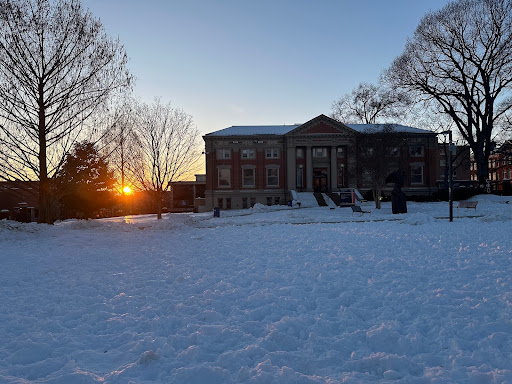
Triplett described the physical difficulties on campus as “snowcrete” — a hardened mixture of snow, sleet and ice that made clearing walkways particularly challenging.
Triplett said crews pre-treated roads, sidewalks and building entryways with salt before the storm, then returned afterwards with shovels, plows and chisels to break up hardened ice. She noted that the density of the ice complicated cleanup efforts across campus, with some snowplows reported as damaged during removal.
Camren Pitts, a sophomore from Las Vegas living in Howard Plaza West, said adjusting to the icy conditions was challenging, even though she had previously spent a year in Canada.
“It’s definitely a transition, coming from Vegas, where winters are usually 50 or 60 degrees, walking on roads covered with slush, snow and ice was really frustrating,” she stated.
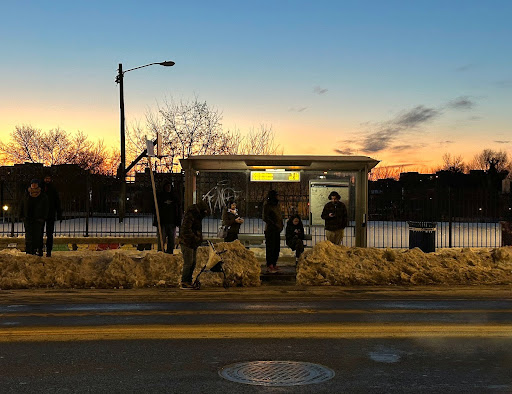
She added that navigating campus without a car made it especially difficult to get from point A to point B, with sidewalks often slippery or partially cleared. While her heater worked, some friends weren’t as fortunate, leaving their rooms uncomfortably cold.
Reflecting on the storm response, Pitts said she hoped future snow events could be cleared more quickly, noting that a week of virtual class seemed excessive if sidewalks were addressed sooner.
For residential students, the combination of frozen sidewalks and icy hills created major mobility risks.
“There were about two to three inches of ice sitting on top of the snow,” Triplett said. “It made it extremely difficult to get off, so we had to literally chisel away ice from sidewalks and resurface them with salt.”

Crews also used Bobcats and smaller plows to clear interior campus hills and academic building steps, she said, working outward from dormitories to the main pathways to make the campus as navigable as possible.
Howard officials said the needs of off-campus students were also carefully considered.
“We don’t have someone in every off-campus building, but we maintain a network of building managers, RAs and graduate assistants to understand what’s happening,” Triplett said. “Student Affairs maintains communication so we know how off-campus students are faring and can provide support if needed.”
In addition to physical safety, the university paid close attention to students’ mental health during the extended closure. Young highlighted there was no significant spike in reported concerns, but staff conducted daily check-ins to gauge well-being.
“We didn’t see a particular uptick in mental health concerns related to the storm,” he said. “But we were checking in with students daily, asking how they were feeling and how their friends were doing, to make sure they had support.”
Triplett noted that having live-in building managers provided critical real-time information.
“Many of our residence halls have a living building manager, a staff member who actually lives in the building,” she said. “They give us boots on the ground to understand what’s happening in dorms and to communicate any issues so we can respond immediately.”
Young emphasized that the university’s approach was not limited to residential students.
“We’re constantly thinking about all students, faculty, staff, alumni and guests, anyone who interacts with Howard,” he said. “Our goal is to make the university resilient and operational in all aspects, even during extreme weather.”
Copy edited by Kennedi Bryant