

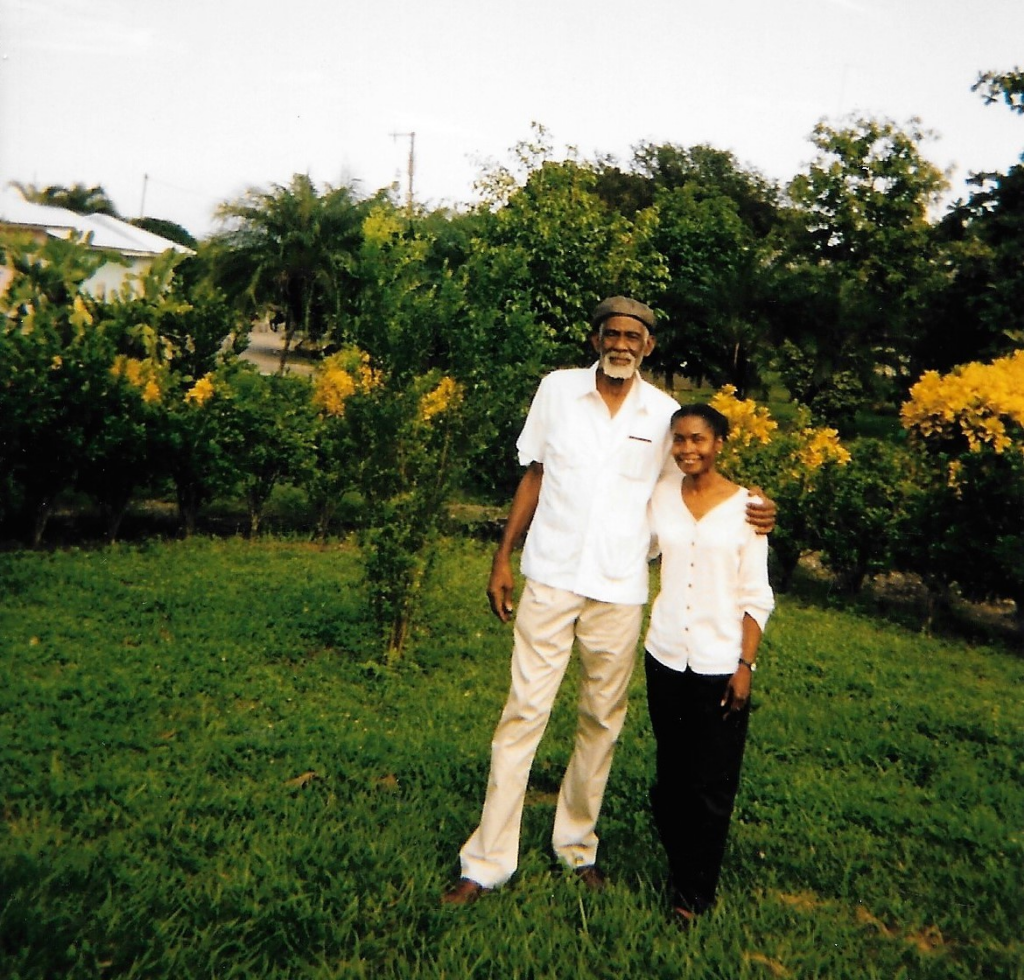
Howard University alumna and author Beverly Oliver released a new book revisiting a decades-old conversation with Alfredo Bowman, widely known as Dr. Sebi, a controversial figure whose holistic health philosophy continues to resonate within parts of the Black community.
“Seven Days in Usha Village: A Conversation With Dr. Sebi 20 Years Later” reflects on Oliver’s 2005 visit to Usha Village, a herbal wellness center founded by Bowman near La Ceiba, Honduras, where she spent a week assisting him with his memoir and documented her experience. The book was released following Bowman’s passing and marks the 20-year anniversary of that visit.
Bowman was a Honduran herbalist who trademarked the African Bio-Mineral Balance diet. His philosophy stated that disease stems from mucus and acidity in the body, and that to heal oneself, one must achieve an alkaline state through a plant-based alkaline diet.
The extent of validity in his claims remains widely disputed. Bowman, who was not a licensed medical professional, faced multiple lawsuits related to his medical assertions and died in Honduran police custody in 2016.
Medical professionals claim that while adding more fruits and vegetables to a person’s diet can be beneficial, Bowman’s diet is restrictive and does not provide enough nutrients for long-term use. They also reject claims that dietary changes can affect the body’s blood pH balance. Oliver claims her secondary research consistently supported Bowman’s views on the food-disease connection.
“I’m a continuation of Dr. Sebi and his teachings. I don’t want to let it die,” Oliver said.
Oliver is a class of 1979 graduate of the school of communications. Her latest work is a culmination of a journey spanning multiple decades through Bowman’s methodology. It began with an interview held with Bowman on WHUR-FM 96.3, Howard University’s radio station, in the 1980s.
Oliver frames the book as both a continuation of Bowman’s legacy and a personal commitment to carrying his teachings forward. She said she feels an obligation to preserve and share what she learned under his guidance, particularly to those she believes have been left uninformed.
“I feel my responsibility as a writer, as a protege of Dr. Sebi, is to tell the truth about food and disease—the history, and I do that under the teaching of Dr. Sebi. I always do it with the thoughts of Dr. Sebi, and his truth about disease and nutrition has become mine, and my responsibility is to impart that truth to underserved and larger communities,” Oliver said.
Oliver’s advocacy for the African Bio-Mineral Diet is not only based on following Bowman’s legacy but also on her own personal testimony and lived experience.
“I am a recipient of Dr. Sebi’s message. I had asthma. I had fibroid cysts, and then taking Dr. Sebi’s compounds—those things are gone,” Oliver said. “I am a staunch advocate and patron of the African Bio-Mineral Balance products and compounds. They’ve been in my cabinet for over 30 years and they’re not going anywhere.”
After decades of carrying Bowman’s message through memory, research and lived experience, Oliver says her hope is simple. She wants the conversation to continue beyond the page.
“If it sparks one action, it is to make people transition from a heavily meat-based, starch-based, mucus-based diet to one that is more plant-based…[and to] understand why I need to make that change,” Oliver said.
Her work sits within a broader conversation about how medicine engages with culture and trust, particularly in Black communities. At Howard University College of Medicine, where many students train in cultural competency, future physicians say cultural context is not an abstract concept but a daily reality.
For them, understanding why figures like Bowman resonate so deeply within Black communities requires acknowledging both the historical mistrust of healthcare and the role cultural identity plays in shaping how patients approach healing.
Jayln White, a second-year medical student at Howard University College of Medicine, said skepticism toward Western medicine can’t be discussed without acknowledging its history of medical racism.
“There’s a long list of reasons for the Black community to not trust modern-day healthcare, [from] the Tuskegee Syphilis Experiment, Henrietta Lacks, and how gynecology was birthed [with] the father of gynecology operating on black female patients. I think educating ourselves on the history of Black people [and] how science developed. I think that’s a conversation we need to have,” White said.
For medical students, that history often surfaces in conversations about the gap between community-based healing and what is taught in medical school.
“There is a gap, but I think there are people working to close it. At least here [Howard University College of Medicine], there’s a strong emphasis on professionalism, communication and respecting patients,” said Giselle Lample, a second-year medical student at Howard University College of Medicine
That approach, she says, is deeply influenced by the school’s diversity.
“We all come from different backgrounds, and many of us know what it feels like to not be respected as a patient. That shapes how we want to practice medicine,” Lampley said.

While debates around Bowman’s methodology continue, Oliver said her work is rooted in addressing long-standing health disparities and encouraging Black communities to reconsider how food and healing intersect.
“My personal responsibility is to help lower those numbers — to help get us off of those high statistics — and to educate people about food and the origins of our diseases, and let them know there are alternatives,” Oliver said.
Copy edited by Kennedi Bryant