

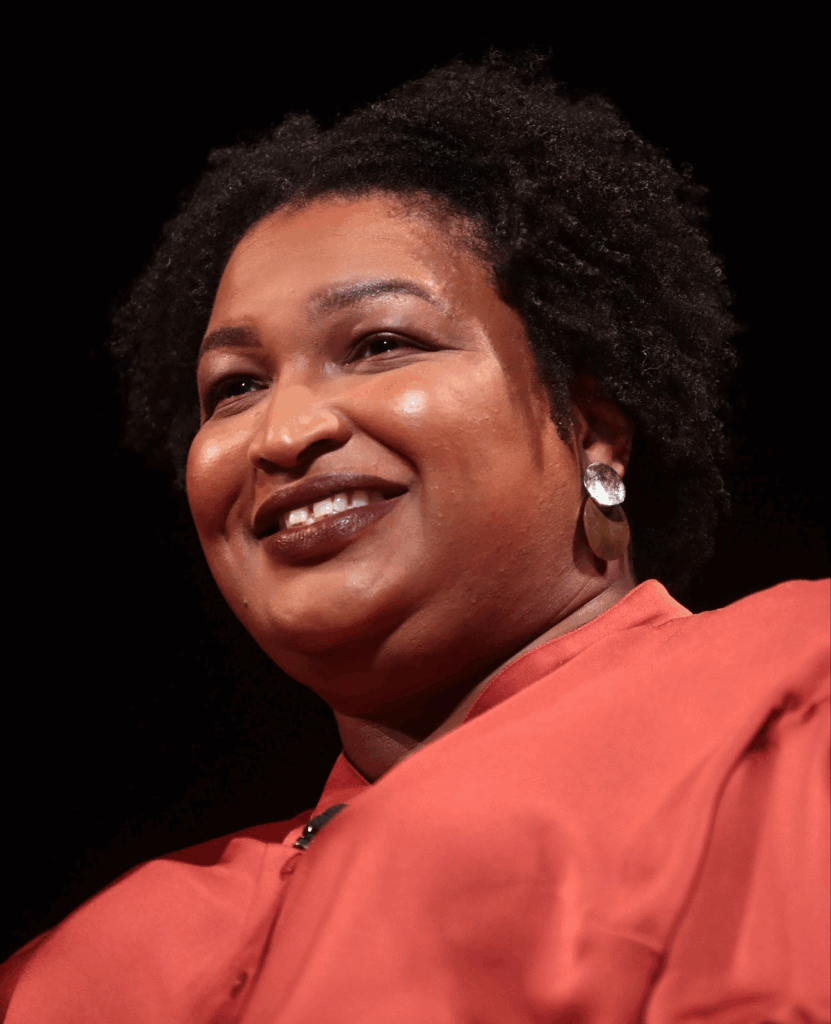
Stacey Abrams, the inaugural Ronald W. Walters Chair for Race and Black Politics at Howard University, led a virtual listening session that drew students, faculty and staff into a wide-ranging discussion on democracy, policing and power.
The event, held Sept. 15, was organized by Howard Ph.D. student Misha Cornelius, who introduced Abrams and framed the session as an opportunity for the Howard community to reflect on what they had been observing, experiencing and were most concerned about both locally in Washington, D.C. and nationally.
The conversation was moderated by Marcus Batchelor, political director for People For the American Way. Batchelor guided participants through anonymously submitted questions.
Abrams began with a stark assessment of the moment. She explained that when she accepted her position, the political landscape already faced challenges around diversity, equity and inclusion (DEI), AI and elections.
“We were facing attacks on DEI, rising concerns about AI, and questions about elections,” Abrams said. “We have been watching the very aggressive, organized and intentional erosion of democracy in this country.”
Abrams said the threat goes beyond abstract concepts. She argued that authoritarianism does not arrive suddenly but creeps in gradually, often through practices like aggressive policing, voter suppression, and the stripping away of local autonomy.
“The decision to be a democracy was the decision to let everyone, at least in theory, have a say. We’ve been delayed in perfecting what that means, but we’ve claimed democracy as who we are,” she said.
The first anonymously submitted question asked, “What role do police and their force, both in terms of control and in perpetuating the threat of violence, play in a classic authoritarian takeover?”
Abrams traced the evolution of authoritarianism.
“In the 20th century, you had a junta overnight,” she said.
She then contrasted this with today’s authoritarian leaders who win elections but manipulate the system so that democracy does not recover.
“Autocrats win elections. Authoritarians win elections. Dictators win elections. And then they make that the last free and fair election we ever see. That is what we are watching,” Abrams said.
But, she cautioned, Trump is not acting alone and clarified that it is not about one individual but about an entire political movement using every branch of government to consolidate control.
“This is an authoritarian power grab. It is the practice and intention of an entire political party that currently controls the presidency, Congress, and the judiciary,” Abrams said.
Abrams called the federal government’s assumption of control in D.C. “a military occupation of D.C. done because step nine of the authoritarian playbook is to normalize violence.”
She explained that when law enforcement is militarized, the police do not answer to the people but rather the commander-in-chief. Thus, “They have taken no oath of office to the community, no responsibility to meet its needs. That is the danger.”
She drew connections to other examples, such as ICE agents.
The second question asked, “What should vulnerable populations in our community do? How do we fight back against these attacks?”
Abrams urged clarity and referenced a recent Supreme Court ruling in which “The Court said it was legal to racially profile people and deprive them of due process based on their accent.”
Then, Abrams called for organized resistance by filming civil rights violations, sharing those videos, providing aid to those in fear and refusing to adopt oppressive language.
The next question asked, “What should Howard and Howard students be doing, especially since the president may target campuses and student activists more aggressively?”

Abrams emphasized Howard’s unique role as the only federally chartered HBCU. She urged students to speak up about the issues they see and take part in tangible action.
“Volunteer where services are cut off. Organize networks of communication and care,” she said.
Another question asked was “How should students respond to redistricting efforts happening nationally and locally?”
Abrams called it a defining struggle. She explained that disinformation campaigns around redistricting are designed to divide communities and silence voices.
“We live in a fractured media economy, where people think they know but don’t. Step six of the authoritarian playbook is to fracture the media and block out information,” she said.
She argued the stakes go beyond partisanship. She stressed that the question is not party loyalty, but whether people truly support democracy.
“It is authoritarians versus Americans. Do they believe in democracy, or do they believe in authoritarianism? That’s the real question,” she said.
On gerrymandering, Abrams pushed back on false equivalencies. She argued that one side seeks fairness while the other undermines democracy, and warned against the lie that “both sides are the same.”
“When California redraws maps, it’s to nullify the egregious acts of Texas and Missouri. That is not tit-for-tat. One is wrong; the other is trying to stop wrong so we can get back to right,” she said.
The next question asked, “Why was the District of Columbia particularly vulnerable to Trump’s attacks, and what does this mean for the statehood movement?”
“D.C. is vulnerable because it was never given statehood,” Abrams explained. “It is a creature of the federal government.”
She insisted D.C. statehood must be a priority if authoritarianism is defeated.
She also called on Howard students to amplify what is happening. She warned that what is happening in D.C. will happen everywhere if not challenged.
“You might be from Mississippi, Louisiana, Georgia, Ohio, Michigan, Pennsylvania. Take what you see here and send word home,” she said.
The final question asked, “Why should students be hopeful, and how should we feel about voting and civic engagement?”
Abrams turned to history. She recalled how, despite slavery, Jim Crow and systemic violence, African Americans endured and reclaimed their place in democracy. Her message was that resilience has always been part of the fight for freedom.
“They are trying to steal our power because it is righteous. Remember, this nation stripped us of humanity, denied us citizenship… yet by 1865, we were Americans… our presence is our power,” she said.
Abrams said that hope must be tied to intention.
“Voting is how we prove democracy works. Every election matters – local races, judges, city councils. They won by winning every level of government. We win by taking every level back, ” she said.
Abrams closed by underscoring the role Howard students can play.
“We can recognize what they’re doing, activate ourselves, and build the nation we deserve starting right here at Howard. And I’ll be here to help,” she concluded.
Copy edited by D’Nyah Jefferson – Philmore