

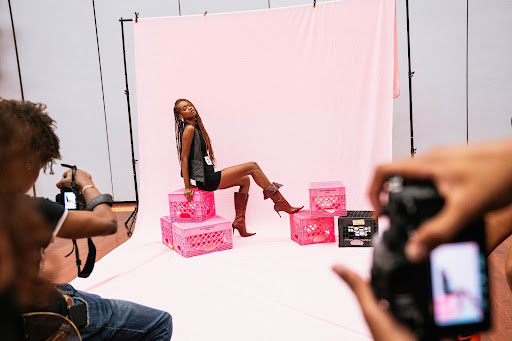
The clicking sound of stilettos on the floor echoed throughout a back hallway of Blackburn University Center last Friday. Vanessa Oyarekhu, a freshman nursing major from Atlanta, Georgia, stood at the end of the hallway, striking her final pose and whispering minor critiques to herself. She turned on the balls of her feet, patting the beads of sweat on her forehead, and began her strut.
She wasn’t the only student feeling the thrill of anticipation. On Friday, Blackburn buzzed with energy as STRIPT, a fashion brand created by alumna Arianna Davis, partnered with UGSA and ELITE Models to host its annual model call.
“I’ve been preparing since the summer. Joining a club, especially a club like this [ELITE], is something I have wanted for a long time,” Oyarekhu said.
Selling out 400 free tickets, students from across campus sat in rows, eager to showcase their creativity, confidence and style as they dressed in form-fitting Black attire in front of a camera.
Just days before, STRIPT opened applications for its HBCU student ambassador program for the second year in a row, giving students a chance to extend their involvement with the brand beyond the runway.
“I’ve been practicing my walk on the treadmill, practicing as much as I can. I’m not too worried about messing up or walking right. I’m more focused on showing my face and my interest,” Oyarekhu said.
Arianna Davis, a double Howard graduate, launched STRIPT after deciding to pursue fashion instead of a traditional legal career.
She said the brand provides HBCU students and women with opportunities to explore creativity, express themselves and step into leadership roles.
“We all have creative potential and we should give ourselves space to explore it. Life is short, you should do what you love and express yourself fully,” Davis said.
Row by row, models lined up outside the ballroom for photos. Among them was Madeline Hale, a senior journalism major from Atlanta, returning after being selected at last year’s call.
“I was here last year covering this event with a magazine. My editor asked me, ‘Why don’t you give it a try?’ And I tried,” Hale said. “It was my first time ever being in front of the camera. I kind of forgot about it, and then I got asked to come back and do a shoot a few months later. I was really shy and nervous.”
Hale returned this year with a new sense of confidence.
“Coming back is really exciting because I’m finally getting out of my shell and I want to try again,” she said.
Davis said Howard inspired STRIPT’s mission to create opportunities for HBCU students.
“At Howard, giving back and community is such a big thing that we learn while we’re here, Davis said. “Because I love Howard so much, and I feel like so many of us do when we leave, we just have this appreciation for it that makes it feel natural to return and create opportunities for the next generation.”
She added that STRIPT intentionally centers its brand around Black women and HBCU students, aiming to emphasize representation, professional development and empowerment.
“HBCUs are the future leaders of the Black community, the current leaders of the Black community,” Davis said. “I believe so much in HBCU education, I think it’s the best thing you can do, if you can do it. I think it’s necessary, it’s so nurturing, empowering, such a unique experience, so I want to make sure I’m platforming HBCUs the best way I can.”
In the front row sat freshmen participant Spider Harris, a psychology major from Atlanta, and Miles Coleman, a marketing major from Virginia.
They said the event highlighted challenges of Black representation in the fashion industry.
“As times have changed, especially within the government, a lot of companies have fallen back, pulled out, or just won’t give at all,” Coleman said.
Following shifts in recent government administration, many corporations, including those in the fashion industry, scaled back diversity, equity and inclusion initiatives.
According to an article by Forbes, Victoria’s Secret halted a goal to promote Black workers, Target ended its Racial Equity Action and Change Program, and Walmart phased out its DEI commitments, including winding down its $100 million Center for Racial Equity.

“I feel like it shows young Black adults what our futures can look like when it comes to working with companies and putting ourselves out there,” Harris said. “Especially in modeling, where the runway is so white-centered, having a space like this for us, to see a room full of young Black people pursuing this, it’s inspiring.”
Copy edited by D’Nyah Jefferson – Philmore