

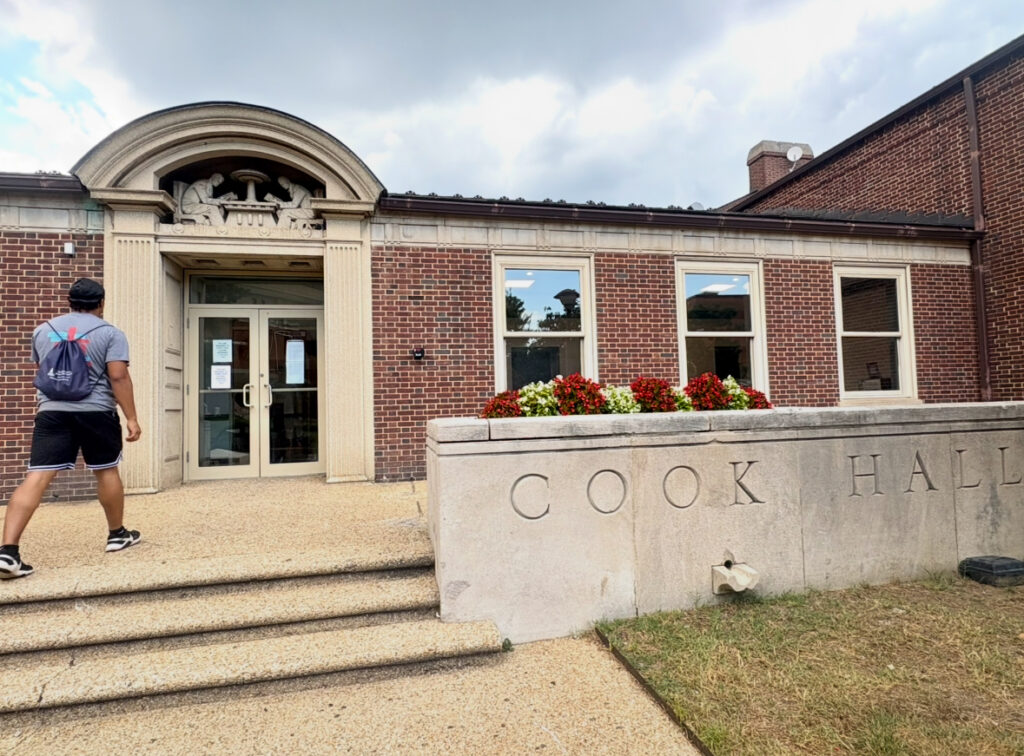
As Howard University prepared for the 2025–2026 academic year, a record number of rising sophomores were placed in off-campus housing, sparking frustration over unkept promises to expand and improve living accommodations.
Housing options have not expanded despite enrollment consistently increasing with last year welcoming 2,700 students, the largest freshman class to date.
Underclassmen are guaranteed housing, but students like Caden Wilcoxson didn’t expect to be placed off campus even though it was technically an option to apply for “sponsored off-campus housing.”
“I think it shows a deep lack of effort on the admin’s part — it shows that they aren’t as committed to their students as they claim they are,” said Wilcoxson, a sophomore legal communications major from Dayton, Ohio.
Wilcoxson was placed in Mazza GrandMarc, an off-campus apartment complex in College Park, Maryland that partners with Howard.
“The biggest problem with sophomores being placed off campus is getting to and from campus for classes,” Wilcoxson said. “A lot of us don’t have cars here, and our classes are more sporadic as we still have a lot of classes to take, as opposed to upperclassmen.”
Off-campus options include Vie Towers, Wish and The Lanes; those applications didn’t open until May. Housing assignments were released in mid-July, which is when students began to realize that a significant increase in the number of students, especially sophomores, were being placed off campus.
Each year has seen record-breaking admissions by the university. In May, 41.34 percent of Howard applicants for the current school year were accepted. This shows a 6 percent increase compared to the 2023-2024 school year, which had a 34.9 percent rate of acceptance according to the official College Board and Data USA websites.
Sterling Brooks III, a sophomore accounting major from Brandywine, Maryland, echoed Wilcoxson’s concerns, saying off-campus placements disrupt daily student life.
“Every student wants to be able to go back to their dorm and rest between classes, but that’s harder to do when you live off campus, especially if you have back-to-back classes,” Brooks III said.
In March of 2021, Howard announced its $500 million deal to improve and expand housing. An official document provided by the University gives insight into what the deal entailed and how the institution plans to execute that.
The institution reported on closing out a $316 million tax-exempt bond that allowed the University to address the crucial housing needs appropriately. Artifacts include(d): rats, mold, frequent laundry machine breakage, and no hot water. All things that have still been reported by students to this day. This also aligned with Howard’s “Central Campus Master Plan.” It included adding “1,500 housing slots and 500 housing units by converting a 1.85-acre lot into a multipurpose building.”
Walter Servance, current Executive Director of Campus Life, who served as the Assistant Director of Residence Life and University Housing when this deal was made, did not respond for comment in time for publication.
Some students are particularly upset about the placements of sophomores off campus because off-campus living is more costly. This year’s estimated cost for living on campus is $64,142, including an estimated housing cost of $12,380 and $1,154 for transportation. In contrast, the cost of living off campus is $73,268, including $18,050 for housing and $3,020 for transportation.
“Financially, off-campus living can be more expensive,” Brooks III said. “The cost of rent, food, and transportation adds up quickly, especially if students are paying out of pocket or relying on services like Uber.”
Now, every year, the university releases estimated costs on the official website to help inform and allow families to plan. This year’s estimated cost for living on campus is $64,142, including an estimated housing cost of $12,380 and $1,154 for transportation. The cost of living off campus is $73,268, including $18,050 for housing and $3,020 for transportation.
“Housing is more than just a place to sleep — it’s about safety, stability, and equity,” Brooks III said. “When statements are made without action, it erodes trust and sends the message that student well-being isn’t being taken seriously,” Brooks III said about the administration’s efforts to execute plans for future housing.
When reached out to administrators for questions, an official statement was provided by the Office of University Communications.
“The University offers over 5,300 on-campus beds, prioritized for the guaranteed housing groups outlined previously. As of August 7th, there were just under 5,200 underclassmen registered at the University,” the statement said.
“The University partners with four off-campus housing providers to supply nearly 900 additional beds, enabling continued direct provision housing opportunities for upperclassmen outside guaranteed groups on first come, first served basis,” it continued.
The statement also said on August 4, the beginning of move-in week, the university had assigned 98% of its available on and off campus beds, with 82% of those students paying their deposit and accepting housing.

In terms of making more housing available to meet future demands, the statement cited new partnerships with buildings near campus. However, Howard Manor and The Oliver are only available to graduate students.
“The University has continued to partner to increase the housing stock in the neighborhood, special offers for Howard students/staff with recent openings of Howard Manor, The Langston, Ellington Apartments, and The Oliver,” noting that Howard Manor and The Oliver are for graduate students only.
Concluding with this statement, admin addresses a possibility for new housing, “…the University has begun the process of closing down the Wonder Plaza building for redevelopment, a project that aims to bring over 500 on-campus beds.”
Damerian Washington, a junior history major from Brooklyn, New York, criticized the school’s financial management.
“The money seems to be used in terms of PR when it comes to trying to maintain this curated image that we are a perfect school,” Washington said.
Washington is one of the many third year students who did not get housing at all.
“Howard offered upperclassmen off-campus housing options that could accommodate the class of 2027, and yet, due to yearly over-admittance of students with little to no placement,” Washington said.
When the junior class was made aware of updates on their applications, many were met with a waitlist.
“Students saw the negligence that came with the housing situation, and the majority of the class of 2027 was forced to quickly find housing, myself included, within a one-month time frame,” said Washington.
Washington said he wants answers and more effort overall from the admin.
“Howard needs to provide proof of where the money goes,” he concluded.
Copy edited by D’Nyah Jefferson – Philmore