

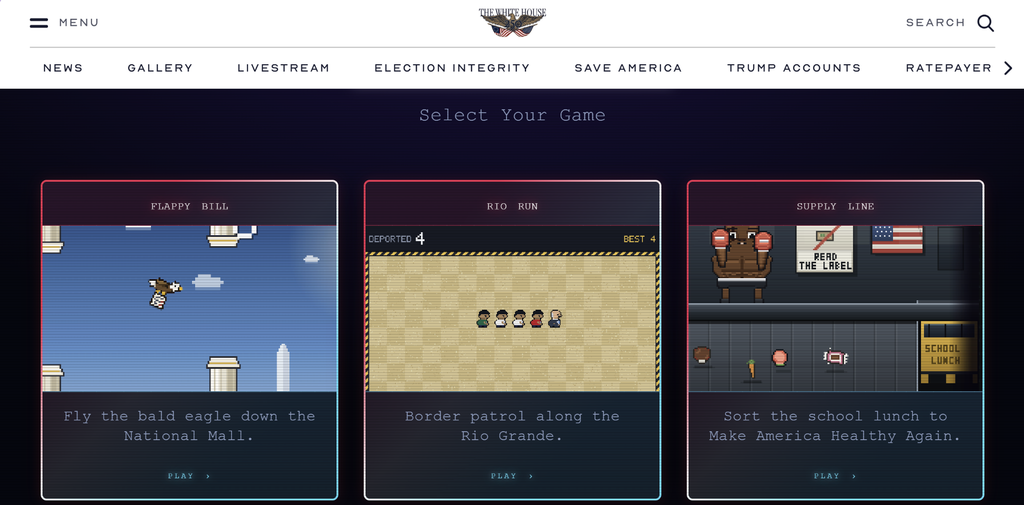
This month, the White House launched arcade.gov, a set of retro-style browser games repurposing classics like Tetris, Snake and Flappy Bird to push border security, food policy and child savings accounts.
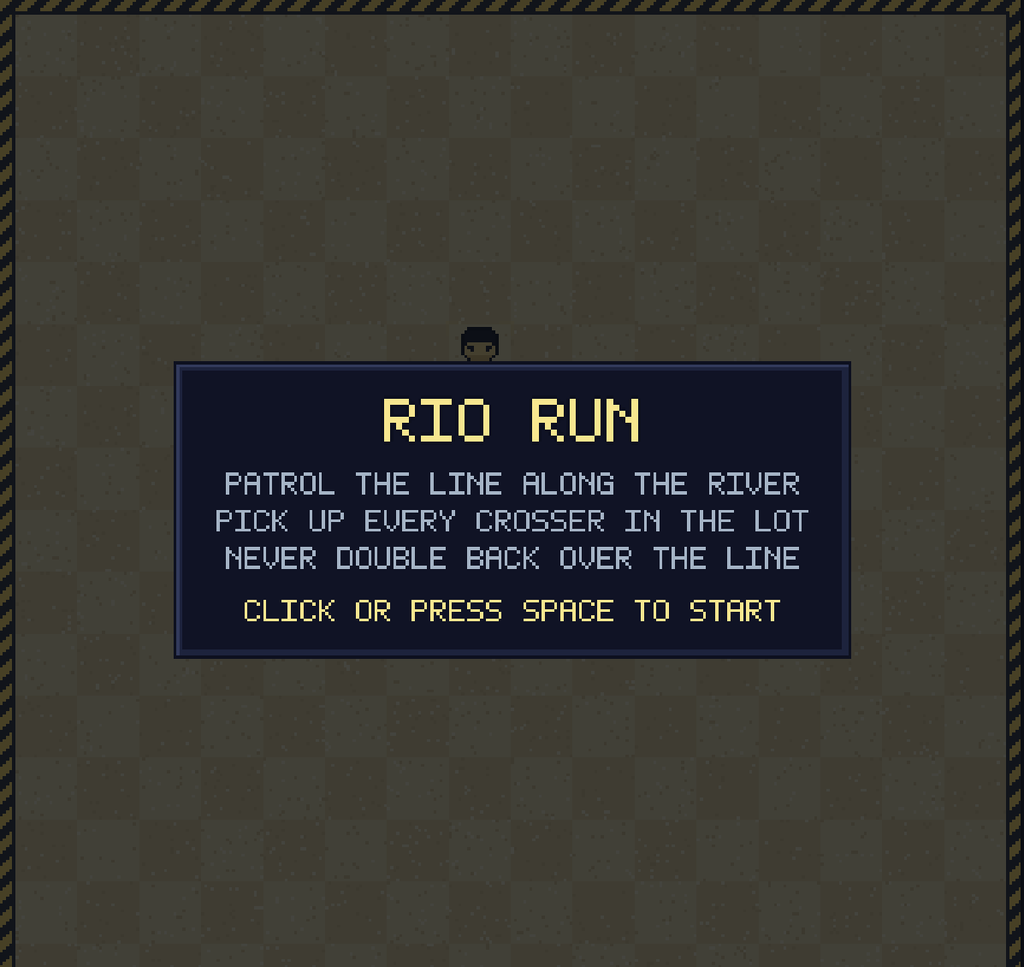
“Build the Wall,” the Tetris based game, has players stack sections of a border wall to “protect the border from the coming horde.” “Rio Run” recreates Snake, with players moving across the board as an Immigration and Customs Enforcement (ICE) officer, working to gather plain-clothed migrants. They are then collected in a line behind the ICE agent in jumpsuits and handcuffs, mimicking deportation.
“Supply Line” based on the arcade game Tapper, has players sorting school lunch items to fit “Make American Healthy Again” standards, a slogan created by President Donald Trump for a public health campaign spearheaded by the Secretary of Health and Human Services, Ronald F. Kennedy Jr. “Flappy Bill” sends a bald eagle carrying a piece of legislation over the National Mall in the style of the mobile game Flappy Bird, and “Trump Saving Tycoon” has players catching flying cash and gold bars to “fill your kids’ Trump Accounts,” a nod to the administration’s child savings account program.
“This is an effort to further contrast between a culture of fun and winning and the dark socialist vision Democrats have for America,”the White House said in a statement to TIME.
Kaelan Dorr, the deputy assistant to the president, who leads digital strategy, called the project “policy you can interact with.”
Officials have said more games are planned on a weekly basis, and the launch was promoted on social media with the tagline “Can’t stop winning.”
Amerika Garcia Grewal, an immigration advocate and co-founder of Frontera Federation, said the administration has effectively turned its own policies into entertainment.
“They’ve been playing games with people’s lives for years, now they’ve made a video game of what they’re doing,” she told AFP News Agency. .
Immediately following the White House’s launch, the Tetris Company took legal issue with Build the Wall, clarifying in a public statement that it had not authorized or licensed its intellectual property for the administration’s project.
“At Tetris, we believe in the power of connection and bringing people together, not dividing them,” the company said in a social media post. “P.S. The Tetris Company was not involved in the creation of ‘Build the Wall.’ P.P.S. We take copyright infringement very seriously.”
For gaming communities, game mechanics and design carry serious weight in maintaining a culture of creativity. Members of the Howard Esports Association, who compete nationally, view gaming as a space for high-level competition but also inclusivity.
Elijah Saunders, a junior marketing major from New York and the secretary for Howard Esports, said the video game spinoffs are fundamentally contradictory to gaming culture.
“Gaming in general is about community and bringing people together,” Saunders said. “A lot of these games seek to use political messaging to tear people apart and push messages of hatred and division.”
Saunders pointed to the Tetris Company’s statement as evidence that the gaming industry is being weaponized for divisive political messaging. He also expressed concern over attempts to normalize hostile messaging to reshape the gamer identity.
Following criticism, the White House removed Build the Wall from its site.
Clips from the game featured animated intro screens mimicking the signature boot-up sequence of an Xbox console and similarly used loading animations from PlayStation. The trailer also included a parody of a Nintendo loading screen just days before the White House doubled down on their video game theme, posting “Legend of Trump” based on the Nintendo game “Legend of Zelda.”
Parent companies including Microsoft, Sony and Nintendo, whose game design, logos and mechanics were used for the site, have yet to comment on the White House’s use of their intellectual property. Because the federal website recreated game mechanics without stealing source code from the original game, U.S. copyright law allows developers to legally create nearly identical games.
While legal loopholes protect the federal website from most copyright infringement claims, gamers including Saunders argue that the attempt to push a partisan message through popular culture leaves a lasting impact on gaming communities.
“They’re trying very hard to market to gamers and try to push them towards the right,” Saunders said. “I hope that these games are limited and taken down because they shouldn’t be used to promote hate.”
Copy edited by Daryl R. Thomas Jr.