

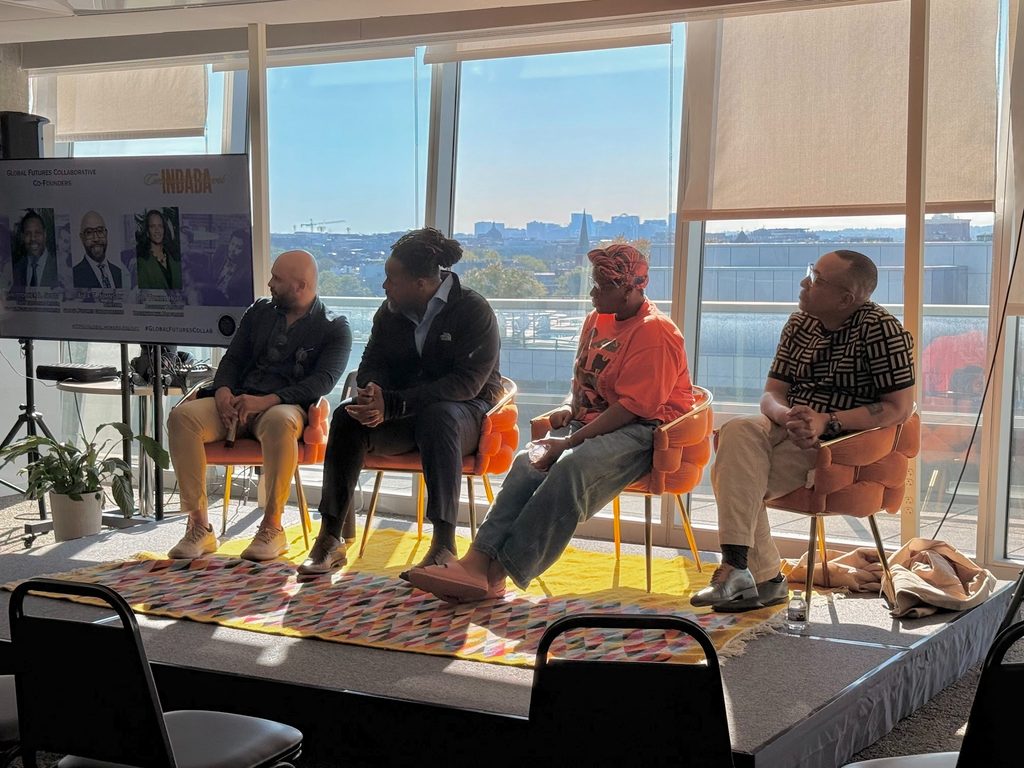
A dozen attendees gathered at an eighth-floor industrial office in the 7th Street United Negro College Fund, Inc. building on Wednesday. They came for an “indaba,” a dialogue structured for direct participant engagement, hosted by the Global Futures Collaborative (GFC).
As a policy research hub closely tied to Howard University’s Ralph J. Bunche International Affairs Center, GFC is a nonprofit focused on diplomacy through community. This indaba marked the official launch of its new Community Network initiative. The Network seeks to bring disenfranchised voices into global debates by valuing contributors and respecting their experiences.
To spearhead its development, 14 liaisons, were strategically selected for their backgrounds and expertise, according to Christopher Scott, a GFC co-director.
Scott is a former U.S. Department of Education appointee from the Obama administration who concentrates on criminal legal systems. He said he felt empowered by the indaba because of the mutuality.
“We really got to be vulnerable and talk about what makes us us; in the essence of our authenticity, as Black folks, in corporate environments, the international space and foreign policy,” Scott said.
The indaba featured personal stories from the panelists, including their familiarity with being in rooms where they were not always welcome.
Scott said this enabled the group to “resonate” the dialogue with participants’ value in the policymaking world.
Students, as the next leaders in this field, are a focus of the Community Network, GFC Co-director Alex Johnson said.
Johnson is a former diplomat and national security expert who previously served in the Obama Administration. He said that as the Network grows, it aims to bring students majoring in international affairs and political science into the planning process.
“We do events in our space, which is a community asset here in the UNCF building, but we also do events on campus. There will be mentorship [and] opportunities to engage with the Community Network members,” Johnson said.
Recalling recent efforts by the GFC Community Network to engage with younger audiences, Johnson highlighted a recent meeting at Chesapeake College in Maryland.
“We were meeting with the mayor and students at Chesapeake College, and we also had an opportunity for students to join us as well. So as we do these subnational delegations, we’re going to bring students in to get the masterclass,” Johnson said.
On resource expansion, Johnson’s goal is to extend the Network’s presence to every U.S. state with more associates.
“One year out, I hope our Community Network is flourishing, and in one year, we will be able to find two cohorts of Community Network members,” Johnson said.
Mic Crenshaw, a recording artist, poet and community activist based in Portland, Oregon, is one of the 14 members. He said he is most looking forward to connecting and brainstorming about African empowerment.
“I’m hoping to find some common interests and support a Pan-African approach to international networking, resource sharing and hopefully contributing to projects that benefit…African people on the continent,” Crenshaw said.
GFC leaders appointed the liaisons for a one-year, renewable term.
A year from now, Crenshaw envisions the Community Network making significant progress for minority groups.
“[I hope to] strengthen international relationships between stakeholders on the continent of Africa and…strengthen their relationships with Black people in the diaspora,” Crenshaw said.
From Crenshaw’s perspective, Howard University and its personnel are crucial in developing the initiative.

“I think educators [and] administrators have a role to play in making sure that educational resources inform our conversations. I think young people have the energy and the passion,” Crenshaw said.
Copy edited by Sydney Middleton