

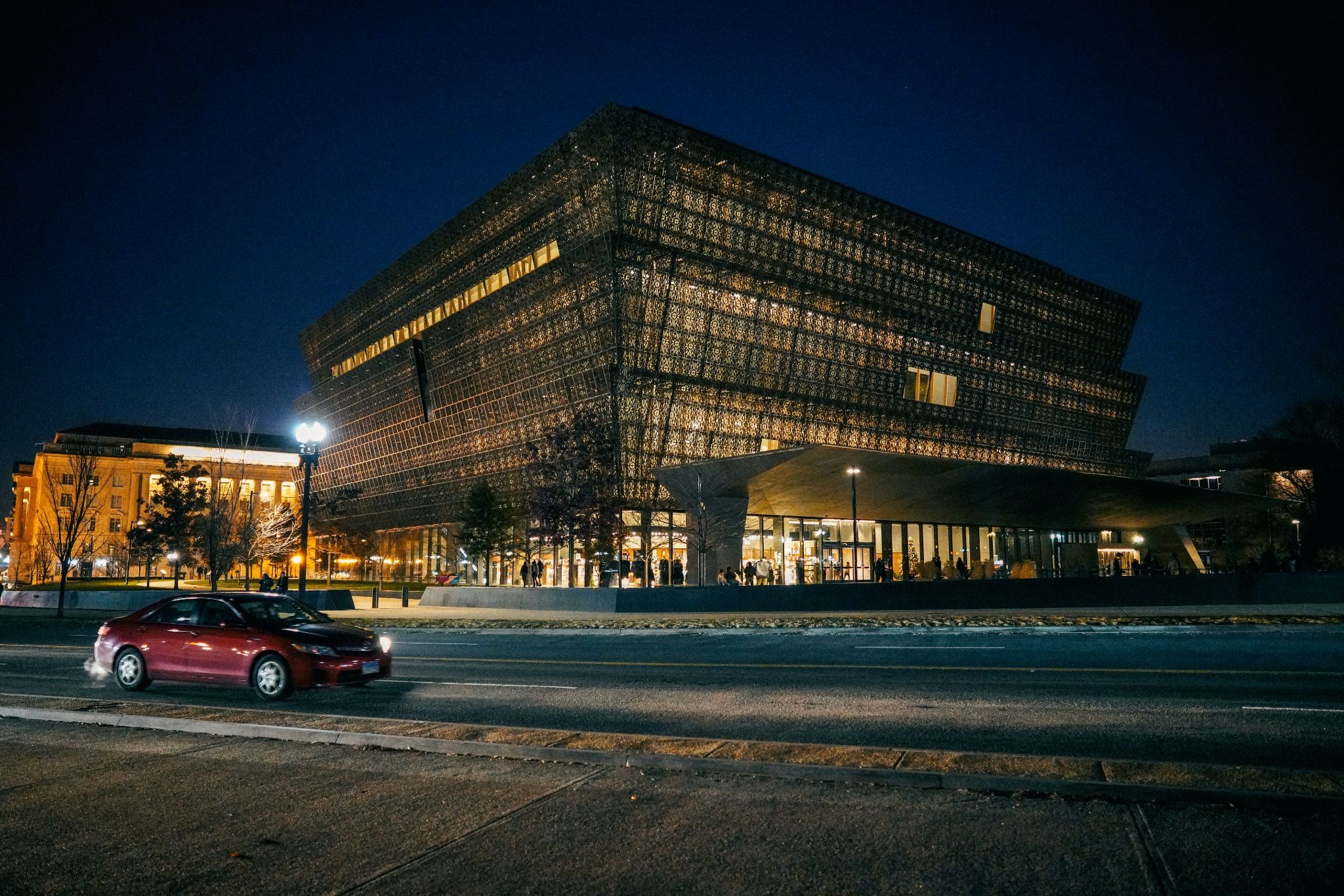
Nearly a decade after its historic opening on the National Mall, the National Museum of African American History and Culture (NMAAHC) is gearing up to celebrate its 10th anniversary. Since 2016, the museum has served as America’s foremost archive for African American culture, attracting millions from across the world while preserving and displaying Black history.
Though Congress passed the National Museum of African American History and Culture Act in 2003 to serve as a hub of African American culture, art and history, the dream wasn’t fully realized until Sept. 24, 2016. Since opening its doors, more than 13 million visitors have walked through its halls to examine a growing collection of over 45,000 donated artifacts.
“Hopefully this museum can help us talk to each other, and more importantly listen to each other, and most importantly see each other,” said President Barack Obama during the museum’s opening ceremony. “See how our stories are bound together.”
While the museum serves as a national monument for millions of tourists worldwide, for students at Howard University, just two miles away, visiting the landmark has become an unwritten rite of passage.
Bryce Drayton, a freshman honors international business major from Atlanta, has visited the museum seven times. Drayton discovered his direct ancestral connection to the exhibits while walking through the museum’s lower levels.
“This museum means everything,” Drayton said. “There is a picture on a wall of my ancestors; it’s really cool to see. I know my family’s lineage, but I didn’t know that my ancestry was featured there.”
While students, including Drayton, discover direct familial ties in the museum itself, for Deborah Bada, a sophomore honors political science major from Atlanta, Georgia, her first visit to the museum as a Howard student offered a connection across the diaspora.
“Growing up as a Nigerian American, visiting [NMAAHC] added another layer of American history outside of what I’d seen growing up,” Bada said. “Visiting the museum puts into perspective that not long ago, we weren’t even treated as human. It showed how far we’ve come, but also how far we have to go.”
For thousands of bison visiting, walking through the museum directly reinforces the purpose of their education at Howard by demonstrating the long-standing connection between the HBCU and the museum. The museum’s recently closed exhibition, “At the Vanguard: Making and Saving History at HBCUs,” honored how schools like Howard pioneered the preservation of Black history long before federal museums existed.
In the lower history galleries, the museum documents Howard’s founding during Reconstruction, while the upper “Culture and Community” galleries feature campus artifacts, including a hat from Howard University’s “Showtime” marching band.
The museum’s Barnett-Aden Art Collection was assembled by James V. Herring, the chair of the art department at Howard, and Alonzo J. Aden, who also served as the founding curator of Howard University’s Gallery of Art.
For Mary Elliott, curator of American Slavery and Emancipation at NMAAHC, her connection between Howard and the museum is deeply personal. An alumna, Elliott started working for the museum in 2011. She co-curated the museum’s foundational “Slavery and Freedom” exhibition and served as the inaugural curator for the museum’s digital searchable museum, allowing those who can’t visit in person to access the museum’s artifacts.
Although the museum serves to highlight contributions of Black culture, Elliott explained that it does so to illuminate their place in a broader American story.
“What I think is very important about this museum is we touch upon a cross section of stories simply by telling the American story through the African American lens.”
That mission, however, has faced increasing scrutiny. In its decade of public-facing operation, NMAAHC has found itself at the center of several national debates over the role of historical truth.
Under the 2025 Executive Order, “Restoring Truth and Sanity to American History,” the White House accused NMAAHC and the Smithsonian Museum of pushing “divisive, race-centered ideology.”
For curators including Elliott, these external political pressures only reinforce the vital need for the accurate, uncompromising preservation of history.
“Our work is grounded in sound scholarship,” Elliot said. “We have authentic material culture that people can look at that has been vetted and comes with that rigorous research, ensuring we serve as a trusted, uncompromising source of American history.”
As NMAAHC enters its second decade on the National Mall, curators are ensuring that history isn’t just commemorated years after the fact but preserved as it unfolds.
“In our museum, we talk about living history, not just collecting around moments from decades ago,” said Elliott. but collecting around the moments that are occurring right now…so that we can preserve them for generations to come.”

Copy edited by Sydney Middleton