

For Grace Kalere, State of the Party is about creating wellness and recreational spaces where Black people and others can feel represented. Kalere said part of his motivation for creating State of the Party was addressing stereotypes around Black men in wellness spaces.
Kalere, a Howard University junior double majoring in international relations and economics, founded State of the Party to offer an alternative to traditional nightlife through free wellness and recreational events, including yoga, running and tennis. Although many of its members are Howard students, the organization has expanded its audience beyond campus and aims to build a larger DMV community.
State of the Party has built an audience for free wellness events through student volunteers, sponsorships and community partnerships, but those resources have not yet covered all of its costs. As Kalere considers memberships and ticketed events, the organization is working to develop a model that can support its growing schedule while keeping its events accessible.
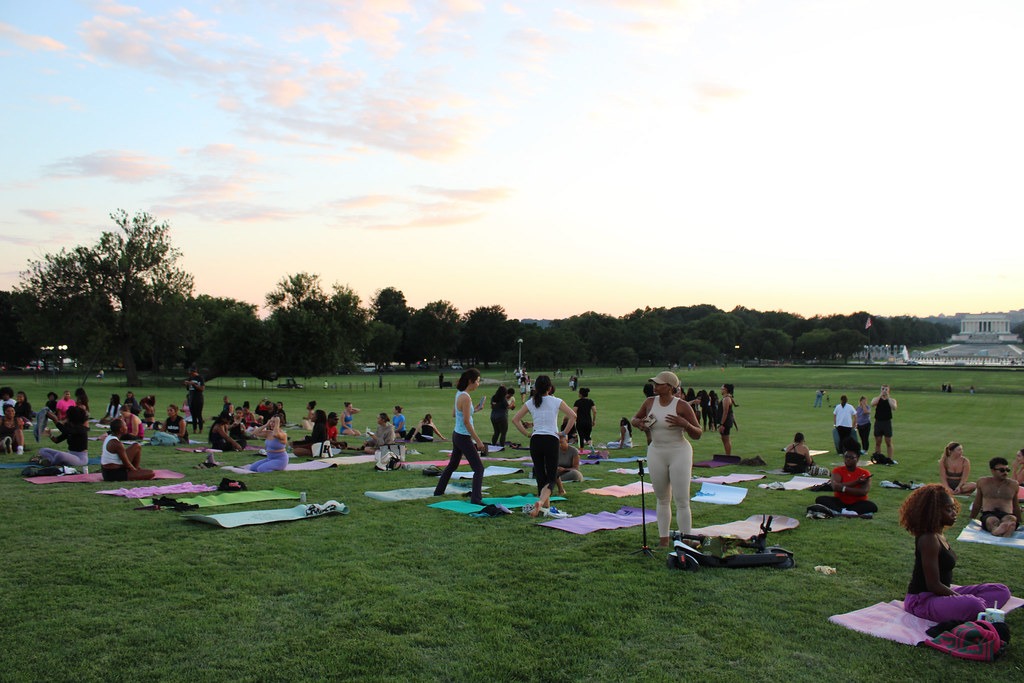
On Aug. 18, students gathered on the National Mall as the sun set behind the Washington Monument. Students, following an instructor’s directions, were spread out across the grass for an evening yoga session as Celsius drinks were handed out to the attendees.
For first-time attendees Serenity Sinclair, a freshman nursing major from Rochester, New York, and Courtney Norton, a freshman civil engineering major from Cleveland, Ohio, the appeal was partly leisurely and partly financial. Extracurricular activities and third spaces can cause financial distress.
“It was about to be fifty dollars to get into a party, so we decided to go get Insomnia [Cookies] instead,” Norton said, reflecting on a previous night.
On a different day, choosing State of the Party offered Norton another option for spending the evening without the cost of a night out.
Sinclair said she would attend even without giveaways or drinks, because, for her, the event proved to be a chance to step away from the stress of school. While the events are free to attendees, producing them requires planning and volunteer efforts.
Jade Serieux, a sophomore biology major from Brooklyn, New York, and one of the organization’s yoga coordinators, estimated that she spent around four hours each week working on the event during the three weeks leading up to it. She said her work included promotion and vendor relationships as well as managing the RSVPs.
Isabella Biscombe, a junior chemistry major from Miami, Florida, and a yoga coordinator for the organization, said members are divided in sections including community, events and media. She estimates that she spends five to 10 hours a week working on State of the Party, including helping develop the yoga routines and coordinating with Kalere.
“We really have to hold our weight, and we all have our own thing that’s going on,” Biscombe said.
With no paid staff, students volunteer their time to take on the responsibilities across different parts of the organization. The structure allows student volunteers to divide the planning and coordination required for each event which keeps events accessible, even though the organization still has costs to cover.
State of the Party currently relies on the community for sponsorships, partnerships and volunteers to keep its events free for attendees. Cash contributions go toward gear and operational costs, while partnerships provide support and other resources for events.
Watch the Yard previously reported the organization receiving around $25,000 in sponsorship support. Much of that support has come through products and services rather than cash, including Celsius.
Jaden Addo, a senior biology major from Sayreville, New Jersey, and a Celsius student marketing ambassador, has worked with State of the Party since last semester. He and Kalere have stayed in contact between events, with Addo helping provide Celsius drinks for events.
Kalere said he pays for some expenses out of pocket, leaving State of the Party at a current net loss.
The organization uses its engagement on Instagram and TikTok to gauge what its audience responds to when planning future events and approaching potential sponsors.
Much of their growth is tied to a larger purpose than only being an alternate night out. Kalere said State of the Party is intended to make wellness and recreational spaces more available to Black people and others who may not feel represented in those environments.
While studying abroad, Kalere returned to the United States to continue running State of the Party and oversee its growing number of events.
“I was studying abroad, but I came back to host the event. I put a lot of effort towards making things work,” Kalere said.

As State of the Party expands its events and audience, Kalere is considering additional ways to fund the organization. He said there are potential plans for a monthly membership, where community members would pay an amount to cover more equipment, like more yoga mats.
The organization is also considering introducing tickets for future events, potentially charging no more than ten dollars, according to Serieux. The money would help cover materials and other event expenses, like permits.
Copy edited by Jori Johnson