

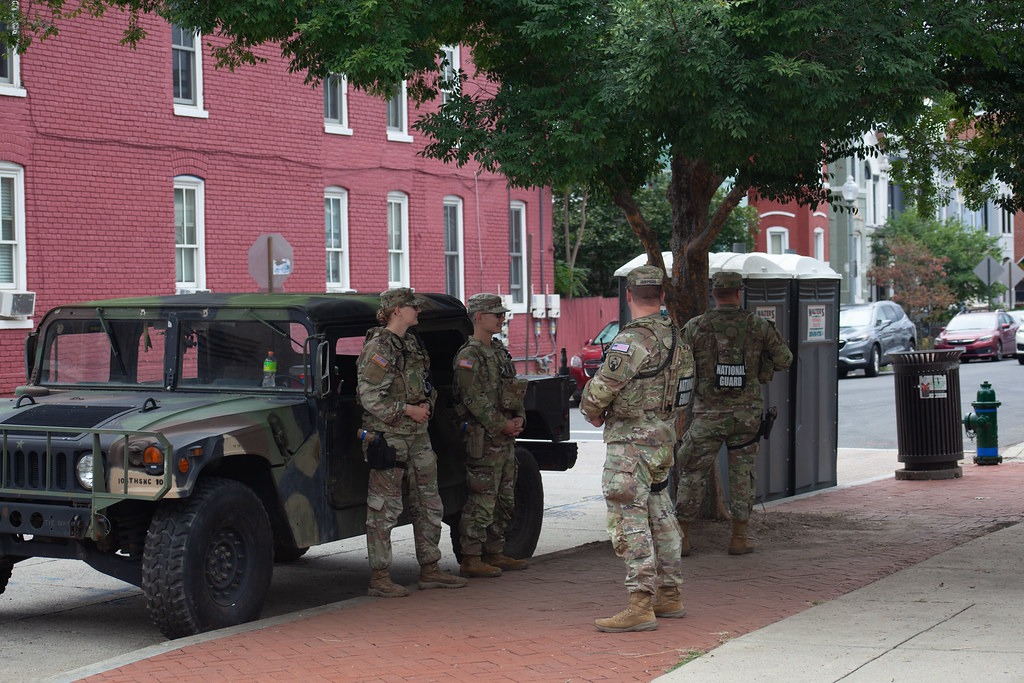
One year after President Donald Trump invoked the District of Columbia Home Rule Act to federalize the Metropolitan Police Department, the Pentagon announced on July 14 that it has officially extended the National Guard’s deployment through January 2029.
From the National Mall and Metro stops to the corridors surrounding Howard University, students navigating heavy foot-traffic areas have grown accustomed to an armed, uniformed presence on city streets.
When first issued on Aug. 11, 2025, the executive order declared a crime emergency in D.C., deploying approximately 800 National Guard troops to support law enforcement operations. Despite violent crime in the city reaching a 30-year-low, the declaration bypassed Mayor Muriel Bowser and the city council, placing D.C.’s Metropolitan Police Department under direct federal control.
Though the declaration was lifted one month later, the military footprint was not. The Pentagon’s extension drew widespread criticism from local leaders, civil rights organizations and campus communities.
“There’s a deep irony that here we are in the capital of the free world, and our president is treating it like a police state,” Scott Michelman, legal director of the ACLU of the District of Columbia, said in an interview with PBS. “D.C. residents have lived with our National Guard troops in our neighborhoods for about a year, despite the absence of any genuine emergency and really any reason for them to be here.”
The troops primarily perform “presence patrols,” walking commercial corridors and transit hubs in small groups to deter crime. The Niskanen Center, a nonpartisan think tank, found these patrols decreased “opportunistic” crimes by 24% but showed “no measurable effect” on violent crime.
Local lawmakers argue the long-term deployment carries risks that far outweigh any temporary stat line. Councilmember Brianne K. Nadeau, who represents Ward 1, views the extended deployment as a direct threat to local autonomy.
“What we’re seeing is a stunning deviation from democratic norms, and straight from the totalitarian playbook,” Nadeau said in a statement to The Hilltop. “The longer the National Guard is here, the more normalized every encounter becomes.”
Robinson Woodward-Burns, an associate political science professor at Howard, explained that the current deployments have deep roots in D.C. history with the National Defense Authorization Act.
While the Act grants executive authority to deploy the National Guard during emergencies, Woodward-Burns notes that the legal rationale for an extended deployment has largely evaporated.
“It’s not clear that there was a justification for an active crime emergency in August of 2025,” said Woodward-Burns. “I don’t know how you would find a legal justification for extension beyond that.”
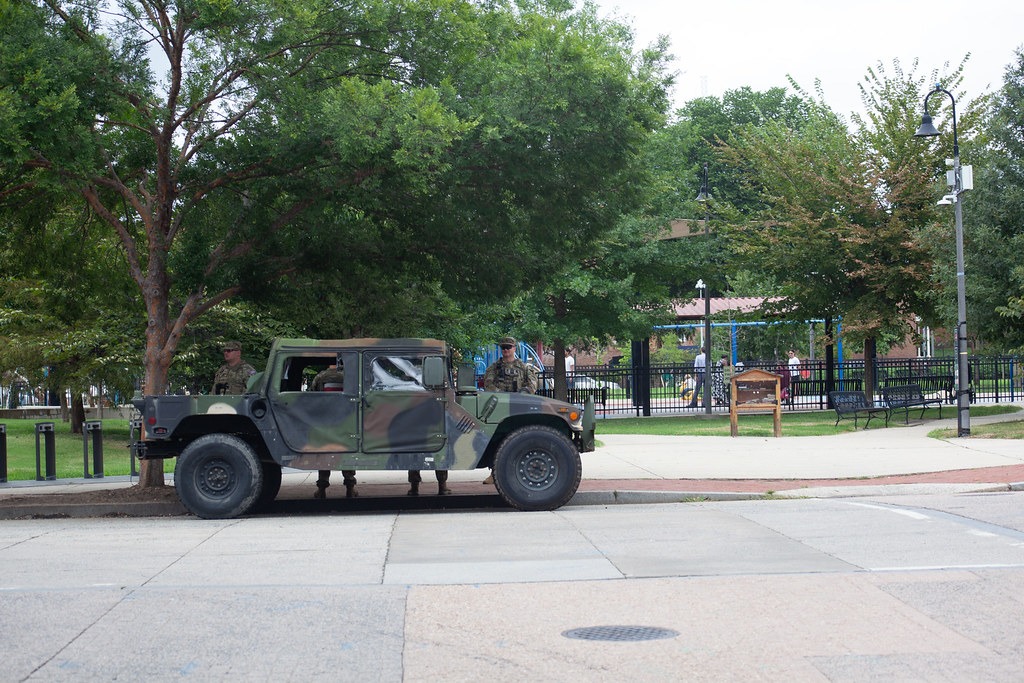
Woodward-Burns shares Nadeau’s concern that the federal presence will have wider-reaching consequences. He noted that in the past, D.C. has served as a “testing ground,” citing the deployment of the guard in Minneapolis in the months following their arrival in D.C.
For students navigating the area around Georgia Avenue Northwest and the Shaw-Howard U Metro station, the federal presence shifts the daily reality of campus life. Joy Baker, a sophomore sociology and international affairs double major from Atlanta, said the deployment has framed her entire college career.
“When I’m hanging out with my friends, and I run into a gang of National Guards, I don’t feel anything but fear,” said Baker. “I walk on eggshells around the National Guard more than any other law enforcement.”
For students like Baker, the intimidation doesn’t stem from aggressive action but from the constant surveillance of armed troops stationed outside of campus gates.
“I haven’t really seen them do anything except stand there.” Baker remarked, “That type of presence is not doing much for me as a college student, especially when I go to an [historically Black university] and we know the history of the way that Black people have been treated by law enforcement.”
Woodward-Burns emphasized that students grappling with the deployment should engage beyond Howard’s campus by connecting with local grassroots organizations. He highlighted DC Vote, a nonprofit advocating for D.C. statehood, and Free DC, an initiative offering community training so Washingtonians can safely navigate encounters with deployed National Guard troops while protecting their constitutional rights.
Even in unprecedented times, Nadeau highlights that students still have reason to maintain hope and community resistance.
“The people of D.C. are incredibly resilient. We have a long tradition of fighting back and protesting,” said Nadeau in the statement. “The Free DC Project is a perfect example of that — fighting the fight, full of energy and hope and joy, playing the short and the long game.”
Copy edited by Sydney Middleton