

The United States and the Soviet Union were involved in a race to orbit Earth and the Moon for several decades. Space co-operation, a distinct shift from “race,” came later as the International Space Station started to take shape in 1998. It was a joint project of five space agencies that put rival programs in the same dugout. However, in a distinct part of the world, a quieter change started to take place.
Vikram Sarabhai, Ph.D., the physicist who founded India’s space program that later became the Indian Space Research Organization (ISRO), chose not to join the race. He said that India did not have “the fantasy of competing with the economically advanced nations” in exploring the Moon.
Years later, in 2023, the organization he built landed its Chandrayaan-3 mission near the lunar south pole, making India the first country to ever reach this region. At a net cost of $75 million, India’s moon mission was cheaper than the production budget of the film “Interstellar” and far cheaper than NASA’s $4.1 billion Artemis 1 mission.
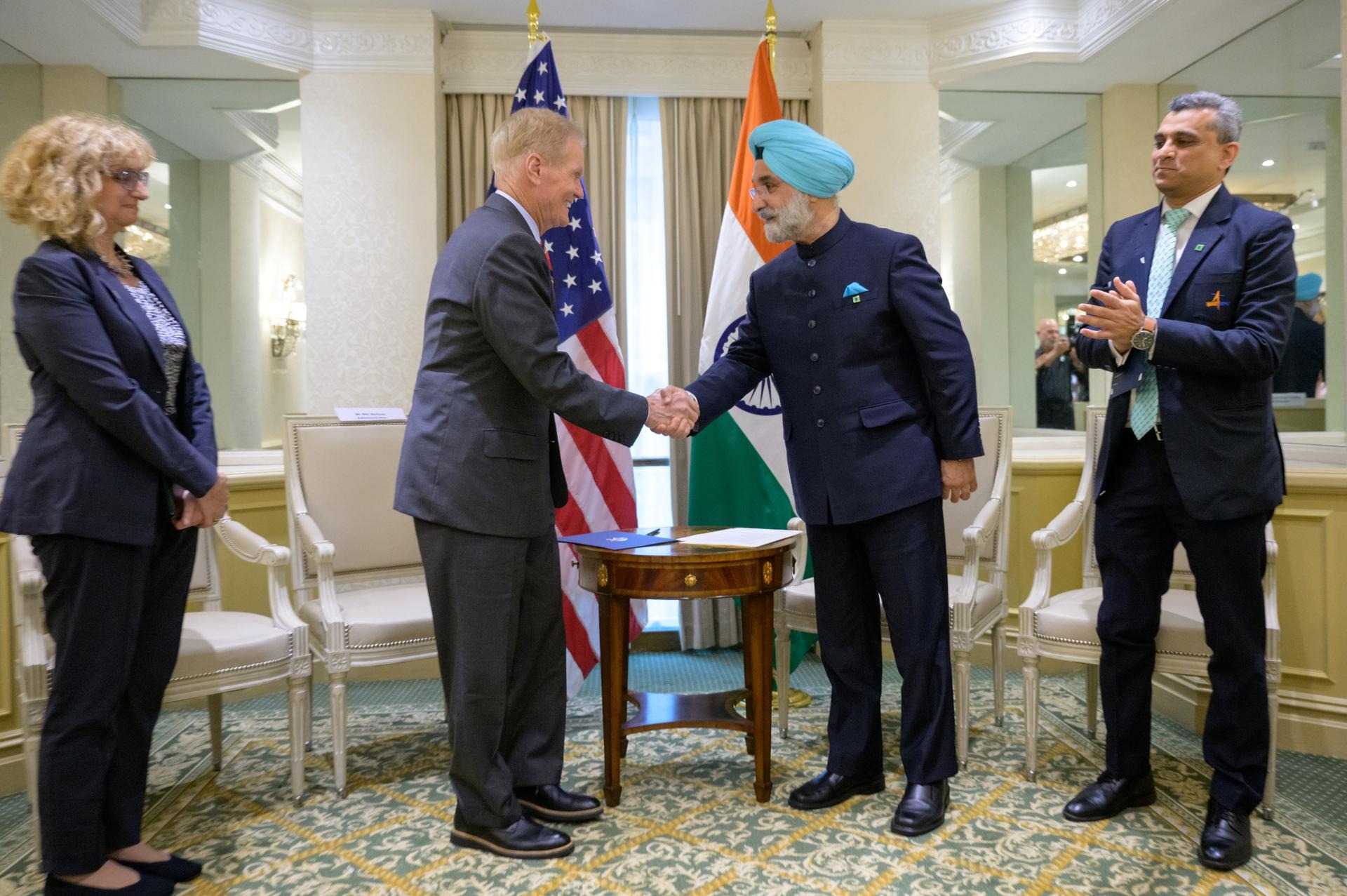
Now NASA has invited the ISRO to join its Moon Base program, a project aimed at building a permanent habitat near the lunar south pole.
“NASA invited ISRO to join its Moon Base program, building on the two countries’ partnership under the Artemis Accords,” the U.S. Embassy in India said in a press release.
The Artemis Accords are an international agreement that sets common rules for countries and companies to explore and use the Moon and outer space responsibly and peacefully.
The two sides also agreed to advance discussions on cooperation in open scientific data sharing under the accords.
The invitation came during the ninth meeting of the India-U.S. Civil Space Joint Working Group, which ISRO hosted on Aug. 5 and 6 at its headquarters in Bengaluru. ISRO Chairman V. Narayanan and U.S. Ambassador to India Sergio Gor addressed the opening segment of the meeting, which advanced cooperation under the U.S.-India Transforming the Relationship Utilizing Strategic Technology Initiative.
The working group also discussed future cooperation in space science, human spaceflight technology and Earth observation, according to the press release.
Jeff Gardner, a senior writer at the Space Foundation, said that lunar activity is expanding well beyond the traditional space powers.
“We are seeing more actors on the Moon than ever before, with private industry, major powers, and smaller nations all reaching for the lunar surface,” Gardner said. “The growing cislunar economy is creating opportunities for corporate partnerships as well as international collaboration.”
The meeting was put together a year after the launch of the NASA-ISRO Synthetic Aperture Radar satellite, known as NISAR, which lifted off from the Satish Dhawan Space Centre in Sriharikota, India, on July 30, 2025. This joint Earth observation mission scans the planet’s land and ice surfaces every 12 days using two radar frequencies built by NASA and ISRO, respectively.
India signed the Artemis Accords on June 21, 2023, becoming the 27th country to join the set of principles guiding cooperation among nations participating in NASA’s Artemis program.
Gardner said India’s recent record positions it to build on the partnership.
“India has major lunar ambitions and has already accomplished some, including the successful landing of its Chandrayaan-3 Moon probe,” he said. “By increasing its space budget by more than 10% from 2024 to 2025, India looks eager to build on this success.”
The Chandrayaan-3 landing site sits in the same region NASA has targeted for its Moon Base. India is also pursuing its first human spaceflight mission, scheduled for the first quarter of 2027, and a lunar exploration roadmap stretching into the 2040s.
The scale of the Moon Base project makes broad participation likely. “It should come as no surprise that NASA is looking to form numerous partnerships for a project as massive and complex as a Moon base,” Gardner said.
Upon reflecting on greater global scientific cooperation and the importance of the Artemis Accords, Gardner said that “More than 60 nations have agreed to the safe and cooperative exploration of space.” He also emphasised that in practice many space missions, including the Artemis campaign, now include the sharing of satellite data and the participation of a growing cadre of international astronauts.
Copy edited by Sydney Middleton