

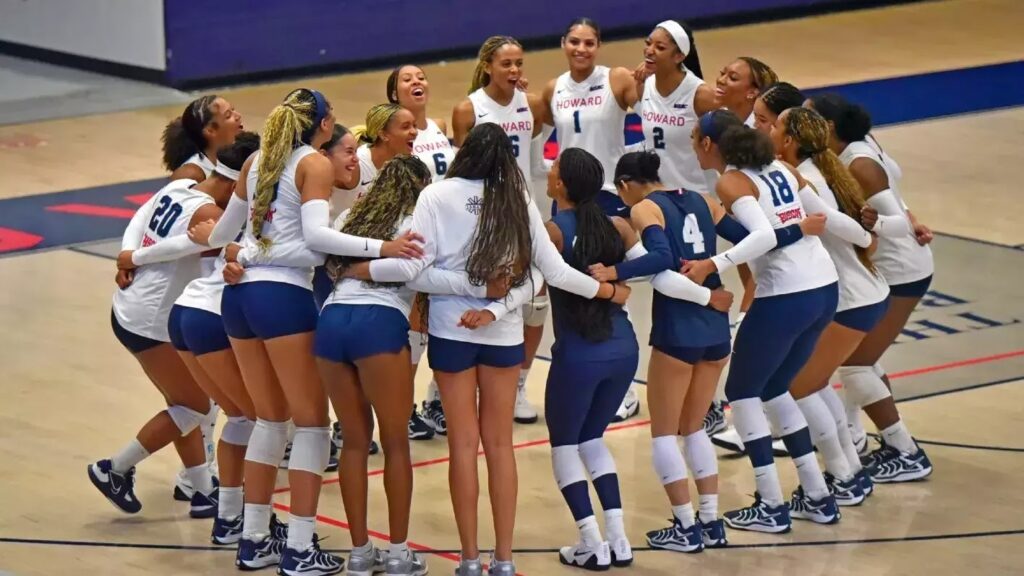
As preseason approaches, Howard University’s volleyball program is welcoming a new group of student-athletes whose journeys to the Mecca have been quite different from one another.
Incoming freshman libero Lauryn Wiley was drawn to Howard because of its reputation for developing student-athletes on and off the court.
“Both my parents went to an Historically Black University (HBCU) and they always raved about their experiences there, so I knew I kind of wanted the same thing,” said Wiley, a finance major from.
For the five incoming freshmen, adjusting to college athletics means adapting to a more rigorous course load and balancing the demands of division one volleyball at a faster pace.
Similarly for the newly transferred players, they are to balance the expectations and responsibilities of a new program, all the while embracing the unique culture of an HBCU. At Howard, that transition for these players is supported through programs and resources designed to help newcomers adjust before the season begins.
Head coach Shaun Kupferberg said “We were looking for people that had inner drive and had a lot of desire to compete at the highest level.”.
“People that didn’t think they were a finished product — people that wanted to grow and develop,” he continued.
This year’s recruiting class shared the qualities the program values most. Kupferberg described the 2026 team as one that “came together in pieces,” with volleyball experience spanning multiple years alongside late additions and transfers. Regardless of where they came from, he said the staff sought athletes with a common mindset.
Kupferberg acknowledged that joining a DI program at Howard comes with challenges that extend far beyond the sport. Incoming freshmen are adjusting not only to a faster, more competitive level of play but also to the realities of college life.
“You’re moving away from home, you’re starting college…it’s all that new stuff on top of competing constantly in the athletic arena and academically like they never have before,” Kupferberg said.
As the volleyball team prepares for another season with conference championship aspirations, newcomers have recognized the importance of team chemistry in achieving those goals. Across the newcomers, players have pointed to daily practices, film sessions, travel and time spent together outside of the gym as key to establishing the trust and communication necessary to compete as one unit.
Rather than focusing on individual accomplishments, the Bison have emphasized playing connected volleyball. The team has welcomed the newcomers while reinforcing the expectations that have helped Howard remain one of the Mid-Eastern Athletic Conference’s (MEAC) top programs.
Wiley believes the relationships developed away from volleyball naturally strengthen the team’s performance once competition begins.
“I love having team chemistry and just having fun with them off the court. When we’re on the court, it feels like it’s just natural,” Wiley shared.
For freshman outside hitter Easnadh Nobel To’olo, volleyball has always been part of her story. Her father introduced her to the sport after playing himself and maintaining a close relationship with a coach on Cameroon’s national volleyball team throughout her childhood.
Unlike many DI athletes with years of club experience, To’olo began playing competitive club volleyball for the first time during her freshman year of high school. Beforehand, she competed in gymnastics and track because of the limited opportunities available in her hometown of Orono, Maine. When thinking about college, she knew she wanted something different.
“Everyone in Maine goes to schools in Maine. I wanted something bigger,” said To’olo, a psychology major.
Howard offered that opportunity. After attending predominantly white schools throughout her education, she wanted to experience a larger, more diverse community. A family friend who attended Howard introduced her to campus through the perspective of an alumna, helping solidify her decision.
“I stepped foot on campus and said I need to be here,” To’olo said. “Every time I went back, it solidified my desire to go to Howard.”

To’olo’s attention shifted from choosing a college to preparing for DI competition. Howard’s Summer Bridge program has allowed incoming student-athletes to adjust to college coursework, learn the team’s systems and begin building the habits expected throughout the season before preseason two-a-days officially begin.
Transfer middle blocker Zenai Jethroe arrived at Howard through a different path. After beginning her collegiate career at Texas State University and taking a redshirt season, she searched for a program that aligned with both her athletic and academic goals. Howard, she said, “checked every box.”
“I know what I’m trying to do,” said Jethroe, a junior health science major from Dallas. “I’m trying to make a difference on the court, earn awards, compete for a championship and make connections while earning a degree.”
Having experienced another DI program, Jethroe said Howard’s approach to player development immediately stood out. Practices create an environment where every repetition is intended to prepare the Bison for conference competition.
“Here it’s more about slowing things down and focusing on the fundamentals. I wanted a coach who was actually invested in helping me improve,” Jethroe said.
As Howard prepares for another season, the coaching staff’s focus is not on replacing the graduating class but on helping this new group establish its own identity. Rather than expecting individuals to fill the roles of former standouts, Kupferberg believes success will come from maximizing the collective strengths of the current roster.
“We just need people to do the best that they can…and find where we can be our best team possible for the 2026 team,” Kupferberg said.
For Kupferberg, the expectations remain unchanged despite the influx of new faces.
He expressed that his “expectations are that they compete as hard as they can and work as hard as they can.”
Those expectations mirror what the newcomers have already begun to embrace, expressing the same commitment to the program’s culture and the same goal of helping the Bison compete for another MEAC championship.
Copy edited by Daryl R. Thomas Jr.