

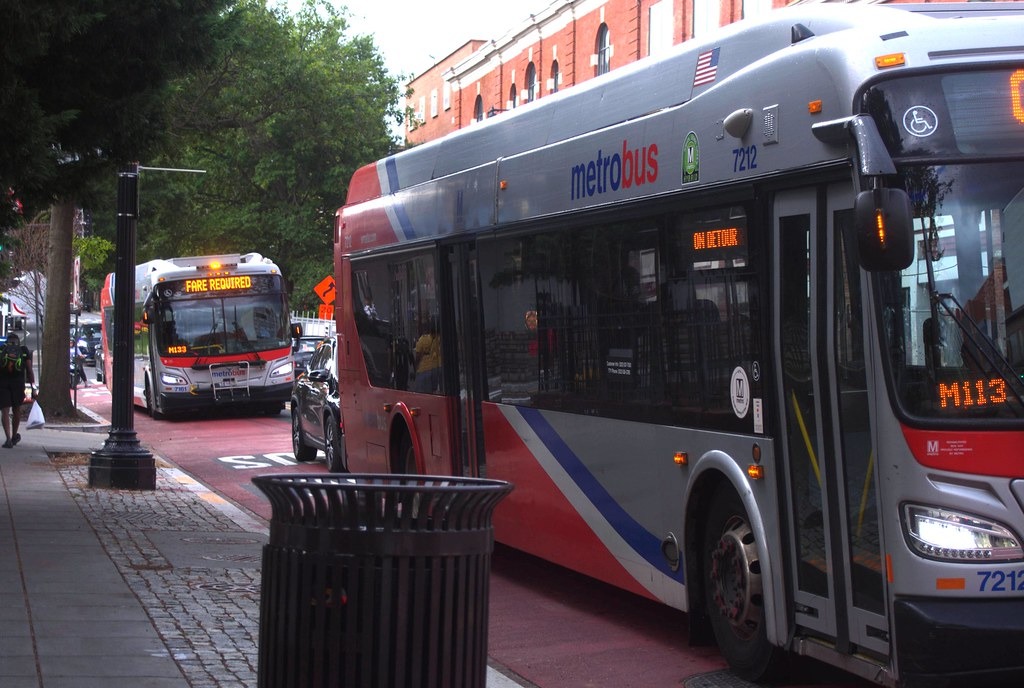
The Metro U-Pass program was implemented nearly a decade ago, and since then, Howard University has remained one of the only universities in D.C. that has not adopted it on its campus. This year, the university is looking to change that.
The program gives students at eligible colleges unlimited Metrorail and Metrobus rides during the semester. Other schools in the area, such as George Washington University and American University, have joined the U-Pass program — providing undergraduate students with semesterly rates of $115 and $136, respectively.
In 2023, the Office of Auxiliary Enterprises (OAE) conducted a survey to gauge student interest in adopting the program.
“Respondents overwhelmingly expressed support for adopting the U-Pass program,” said Michael Mason, OAE director of operations and finance. “The survey results demonstrated strong student interest in expanded access to public transportation benefits.”
Since then, the office has made efforts to implement the U-Pass at Howard and is actively pending approval from senior administration to begin contract negotiations with Washington Metropolitan Area Transit Authority (WMATA), according to Mason.
Introduced in 2016, the Metro U-Pass program offers daily bus and train rides for students attending participating universities — with the cost included in the student’s tuition at the equivalent of $1 per day, according to WMATA’s official website.
That price reflects a decrease from the standard Metro ride cost, ranging from $2.25-$6.75 for a one-way trip. Through the implementation of the U-Pass program, public transportation has been made more affordable for university students across the United States through “substantially discounted prices,” according to WMATA.
While many use public transportation, others rely on different forms of transportation, including using rideshare platforms and even bringing cars to campus.
Jessica Wooley, a sophomore computer science major from Atlanta, said she decided not to bring her car to campus because she would rather walk or use public transportation around campus and the city. However, when going out late at night, she turns to rideshare apps due to safety concerns and logistics.
For similar reasons, a subset of students have decided to bring cars to campus. During the 2025-26 academic year, 503 student parking permits were sold, with an additional 602 for faculty and staff.
An on-campus student parking permit for one academic year costs $680.
Drivers on campus also have to consider the cost of fuel. As of Aug. 13, the average fuel price in the D.C. is $4.21 per gallon of regular gas, according to the American Automobile Association. For electric vehicle drivers, this cost may be significantly lower, but charging their vehicle on campus may be difficult due to Howard only having one electric charging station located behind the Miner Building.
Howard’s variety of transportation services were implemented for students and staff to commute to and from campus more conveniently, according to the Office of Auxiliary Enterprises website.
Although students say that both transit systems and personal transport can be either cost-efficient or too expensive, some say that the D.C. Metro pass is worth the potential fee being reflected in student billing.
“The train can cost $2.50 every single time you try to get on and that adds up,” Wooley said. “So having that Metro card would really help [student expenses] being more affordable.”
According to the WMATA website, costs depend on ride length, day and time that you ride. On weekdays (5 a.m. – 9:30 p.m.), the cost can range from $2.25 to $6.75. After 9:30 p.m., rides range from $2.25 – $2.50. On the weekends, rides also range from $2.25 – $2.50.
Faith Carter, a senior marketing major from Olney, Maryland, expressed mixed sentiments about the reliability of public transportation in D.C. Still, she feels adopting the U-Pass would be valuable.
“I think it’s crazy that we don’t have Metro cards because I know a bunch of other schools in D.C. that do. So I feel like there should be an affordable way to fit that into the school’s budget without further raising tuition or fees a crazy amount,” Carter said.
Carter has access to a car, but because parking is not always easily available, she chooses not to drive while on campus. The amount of public parking spaces throughout the day is limited and so is the amount of Howard-permitted parking spaces.
“It is pretty difficult to find parking, but I usually just do street parking. I’m not really trying to pay for Howard’s parking pass or the one my apartment has. They’re both pretty pricey,” she said.
Denver Hunt, a junior journalism major from Jacksonville, Florida, also relies on public transportation and university shuttles to get to and from campus during the school year.

Hunt is a resident of Vie Towers in Hyattsville, Maryland. The apartment building is approximately a 25-minute commute one-way via the shuttle to campus without accounting for daily traffic.
On one hand, Hunt has said that the shuttle is consistent with pickup and drop-off timing.
“The schedule is a little weird, but I’m grateful for it. It runs every hour, so if you have a class at 8:00 a.m. you probably would need to take the shuttle at 7:30 a.m.”
On the other hand, she’s faced multiple challenges coordinating her trips to campus.
Due to overcrowding on the bus, Hunt has had to frequently let more than one of her professors know her situation to avoid getting any academic penalties. While she does not frequently experience shuttle delays, the professors tend to be understanding, Hunt said.
“Especially during the winter months, [commuting] can be really bad because of the snow and detours,” she said.
Jenaya Cox, a senior environmental science major from Atlanta, Georgia, does not drive a car on campus. She expressed that some late shuttles have led to her having to rely on paying for public transportation to make it to campus when necessary.
“The shuttles at The Lanes run once an hour and if you don’t have a class at that time it’s inconvenient sometimes to just sit up on campus. I’d take the bus as needed, but I’d have to pay, which added up over time,” Cox said.
Some students say that they have been able to adapt to public transportation and daily shuttles, while other students say that it hasn’t been quite so easy. If implemented, the U-Pass transit program could cut down on daily costs for students who rely on transportation.
“I feel like tuition is going up anyways so I would rather be able to see directly what it’s going to and that it’s going to a good cause,” Cox said. “Cheaper transportation would definitely help.”
Copy edited by Daryl R. Thomas Jr.