

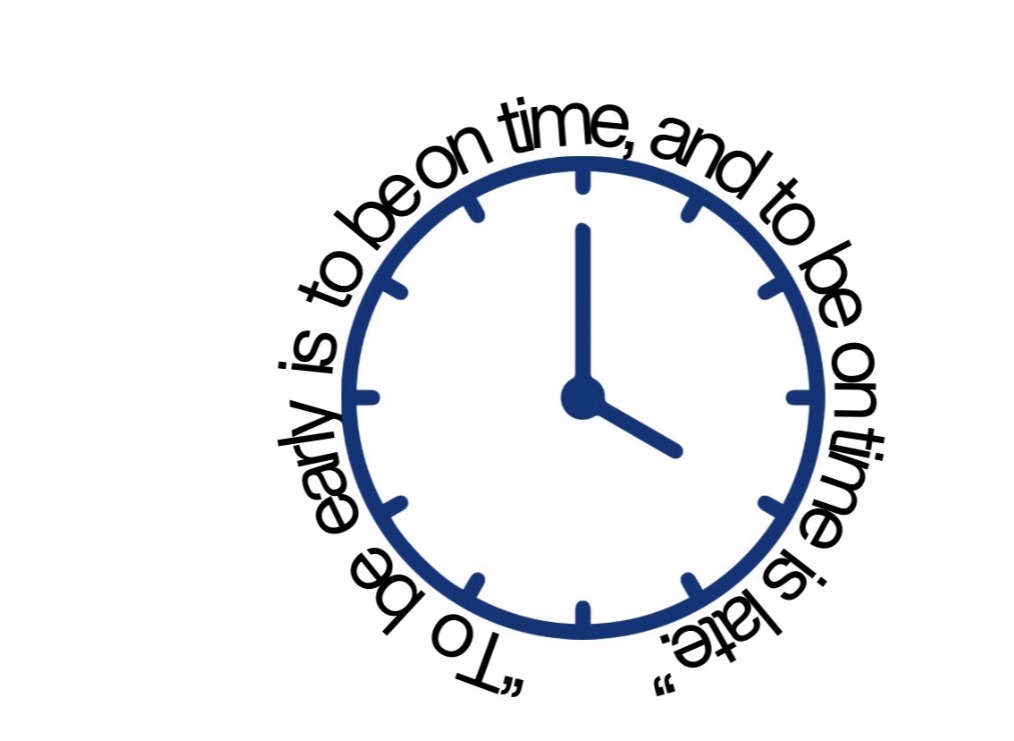
As the saying goes, “To be early is to be on time, and to be on time is late.” Or at least, that’s how it should be. But on a campus where starting promptly is the exception, not the rule, the phrase rings hollow.
It was the first thing J. Elijah Bratton PhD, Assistant Director of Academic and Student Affairs, said to a room of bright-eyed freshmen at the College of Arts and Sciences honors orientation during Bison Week — while students continued trickling in behind him. His words set a tone. But as the week went on, events like the D.C. Night Tour and the Howard University Day of Service started late and were disorganized and it became clear that punctuality wasn’t a campus-wide value.
Professors with strict tardy policies start class well after the scheduled start time. Social events routinely begin long after their posted times. This isn’t just a student problem — it runs from the bottom to the top. While Howard as a community seems to have quietly accepted this, acceptance isn’t the same as it being okay. Chronic lateness is the normalized monster that costs us opportunities we never get back.
A recent example is the resident assistant interview process that began Feb. 17. Candidates were assigned 15-minute slots and instructed to arrive five minutes early. Instead, they found lines stretching down the hall and no clear timeline in sight. What should have taken 30 minutes became an all-day ordeal for some. Others had to return the next day.
One junior, who asked to remain anonymous to protect their candidacy, waited over four hours to complete a 15-minute interview.
“I was honestly really frustrated — I missed class, and I had so many questions. My biggest one was: ‘is this how you guys do this all the time?’ It made me reconsider if I even want the position,” they said.
When asked about their own punctuality they explained, “Not really — because I know I won’t be the only one late, especially here.”
Howard University Assistant Director of Student Engagement and Programming Patrick Scarborough, known as Mr. P to most, acknowledged the delay but framed his response simply: he stayed until the last person was interviewed.
“When you sign up to do a job, you have to do that. You committed yourself to the time,” he said.
He also noted what chronic lateness does to the people who do show up on time — it creates stress, forces others to pick up slack and erodes team cohesion.
“Being late is so pervasive in campus culture that I don’t even feel entitled to my own time anymore,” said Clay Cauley, a graduating senior film and TV major. “We’re paying real money to be here. That should be reciprocated.”
To be clear, things happen: Ubers get cancelled, traffic worsens and miscommunication is a real problem. With proper notice, being late isn’t catastrophic. But, when it becomes chronic and normalized, it stops being an inconvenience and starts being a culture, one that wastes people’s time and quietly signals that their time doesn’t matter.
As Bratton put it, “Time is a resource you can’t get back. When time is wasted, so is the opportunity for impact.”
People should hold themselves to that — and call it out when they don’t.
Copy edited by Daryl R. Thomas Jr.