

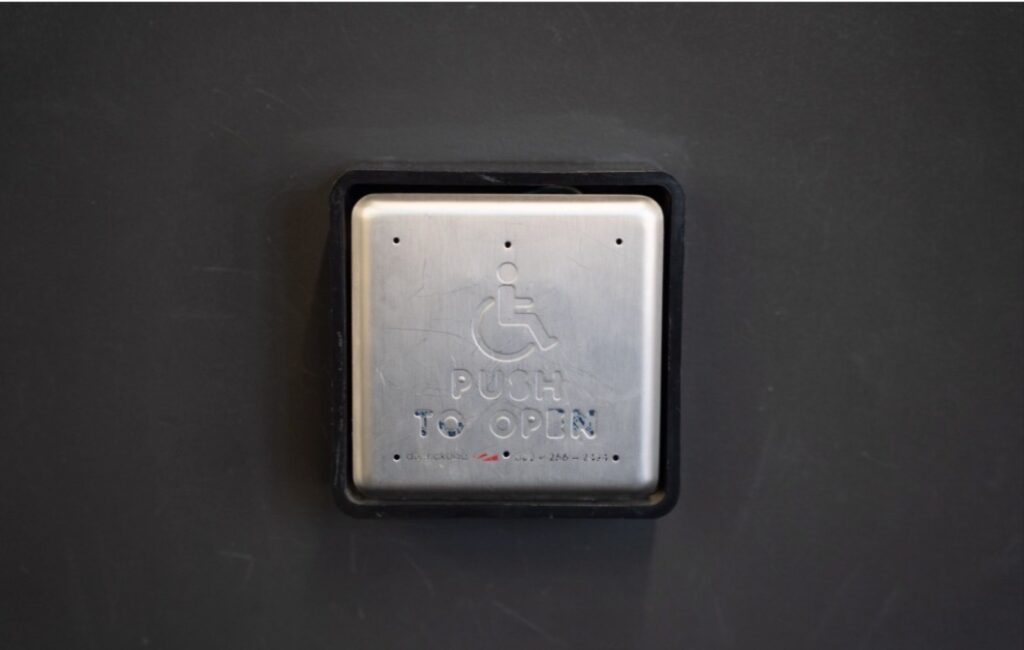
Last semester, Adjunct Professor Kenneth Lee, who is typically seen walking with a cane, had to carry cameras, lights and other class equipment to the second floor of Academic Support Building A (ASA).
“The old [ASA] building was [equipped with sufficient disability accommodations], but the new building is not because it does not have an elevator,” Lee said.
For many at Howard, these kinds of gaps in accessibility on campus make the simple task of going to class a burden – forcing the disabled community to navigate a campus that falls short in accommodating their presence.
According to the District of Columbia’s Office of Disability Rights, the Americans with Disabilities Act (ADA) and District of Columbia policy “require[s] that people with disabilities have equal access to all city services, activities and benefits.”
However, members of the Howard University community with physical, learning, cognitive and sensory disabilities, say a lack of accommodations are harming their learning and teaching experiences.
Student Experiences
One student, Noah Adeyemi, a junior computer science major from Silver Spring, Maryland, has multiple sclerosis (MS). MS is a neurological autoimmune disorder that causes the immune system to attack the myelin in the central nervous system, damaging nerves and impairing their ability to communicate properly with the rest of the body.
Due to his condition, which can cause muscle weakness and stiffness, difficulty balancing while walking and fatigue, Adeyemi sometimes uses an electric wheelchair to navigate Howard’s campus.
“I just have the electric wheelchair to help me move around campus because of how hilly it is… when I’m tired or I want to go use the restroom in another building,” he said.
Faculty also expressed difficulties with managing disabilities at Howard, including Lee who teaches in the Cathy Hughes School of Communications.
As a result of complications induced by colorectal cancer followed by complex surgeries, the internal support in Lee’s leg is gone. He said the condition makes standing and walking painful and he often walks with a cane.
“If I’m sitting down, lying down, there’s no pain at all,” he said. “But when I’m standing up and walking, it can be quite painful.”
Lee, who graduated from Howard in 1989, teaches his classes in ASA, one out of two main campus buildings without an elevator. Both ASA and the neighboring Academic Support Building B building lack elevator access.
He explained that climbing the stairs is particularly difficult while carrying his teaching equipment.
“Last semester, my class was on the second floor and you [had] to walk up the stairs to get there,” Lee said. “I like to bring my equipment in: my cameras…the lights, the microphones and I can’t haul all that gear up the stairs by myself.”
In addition to physical disabilities, some Howard students say that they deal with learning and sensory disabilities. Luka Ribeiro, a freshman clinical laboratory science major from Hickory, Virginia, is hard of hearing and has dyscalculia and dyslexia.
Dyscalculia is a learning disorder that affects an individual’s ability to comprehend, process and recall number-based information. For Ribeiro, it makes math challenging.
Ribeiro said that before coming to college, they taught themself much of the material. However, in higher education, they have found this to be more challenging, causing them to struggle in a statistics course they’re taking.
“I can’t do simple calculations,” they said. “I’ve gone through tutoring. I’ve gone through so many different ways to…help me understand it and it just does not work for me.”
Britney Wilson, a self-described Black disabled advocate and a professor of law at New York Law School, discussed the lack of accommodations provided to help students with disabilities deal with these difficulties.
Wilson, who graduated from Howard in 2012, highlighted the need for intersectionality.

“I think on a [historically Black college or university] campus where racial pride and social justice and things of that nature are stressed, we don’t always do as good a job when it comes to other aspects of marginalized identity,” she said.
Lack of Disability Accommodations
Adeyemi has submitted eight accommodation requests throughout his Howard matriculation and the university and has consistently provided him access to the testing center, extended testing time and assignment extensions, but the university has still not approved all of Adeyemi’s accommodation requests.
As part of his graduation requirements, Adeyemi must take three science labs. However, taking notes and safely using lab equipment is difficult for him due to hand tremors caused by MS, for which he hasn’t received disability aids like a scribe or lab assistant.
Adeyemi submitted an accommodation request for a scribe during his freshman year that he said Howard did not accept. He said he was told that the university did not have the resources for that accommodation.
According to the U.S. Department of Education, “postsecondary schools receiving federal financial assistance must provide effective auxiliary aids to students who are disabled” if needed for classroom or academic use.
Without access to necessary accommodations, Adeyemi began to rely on his siblings to act as scribes for exams that he could not complete digitally. He also submitted a request for lab help in the fall of his freshman year but did so past the deadline and wasn’t able to receive support in his lab courses.
“I wouldn’t trust myself with a flask, [scientific equipment used to measure, mix and melt liquids] because I would be prone to dropping it. Then there would be a spill and broken glass,” Adeyemi said.
Adeyemi withdrew from a general chemistry lab his freshman year because he said participating in the course was unsafe without the lab support he needed.
In the summer of 2022, he decided to start taking courses at his local community college where he would be accommodated with a notetaker. He has done so ever since and did not request a lab assistant from Howard again.
“Honestly, I’ve accepted that I’ll just do the science classes during the summer,” he said.
Adeyemi first came to Howard in August 2022 and said he could have graduated at the end of the 2026 school year if he’d been offered the proper lab support.
He has grown accustomed to what some term the “Howard runaround,” referring to the university’s purported slowness in resolving students’ issues.
“It’s all right because I’ve been dealing with Howard since my freshman year,” he said. “I’ve kind of accepted [the situation].”
Other students besides Adeyemi have also been denied necessary accommodations. Ribeiro said they have had no accommodations approved by the Office of Student Accessibility.
Riberio uses TRICARE, a healthcare program that provides health plans, special programs, prescriptions and dental plans for active duty service members and their families. According to Riberio, Howard wouldn’t accept the TRICARE documentation provided for their hearing challenges due to its formatting.
“I’ve gone to their office and they’ve basically said, ‘this is not something we can accept,’” Ribeiro said.
According to the Howard’s student affairs website, students with mobility, manual, hearing or visual impairments like Ribeiro must have medical documentation that follows seven major guidelines.
The documentation must be written by a certified clinician, have a professional letterhead, clearly indicate a disability under the ADA, support the claimed disability, have a description of medical needs/challenges, explain the individual’s functional limits and clearly support the requested accommodations.
Adon Paris, Howard’s director of student services, said the Office of Student Accessibility does not request insurance information from students during their intake process.
“If a student was given the impression that their insurance type affected their ability to receive accommodations, I would want to address that directly, because that is not how our process works,” he said in a written statement to The Hilltop.
However, Ribeiro said that the issues they have experienced go beyond Howard’s administration and that their professors have also not been sufficiently accommodating their disability.
“I’m failing [chemistry] because my lecturer won’t use the microphone in the lecture hall,” they said. “She turns around a bunch of times during the class and I can’t hear her.”
While Ribeiro has discussed this issue with their professor, they were told the microphone was broken. They wanted to switch out of the course but struggled to rearrange their schedule due to the upper division courses required for their degree.
Ribeiro said they accepted it and decided that if they received an unsatisfactory grade, they would retake the class at a consortium school, an arrangement in which two or more schools work together to share resources and help students achieve their educational goals.
They claimed they need more support for both their physical and learning disabilities as a student at Howard.
“The office is based on accessibility,” Ribeiro said. “So making it accessible would be pretty cool.”
Paris acknowledged that not every accommodation request can be fulfilled but he maintained the office’s commitment to providing each student accommodations for their individualized needs.
“We take the time to make sure [students] leave our office with a clear understanding of their options,” said Paris’ written statement. “Our door is open and we are committed to making sure no student feels like they are navigating this process alone.”
Across Howard University, accommodations look very different. Kenn Browne, a freshman interdisciplinary studies major from Union County, New Jersey, with autism, dyslexia and ADHD, was able to get more requests for accommodation approved than Ribeiro was.
Some of her approved accommodations include access to private testing areas, extended test times and unexplained extensions. However, Browne said the support she is supposed to receive is not consistently implemented in the classroom.
According to Browne, one of her professors consistently ignored her private testing area accommodation. She recalled an informal conversation she had with him regarding her needs when it comes to in-person testing.
“He was like, ‘well, if I let you go somewhere else, that would kind of negate the entire purpose,’” Browne said.
She said she has not initiated a formal meeting with the professor regarding her accommodations because she’s afraid that appearing combative could hinder her final grade.
Browne attributes the inadequate support from professors to a lack of regard or understanding of how her disability affects her learning experience and how to accommodate it.
“[Professors] don’t really understand that being within the classroom is already so much,” Browne said. “So it’s like, I do need that time and a half and often they’re just like, ‘I don’t know what to do.’”
According to Browne, classrooms are not the only campus spaces lacking in accommodations. Browne said the dining hall isn’t entirely accessible to students with disabilities.
“That is the most overstimulating place,” said Browne. “Me and my friend – we’re both on the autism spectrum – will not be able to actually carry out conversations…because the music is so loud as well as so many people being around us. It just makes you kind of shut down in a way where you just have to complete your tasks and leave as quickly as possible.”
Changes in Aid and Support
Recently, some Howard community members have received additional support for their disabilities. Lee said he did not think to request specific disability aid last semester, but this semester, more accommodations were made for him after another professor reached out to administration on his behalf.
“Professor [Jennifer] Thomas saw me this semester on the stairs…and said, ‘Send me an email and I’ll get it straightened out,’” Lee said. “I sent her an email and then they changed my classes to the first floor, so now I don’t worry about walking up the stairs.”
Still, Lee said more work needs to be done to improve conditions for students and staff with disabilities.
“An elevator would be number one,” he said.
The Cathy Hughes School of Communications Dean Kimberly Moffitt, agreed that the lack of elevators in the WHUT building and ASA is a concern, but she believes she and faculty have succeeded at working around this.
“The moment we have a student who is physically disabled or becomes temporarily physically disabled, we then move classes to the first floor,” Moffitt said.
Moffitt affirmed that this applies for all complaints.
“First and foremost, it would be nice to have our new building,” Moffitt said.
According to Moffitt, the timeline is still unclear as to when the school will acquire this new building, but the short-term plan is to hopefully get elevators installed.
She said that the building the School of Communications was located in about four years ago, before she arrived as dean, also did not originally have elevators, but before the accreditation visit, Howard moved to have them installed.
She expects the same to happen in this instance.
Moffitt explained that if Howard’s undergraduate buildings do not have elevators before the University’s next accreditation visit in 2029, it could potentially threaten the school’s certification.
“At this point in time, we believe in higher [education] being accessible to all,” Moffitt said. “So if all are on our campus, but are not all able to navigate it, then we’re not doing right by the students and that program should not be accredited.”
According to Wilson, this lack of accommodation is nothing new and increased acceptance of people with disabilities is still needed. Wilson has cerebral palsy and said that she felt separated from her peers at Howard as a person with a disability.
“When I got [to Howard], I felt more ‘othered’ than I had for a lot of my life,” Wilson said. “While we might have been the same, or mostly the same, from a racial perspective, there was another aspect of my identity that made me very different, and it was my disability.”
Wilson explained that this exclusion extended to the overall culture and even social events.
“A lot about Howard is exclusionary by definition, even things like being able to go to a game, which is a big part of the HBCU culture,” she continued. “There isn’t a protocol for [people with disabilities] just being thought about as part of the culture.”
However, Wilson also acknowledged that conditions for Howard students with disabilities have improved over the years.
“I don’t know that we’re really confronting ableism in the ways that we should be, but I think in general, there’s more recognition and discussion [of] and interaction with disability,” Wilson said. “When I was on campus, it wasn’t something that people were even talking about.”
More accommodations became available at Howard in the late 1980s with the creation of the Howard University Research and Training Center for Access to Rehabilitation and Economic Opportunity, according to a 1990 issue of New Directions, a quarterly magazine published by Howard University.
Final research conducted by the center was published online in 1997, after which its programs seemingly became inactive.
Additionally, the passing of the Americans with Disabilities Act (ADA) in 1990 further increased students’ access to disability assistance by prohibiting all forms of discrimination against people with disabilities.
Wilson explained that though disability awareness and accommodation has improved since she was at Howard, more work still needs to be done to provide safe spaces to people with disabilities, both at and outside of Howard.
“It starts with educating yourself and actually interacting with and developing an awareness of things like ableism and other forms of structural oppression that we might not always talk about,” she said.
Lee agreed on the importance of increased awareness.
“A lot of times, when you’re able-bodied, you don’t think about the challenges somebody who’s in a wheelchair or using a cane has,” he said. “So be aware. Find out what people who are handicapped need, talk to them. Then you can be an advocate.”